Chicago police Superintendent Larry Snelling reflects: 'Once you know it's time to go, then it's time to move on'
Published in News & Features
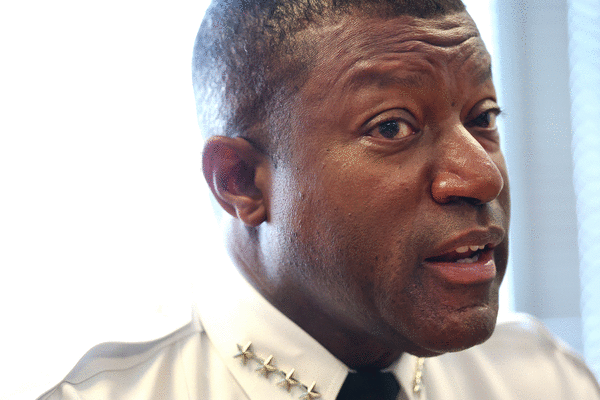
Chicago police Superintendent Larry Snelling is still finalizing his Wednesday dinner plans.
He hasn’t thought about it much yet. There’s still much to do, but there will be reason to celebrate. He won’t join in a Champagne toast — Snelling doesn’t drink alcohol — but he may allow himself one indulgence: a banana milkshake, his favorite dessert since he was a kid growing up in Englewood.
After that, he’ll head to the gym like usual.
When Snelling finishes his day at Chicago Police Department headquarters Wednesday, he’ll no longer be the boss. The 57-year-old is set to retire after nearly three years at the helm of the department he’s been a part of for more than 30 years. Fred Waller, a longtime CPD supervisor who now works for the department as a civilian, will once again serve as interim superintendent.
In an interview with the Tribune last week, Snelling reflected on his time leading the department and some of the hallmarks of his administration — a sharp decline in gun violence; a renewed community-relations effort; a surge of migrants and, later, federal immigration officers; the 2024 Democratic National Convention; and CPD’s ongoing consent decree reforms amid a greatly slowed officer-discipline system.
“You can’t predict the crises that you’re going to have to face, but as they pop up, you have to adjust,” Snelling said. “You have to be fluid enough to step into those roles and make the best possible decision.”
But there was no single moment that prompted him to retire, he said.
“There’s a difference in being ready to go and knowing when it’s time to go, and once you know it’s time to go, then it’s time to move on, and then it’s time to allow someone else to come up and fill these shoes and sit in this seat and work the hardest that they can to continue to make progress for the department and the city.”
He’s not sure what will come next for him professionally, but there are other things to catch up on — spending more time with his grandson, maybe some work around the house.
“I haven’t had a vacation in four years,” Snelling said with a grin. “I haven’t decided what that’s going to be.”
The first iteration of the Community Commission for Public Safety and Accountability in 2023 selected Snelling as a finalist for the job after a series of public meetings in which Chicagoans made clear that they wanted one of their own to run CPD.
At that point, Snelling had spent much of his career as an instructor in the department’s training academy, authoring parts of the curriculum that all officers must pass before graduation.
An expert in use-of-force, Snelling was called as a witness by prosecutors in the murder trial of former Officer Jason Van Dyke, who fatally shot 17-year-old Laquan McDonald in 2014. He later served as commander in Englewood, the neighborhood he grew up in, before he was promoted to chief of counterterrorism.
Mayor Brandon Johnson soon selected Snelling as superintendent, and the City Council approved him that September.
Throughout his tenure, Snelling has often led from the front, though he is quick to offer praise to CPD’s rank-and-file officers and his deputies at police headquarters. Whoever holds the job next, he said, would be well-served by a similar philosophy.
“It can’t just be about the job or you. It has to be about everyone else,” Snelling said. “You have to have compassion for your workforce. You have to see them as people and not just employees. You have to understand something about their human nature, so that when you show them connection, when you show them (care), when you show them respect and empathy, they can then apply that to the people that they’re coming in contact with.”
As the head of the city’s most visible and politically important department, the spotlight is inevitable. Despite an uptick so far in 2026, gun violence levels citywide have drastically fallen under Snelling in the wake of the COVID-19 pandemic.
Still, Snelling said one of his early surprises in the job was “the way people will twist things up to fit their narrative and not get out the proper information to the general public.” He didn’t name any names, but added, “I felt that it’s my job and it’s the job of the Police Department to get as much fact-based information as we can to people.”
In his earliest years as a police officer, Snelling faced two suspensions, the Tribune previously reported.
“Looking back on both of those situations, I could’ve done a bunch of things different,” Snelling said in 2023. “I was a young officer. I learned from those things. Not only did I learn from those things, I used those things in my training when I trained new officers, when I started to work at the academy.”
Snelling has often called for accountability for CPD officers who commit misconduct. Shortly after he assumed his office, though, the longtime process for adjudicating the most serious cases of police misconduct was upended. During collective bargaining between the city and the Fraternal Order of Police, an arbitrator ruled that officers accused of misconduct where the penalty could be firing are entitled to have those cases heard and decided by a third party.
An appeal followed, and the litigation is expected to be argued before the Illinois Supreme Court sometime this year. The Tribune previously reported that the Chicago police’s middle supervisors are issuing more disciplinary citations to officers in recent years.
Meanwhile, the Civilian Office of Police Accountability has continued investigating use-of-force incidents while CPD’s bureau of internal affairs conducts other probes. Snelling’s office has responded to the findings and recommendations, but still, the majority of those sustained discipline cases have languished.
About six months into his tenure, Snelling publicly criticized COPA investigators during the monthly meeting of the Chicago Police Board. He said some in the oversight agency were leaning on “personal opinions and speculation” to reach conclusions.
“When we speculate, when we add our personal opinions, then those penalties become punitive and unfair and unfair to the officers,” Snelling said. “What we’re seeing are egregious penalties for extremely minor infractions. Now, oftentimes when I go through these reports, I agree that the infraction should have been sustained, but a 30-day (or) 90-day suspension is egregious.”
Snelling said of his handling of officer discipline: “We look at all the facts. We look at all the details. And my background in training, my background in use of force, we’re able to, I believe, make better determinations around what disciplinary action should take place based on justifiable uses of force and things of that nature.”
COPA is now led by agency veteran LaKenya White, and Snelling praised her efforts, saying, “We’re actually learning from each other, and that’s the best possible relationship that we can have.”
Since his retirement announcement two weeks ago, praise for Snelling has been effusive.
During a consent decree status hearing Wednesday afternoon, U.S. District Judge Rebecca Pallmeyer, who oversees the city’s court-mandated reforms, said Snelling’s “participation in the process has been invaluable.”
“We will all miss you very much,” Pallmeyer added.
Snelling is retiring about two months before he would be fully vested in his pension.
“This has never been about the money,” he said last week. “It’s about the work that’s being done. There comes a time where you have to ask yourself, you know, are you becoming a dinosaur?”
Further, his departure is set to be the least eventful of any CPD superintendent in more than a decade.
Snelling’s predecessor, David Brown, was deeply unpopular among rank-and-file officers. He tendered his resignation in March 2023, just a day after then-Mayor Lori Lightfoot failed to qualify for a runoff election.
Brown took the place of Eddie Johnson, the superintendent selected by former Mayor Rahm Emanuel in 2016 in the wake of the release of the Laquan McDonald shooting video. Johnson oversaw declines in shootings and a renewed focus on community partnerships, but an embarrassing drunken-driving incident ultimately led to his unceremonious firing after Lightfoot publicly accused him of lying to her.
Before Johnson, the Police Department was led by Garry McCarthy, whom Emanuel fired just days after the McDonald video was made public and the city was embroiled in protests.
_____
©2026 Chicago Tribune. Visit chicagotribune.com. Distributed by Tribune Content Agency, LLC.




Comments