What to know about the golden mussels invading California's waterways
Published in News & Features
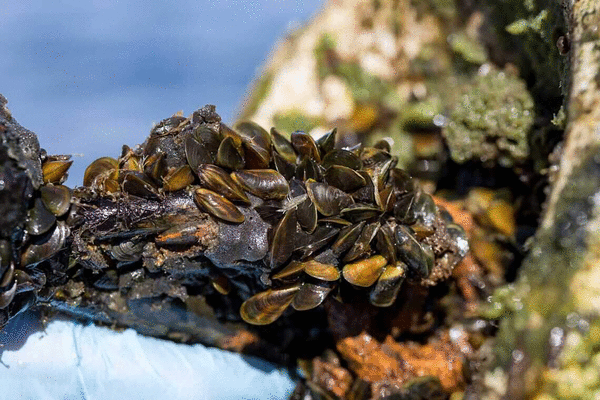
The discovery of golden mussels at Sacramento’s deepwater port late last month, though worrying, was not unexpected by researchers tracking the invasive species’ spread through the Sacramento-San Joaquin Delta. But the ongoing challenge for authorities, and for the state’s aquatic recreationalists, is keeping the destructive bivalve contained to the Delta’s waterways.
Since authorities first discovered the species in the region in late 2024, they’ve sought to make sure the mussels don’t spread to lakes and rivers that aren’t tied into the Delta, including famed recreation destinations like Lake Tahoe and Lake Berryessa.
“At this point, golden mussels have only spread to waters hydrologically connected to the Delta, and that’s good news,” Krysten Kellum, a spokesperson for the California Department of Fish and Wildlife Bay Delta Region, told The Sacramento Bee in an interview Friday.
The discovery at the Port of West Sacramento, first reported last month and confirmed by California DFW on June 27, marks the farthest north in California that the mussels have been documented to date.
First discovered at the Port of Stockton in October 2024, authorities believe golden mussels reached California’s waterways via international shipping. Mussels and other invasive species often spread globally via ship’s ballast systems, through which water is sucked into the ship at one port and discharged, along with the species living inside it, at another location.
Sacramento’s port is connected to Suisun Bay by a 40-mile deepwater channel. These days, ships primarily leave carrying rice and come in carrying cement, according to West Sacramento’s website about the port.
However, authorities say they think the mussels discovered in the port in June came not from a ship but from a locally established population in the Delta, Kellum said.
The DFW maintains an online map tracking confirmed mussel sightings. It shows the species spread south after infiltrating the California State Water Project, the network of pipelines, canals and reservoirs that provides water to the Central Valley and Southern California and is connected hydrologically to the Delta. Last December they were discovered in a water pipeline in the Santa Ana Valley south of Riverside, which is part of the State Water Project.
Sightings have been most heavily concentrated in the Delta itself, however. Though it’s not clear exactly how they traveled to Sacramento’s port, the facility lies upstream from the Delta, and mussels only flow naturally downstream — which suggests humans, as usual, inadvertently lent the species a helping hand.
“These mussels, they don’t have legs, they can’t swim upstream, they can’t go over land,” Kellum said. “Everybody can do their part to keep these mussels from spreading to California’s lakes and rivers.”
The department, and a wide range of other state and local agencies, as well as nonprofits and other environmental organizations, have sought to hammer a simple message home: clean, drain, dry.
DFW offers the following guidance on what that catchphrase in fact means:
“Anyone boating or recreating on waterways around the Sacramento area, and throughout the Delta, should take precautions to stop the spread of golden mussel further upstream and overland on watercraft and equipment used in mussel-infested waters. Golden mussels attach to almost any underwater surface, including but not limited to boats, ropes, buoys and aquatic plants that entangle on anchors and trailers.
“Clean, Drain, Dry — inspect your watercraft, kayak, life vests, paddles and anything that touched the water every time it is removed from a water body. Remove all debris, animals and plants, and dispose of them in the trash. Drain all water from ballasts, bilges and live wells. Lastly, allow everything to dry until moisture is no longer present.”
California DFW assists with surveying and testing efforts, but the work to protect lakes and reservoirs lies with local jurisdictions, Kellum said. The Tahoe Regional Planning Agency, for example, maintains boat inspection stations where watercraft are inspected and tagged for being cleaned, drained and dried before they’re allowed to hit that lake’s famed crystalline waters.
Not every California water enthusiast is playing ball. As of June 25, Tahoe authorities had stopped six boaters who sought to evade inspections so far this summer, according to a news release from the Regional Planning Agency. Those boaters face steep fines. Separately, inspectors have stopped two boats with golden mussels aboard from putting into the lake.
Whether Lake Tahoe can hold off the small invaders is a matter of pitched local concern. This week, the director of a local environmental organization told a television station they worried the state lacked a coherent strategy for keeping the mussels from spreading, including from making their way up into the Sierras via watercraft or other means of human-aided conveyance.
Lawmakers recently gave the mussel prevention effort a funding boost, putting $7.5 million toward five new decontamination sites around the Delta where boats and equipment will be inspected.
Why worry about golden mussels?
Golden mussels degrade both human infrastructure and the natural marine environment they thrive in. They are a hardy species that can live in both fresh and brackish water, and in temperatures ranging from 41 to 95 degrees — such versatility accounts in large part for their successful rapid spread, and for water managers’ fear.
In the natural environment, they do their damage by outcompeting some of the lower species in the food chain. They are “highly efficient filter feeders,” Kellum wrote in an email, “and they consume large quantities of aquatic microscopic plants and animals that native species and sport fish depend on for food.”
In doing so, the golden mussels can outcompete crawfish, snails and other native species. That dents a food source that fish, otters and other wildlife higher up in the food chain depend upon. Researchers have also linked the mussels to toxic algal blooms.
In the built environment, like dams and ports, golden mussels take root in irrigation pipes and other water infrastructure, where they commence what scientists call bio-fouling.
“Bio-fouling literally just means growing on,” Kellum said. Golden mussels grow quickly, and researchers have found them particularly frustrating to infrastructure because they can grow up from a larval stage on the side of pipes, piers and other structures or arrive fully grown, as the adult mussels can detach from one surface and float downstream before attaching to another.
How quickly bio-fouling occurs is difficult to measure, Kellum said, because much depends on the structure itself — the circumference of an irrigation pipe, for example, will determine how long it takes a mussel colony to impact the flow of water through it
A YouTube video posted by the California Department of Water Resources shows the mussels collecting thickly on grates that strain trash out of waterways and coating every inch of an unidentified piece of equipment.
At the Port in Sacramento, large adult mussels were found on a water monitoring instrument, Kellum said in an email. They hadn’t been there when the instrument was inspected a month prior.
Any sightings of the golden mussel should also be reported to the CDFW online at its Report an Invasive Species Sighting webpage, via email Invasives@wildlife.ca.gov, or by calling 866-440-9530.
_____
©2026 The Sacramento Bee. Visit sacbee.com. Distributed by Tribune Content Agency, LLC.






Comments