Routine blood testing reveals San Diego County's first case of locally acquired Chagas disease
Published in News & Features
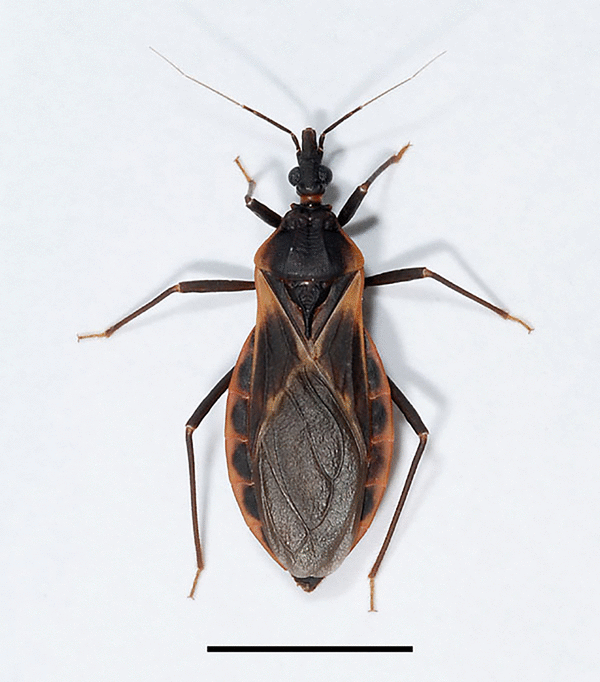
SAN DIEGO — San Diego County announced its first locally acquired case of Chagas disease Monday. Left untreated, the parasitic illness can cause cardiovascular and digestive problems, even sudden death, according to the U.S. Centers for Disease Control and Prevention.
While most infections occur in Latin America, Dr. Mark Beatty, an assistant medical director in the county’s Epidemiology and Immunization Services Branch, said that no such exposures were identified in the case that caused Monday’s public health notice.
“We went through her travel history for, you know, her entire life, basically, and the person had not traveled outside of the U.S., not to an endemic area, for any significant period of time,” Beatty said.
Chagas disease is much more commonly picked up in Latin America because, Beatty explained, kissing bugs, which carry the parasite that causes the disease in their stool, are more likely to leave behind droppings near the insect’s own bites or existing open wounds.
Kissing bugs are especially associated with rural structures made of mud and straw in Latin America but are more often observed near rodent nests in the United States. As kissing bugs are more active after dark, exposures are more likely during camping in the states, though the specific route of exposure in San Diego’s locally acquired case is not known for certain.
Chagas is not among the nation’s long list of nationally notifiable conditions which, by law, must be reported to local health departments when detected. However, San Diego County began requiring local reporting in 2024.
Since then, just four of 22 reported cases have been confirmed, including the single locally acquired case reported Monday.
While the symptoms of Chagas infection initially look like the flu — ranging from fever and headache to cough and abdominal pain — 30% to 40% of cases develop long-term medical complications, including heart failure and enlarged esophagus or colon, which can affect eating and digestion.
Those symptoms can take years to develop. The local case reported Monday was picked up during a routine blood donation screening. By law, blood banks must test all collections for a wide range of transmissible diseases, often detecting infections before symptoms develop. The patient had no symptoms.
According to a report published by the CDC in 2025, Chagas is a notifiable disease in eight states: Arizona, Arkansas, Louisiana, Mississippi, Tennessee, Texas, Utah and Washington. In addition to San Diego County, Los Angeles also requires reporting in California.
The local mandate, Beatty said, recognizes that border communities such as San Diego have a greater possible exposure.
“We recognize that a large segment of the population may have lived in Latin America at some point, so the risk is bigger here,” Beatty said.
Infections can be eliminated with a month-long course of anti-parasitic medication.
The CDC estimates that about 280,000 people living in the United States have undetected cases of Chagas disease.
©2026 The San Diego Union-Tribune. Visit sandiegouniontribune.com. Distributed by Tribune Content Agency, LLC.






Comments