Venezuela quake death toll rises to 2,954 as recovery shifts to reconstruction
Published in News & Features
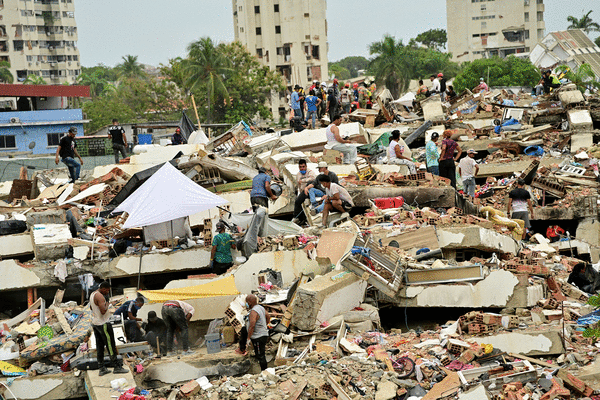
With hopes of finding additional survivors fading, Venezuela is entering a new phase of its earthquake response centered on rebuilding shattered communities as officials reported 2,954 dead and a U.N.-backed assessment estimated $37 billion in direct physical damage.
The twin 7.2- and 7.5-magnitude earthquakes that struck north-central Venezuela on June 24, just 39 seconds apart, have left 12,666 people injured, according to the latest figures released by the Ministry of Communication. Authorities said 6,462 people have been rescued while 15,050 remain without permanent housing after losing their homes.
Officials also reported 890 aftershocks, 885 buildings affected, including 189 that collapsed completely, nearly 86,117 families assisted and almost 29,600 military, police and emergency personnel deployed alongside 3,305 international rescuers and more than 25,800 registered volunteers.
Although search-and-rescue operations continue in several collapsed buildings across La Guaira and other hard-hit areas, emergency officials acknowledge that the chances of finding additional survivors have become increasingly remote 10 days after the disaster. Even so, families of those still unaccounted for continue urging authorities not to abandon the search.
One of the largest rescue efforts Saturday focused on a collapsed residential building in Caraballeda, where teams from Spain, Portugal and Venezuela deployed drones, thermal-imaging equipment and search dogs in an attempt to locate Fabio, a 9-year-old boy whose relatives insist might still be alive beneath the rubble. Although rescuers had not detected conclusive signs of life, the operation continued under the watch of the child’s parents and grandmother.
The uncertainty surrounding thousands of people whose whereabouts remain unknown continues to weigh heavily on the disaster response.
While Venezuelan authorities have not released an updated nationwide tally of missing persons, humanitarian organizations and citizen-led registries continue documenting tens of thousands of unresolved cases.
The International Organization for Migration (IOM) and other humanitarian organizations have previously estimated that roughly 50,000 people remain unaccounted for, many of whom could still be trapped beneath collapsed buildings and other structures. Volunteer-run online registries contain more than 43,000 reports submitted by relatives searching for loved ones.
Most of those reports are concentrated in La Guaira, Caracas and Miranda, where crews continue removing debris from collapsed apartment buildings, homes and commercial structures. Officials caution that not everyone reported missing is necessarily trapped beneath the rubble because communications failures, mass displacement and transportation disruptions have complicated efforts to reunite families.
For thousands of Venezuelans, however, the absence of definitive answers has become one of the tragedy’s most painful consequences. Outside hospitals, temporary shelters and improvised morgues, relatives continue posting photographs and names of missing family members on social media, hoping someone might recognize them or provide information about their fate.
While rescue operations continue at selected sites, the government’s attention is increasingly shifting toward restoring damaged infrastructure and preparing for long-term reconstruction.
Transportation Minister Jacqueline Faría said crews remain deployed throughout La Guaira repairing roads, resurfacing bridges and assessing transportation infrastructure damaged by the earthquakes. Work is underway on a bridge in Caraballeda, where authorities are replacing guardrails, laying new asphalt and repairing expansion joints to restore safe travel conditions.
Thousands of residents remain reluctant to return to their homes, choosing instead to sleep outdoors or in temporary camps while engineers determine whether damaged buildings remain structurally sound after hundreds of aftershocks.
The enormous scale of that assessment is becoming clearer.
A preliminary study prepared for the United Nations Office for Disaster Risk Reduction (UNDRR) estimates the earthquakes caused approximately $37 billion in direct damage to buildings and infrastructure, equivalent to about 3.4% of the physical assets exposed across the affected region.
Prepared with support from engineering firms Ingeniar CAD/CAE Ltda. and ERN, the assessment describes the estimate as an initial technical evaluation rather than a final accounting. It covers only direct physical damage and excludes broader economic losses such as business interruptions, lost productivity, emergency-response costs, environmental impacts and the expense of rebuilding stronger infrastructure.
According to the report, approximately $24 billion in losses occurred in residential, commercial, industrial, educational, healthcare and government buildings, while another $13 billion involved infrastructure, including telecommunications, energy systems, highways, railways, ports, airports, water networks and oil and gas facilities.
Telecommunications sustained the largest estimated infrastructure losses at approximately $5 billion, followed by energy infrastructure ($3.1 billion), transportation networks ($2.1 billion), water and sanitation systems ($1.6 billion), oil and gas facilities ($1 billion) and ports and airports ($300 million).
Researchers said the disaster was not a conventional earthquake followed by an aftershock but rather an “earthquake doublet,” in which the initial 7.2-magnitude quake triggered a neighboring fault that was already close to rupture, unleashing the larger, 7.5-magnitude earthquake just 39 seconds later.
According to the study, the first rupture occurred along the Boconó fault system, while the second originated on the San Sebastián fault, two of Venezuela’s principal tectonic structures. Researchers estimate an event of similar magnitude has an average return period of about 180 years.
The reconstruction effort is also mobilizing Venezuela’s engineering community.
The Venezuelan College of Engineers (CIV) has launched emergency training sessions for engineers, architects and technical specialists who will inspect damaged structures and determine whether they can be repaired or must be demolished.
“We are doing what corresponds to us: providing urgent training so professionals obtain the tools necessary to inspect structures effectively in post-earthquake scenarios,” architect José Gregorio Chacón, a member of the organization’s national board, said in a statement.
The training program is open to engineers, architects, technical professionals and senior university students as authorities prepare for what could become one of the country’s largest structural-inspection efforts.
Government officials are also coordinating with international organizations as they shift from emergency response to longer-term recovery.
National Assembly President Jorge Rodríguez said Venezuelan officials met Friday with Gianluca Rampolla, the United Nations resident coordinator in Venezuela, to review plans for comprehensive humanitarian assistance and the management of temporary camps housing displaced families.
Interim President Delcy Rodríguez said this week her administration has also opened discussions with the U.S. State Department and the International Monetary Fund in an effort to recover financial resources for reconstruction.
She previously announced an initial $200 million reconstruction fund, though the U.N.-backed assessment suggests rebuilding costs will ultimately be many times greater.
Authorities say 59 temporary camps are housing displaced families.
While the government reports 15,050 people remain without homes, the U.N. refugee agency (UNHCR) estimates that approximately 16,000 people have been forced to seek alternative shelter after losing access to their residences.
International assistance continues arriving as humanitarian needs remain acute.
A Uruguayan Air Force Hercules transport aircraft departed Saturday carrying the first 15 tons of what officials said will eventually total more than 60 tons of humanitarian aid destined for Venezuela. The shipment includes medical supplies, hygiene products, powdered milk and rescue equipment.
The flight follows additional aid deliveries from Ecuador and continuing relief efforts organized in Spain, where public institutions, businesses and charitable organizations have raised more than $11 million for earthquake victims. Spanish singer Rosalía also announced a donation to UNICEF to support children affected by the disaster.
The Ministry of Education announced that classes will resume Monday in areas unaffected by the earthquakes, while schools in the hardest-hit regions will remain closed. The ministry also said disaster risk management will be incorporated into school curricula as part of the country’s recovery efforts.
Humanitarian organizations caution that the emergency remains far from over.
The International Rescue Committee (IRC) says hospitals and health centers continue operating under heavy strain while many temporary shelters remain at or near capacity. Aid agencies warn that access to safe drinking water, sanitation, medical care, shelter and psychological support continues to rank among the country’s most urgent needs.
The broader humanitarian impact extends well beyond those who lost homes.
The International Organization for Migration estimates that as many as 6.76 million people might have been affected in some way by the earthquakes, reflecting widespread disruption to housing, transportation, public services and economic activity across Venezuela’s north-central region.
_____
©2026 Miami Herald. Visit miamiherald.com. Distributed by Tribune Content Agency, LLC.






Comments