Boston Mayor Wu doubles down on 'safest major city' claim after police union says Hub is trending toward Chicago lawlessness
Published in News & Features
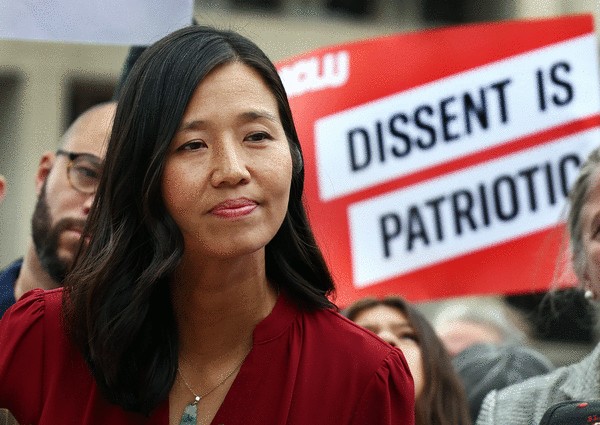
BOSTON — Mayor Michelle Wu doubled down on her “safest major city” in America claim amid criticism from the city’s largest police union that recent violence has Boston trending more toward becoming crime-ridden Chicago “garbage.”
Wu’s office issued a statement Thursday saying the mayor is “proud” to continually shout out Boston’s reputation as the “safest major city” — a claim she’s made for two years — while citing police data that show the city is experiencing “historically low” crime rates.
“Boston’s public safety data shows that the number of shootings, homicides, and other kinds of serious crimes have continued to drop and remain at historically low levels,” Wu spokesperson Marcela Dwork said. “These numbers reinforce the strong progress we’ve made over the past several years, but our work is far from done.
“Even one act of violence is too many, and we will continue building strong partnerships between our neighborhood leaders, faith leaders, community organizations, and public safety and public health officials to keep families safe and connected to opportunity.
“The mayor is proud to call out Boston’s reputation as the safest major city in the country, in order to highlight the impact and effectiveness of these partnerships, and also to challenge all of us to share in the responsibility of setting the highest standards for safety and belonging,” Dwork added.
The statement from the mayor’s office comes after scathing criticism from the city’s largest police union that says the recent spate of violence and attack on cops has Boston trending away from “one of the safest cities” to Chicago’s lawlessness.
“Safest city in America? Not so much,” the Boston Police Patrolmen’s Association posted on social media Tuesday. “The increasing levels of violence and attacks on police should have everyone concerned. And if a triple shooting in Boston’s Theater District doesn’t grab your attention, you may want to check for a pulse.”
The union’s post came on the heels of a Monday night triple shooting, and as videos were going viral of a Boston Police officer who tried to arrest a man Sunday night in Dorchester, but saw his efforts thwarted when a crowd intervened, throwing drinks and objects at the cop before the suspect got away.
BPPA President Larry Calderone told the Herald that the city doesn’t have enough police officers, which is driving the uptick in violence, along with what he described as a ho-hum response from city officials, who aren’t publicly acknowledging the crime spree.
Calderone put the force at roughly 600 cops short of appropriate staffing levels, which he said equates to “about a third of our workforce.”
The lack of manpower, exacerbated by some city councilors’ calls to cut police overtime in the city budget, Calderone said, is creating a “recipe for disaster.”
He said violence is up in Boston — with street takeovers, violence, larcenies, aggravated assaults and shootings “happening every weekend” — but the police department’s manpower is down compared to 18 months ago.
“Those numbers don’t lie, and that’s what makes communities like Chicago and Baltimore,” Calderone said. “That’s what turns once-great cities into garbage cities, and we don’t want to see our great city turn into a garbage city that’s ridden with violence.”
Wu’s office said the numbers tell a different story. Data from the Boston Police Department comparing the first six months of 2025 and 2026 show clear progress in reducing serious crime, her office added.
In 2026, shooting victims fell from 58 to 50, a 14% decrease from 2025 and a 22% decrease compared to the last five-year average. Homicides declined from 21 in 2025 to 10 in 2026, reflecting what the mayor’s office called significant progress in preventing the most serious crimes.
Reports of rape decreased from 95 to 68 over the same period, while robberies and attempted robberies remained relatively stable between 2025 and 2026, though Wu’s office didn’t provide figures on that crime statistic.
Domestic aggravated assaults held roughly flat, while non-domestic aggravated assaults rose modestly, which the mayor’s office said underscores the need for continued investment in prevention, intervention and victim support.
The information from the mayor’s office is similar to what Wu’s Police Commissioner Michael Cox told reporters on Wednesday.
“We’re at the midway point of the year, and we’re doing pretty well with the city as far as overall crime,” Cox said, though he mentioned there’s been a “slight uptick in aggravated assaults.”
“We’ve had, certainly, an uptick in street takeovers, things of that nature,” Cox said. “We want to remind the public, if they see something, say something.”
Calderone on Wednesday had pushed back on metrics used by the police and city officials to determine safety. Homicides may be down this year again, he said, but that’s “because the 15 people that have been shot in the last four weeks didn’t die.”He said Boston is still “one of the safest cities” in the country, but sees it trending in the wrong direction, with weekend shootings becoming more frequent. He sees this summer as a potential tipping point for its safest city reputation.
“We’re just a few extra shootings away from becoming like Chicago and that’s what we’re worried about,” Calderone said. “If we wait too long and become like Chicago or Baltimore, then we’ve already lost the battle.”
_____
©2026 MediaNews Group, Inc. Visit at bostonherald.com. Distributed by Tribune Content Agency, LLC.





Comments