Chicago Electoral Board says circulation rule doesn't apply to school board
Published in News & Features
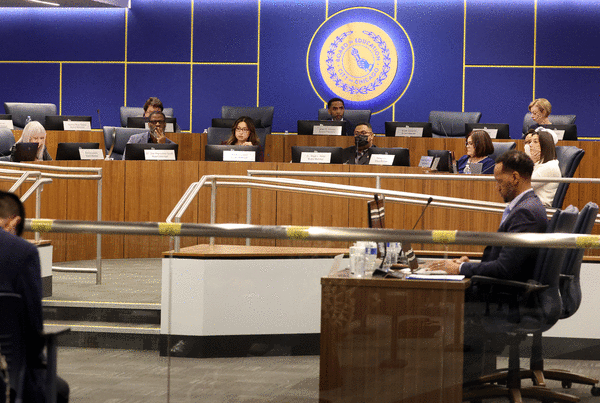
CHICAGO — The Chicago Electoral Board ruled Tuesday that nearly two dozen school board candidates can’t be disqualified simply because their petition circulators also worked partisan races, removing a significant hurdle for nearly two dozen hopefuls in the election.
The provision known as the dual-circulation rule had been used to challenge the nominating papers of 22 school board candidates. Had the board determined that the law could be applied, it may have wiped most from contention.
“We always hear in these arguments that ballot access is a substantial right in Illinois,” election attorney Ed Mullen told the board, arguing on candidates’ behalf. “In this case, it is of greater importance, because this is the first time in history that we’re going to have a fully elected school board.”
The rule says that petition circulators can’t collect signatures for multiple types of candidates in the same election cycle — which includes working for candidates in different parties, or for both independent and partisan candidates.
School board races are nonpartisan, but challengers argued the rule still applied because many candidates used circulators who gathered signatures in the March Democratic primary.
The provision was initially created to prevent candidates who lose partisan primaries from running again in the general election as independents. Attorneys for the candidates contended that it had never been applied to a nonpartisan race.
The objections process is time-consuming and costly: Both the objector and the candidate typically must hire attorneys, as election judges review the validity of contested signatures one by one.
Tuesday’s ruling will be used as guidance for hearing officers as they address individual cases, according to the board. While it doesn’t guarantee candidates’ places on the ballot, it means they can move forward with more standard challenges to their petitions.
Last month, on the final day of the Illinois General Assembly session, lawmakers in attempted to clarify that the provision does not apply to school board races in an omnibus election bill. But the change, which was proposed by State Sen. Robert Martwick, did not pass. Martwick is a close ally of Chicago Teachers Union, but told the Tribune the union was not involved — though it would have benefitted a large number of CTU-aligned candidates.
At total of 51 candidates filed to run for 21 seats. Previously, the board was made up of seven mayoral appointees. The board approaching the end of a two-year transition period, with 10 elected members and 11 mayoral appointees.
The list of candidates for the November election will be finalized Aug. 27.
____
©2026 Chicago Tribune. Visit at chicagotribune.com. Distributed by Tribune Content Agency, LLC.




Comments