Miami archbishop urges prayers -- and pressure -- after Supreme Court's TPS ruling
Published in News & Features
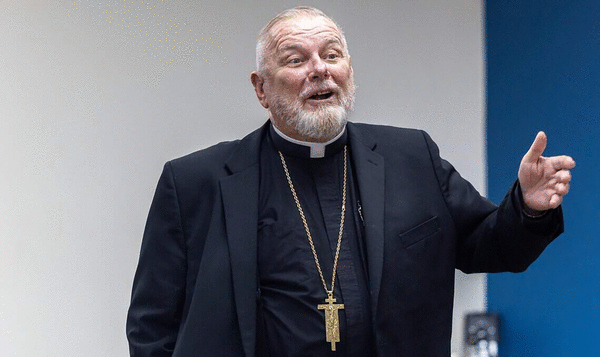
MIAMI — Miami Archbishop Thomas Wenski, local leaders and Haitian immigrants condemned a Supreme Court decision on Thursday allowing the Trump administration to end deportation protections under Temporary Protected Status for over 350,000 Haitians and Syrians.
“These are people that are very nervous. They’re nervous about having to go back to Haiti, because many times there’s no place to go back to,” Wenski said. “Or they can’t go back to the area that they came from, because that area has become under the control of gangs and is too dangerous to go to.”
About 350,000 Haitian nationals in the United States face the risk of being returned to a country that is engulfed in extreme gang violence, widespread hunger and political instability. The United Nations estimates that gang violence has killed over 2,300 people in Haiti since the beginning of this year.
Wenski’s remarks come as many in South Florida, the heart of the Haitian community in the country, are reeling after the justices reversed a lower court ruling upholding TPS protections for Haitians. A 6-3 decision penned by Justice Thomas Alito, said that federal law bars judicial review of the executive branches’ TPS decisions that are unrelated to constitutional claims. Alito also wrote that the argument that Haiti’s TPS designation was terminated because of race, thus violating equal protection claims, was unlikely to succeed. The federal program, established by Congress in 1990, shields immigrants from countries in turmoil from deportation.
Representatives from Catholic Legal Services said that as many as 160,000 Haitians across the Sunshine State, mostly South Florida, are now at risk of deportation. Many of them are nervous about what the future will hold. Some TPS holders have told them they are afraid they will lose their jobs and the instability impacts lives they’ve worked to build in the United States for the past 30 years.
“TPS is not a loophole, it is a literal lifeline,” said Myriam Mezadieu, the Chief Operating Officer of Catholic Legal Services who is originally from Haiti.
Mezadieu said that forcing families to go back to a place riddled with “severe armed conflict, systemic political trauma, compounding humanitarian crises and gang violence is unconscionable and violates core humanitarian law.”
As the threat of deportation looms over many, Wenski said the decision will undoubtedly cause a “disruption” to the economy, impacting job sectors such as the healthcare industry.
“If they lose their jobs, then they’re in a bad position: one, that they won’t be able to help their families in Haiti, but two, how are they going to survive without jobs?” Wenski said.
The decision to end TPS will also impact Florida’s Catholic workforce and clergy. Many Catholic Health Services employees are immigrants and there are a handful of priests who are on TPS, Wenski said, who will also be forced to “suffer the same consequences” as others.
Vanessa Joseph, managing attorney for Catholic Legal Services, said many of her clients are scrambling to figure what to do next. Many are fearful of being out in places with heightened law enforcement or even sending their children to school.
“There’s a lot of fear and uncertainty,” Joseph said. “There’s this whiplash. Yesterday, Haiti scored two goals in a match against Morocco, that was a huge high for so many people, and then to receive this news today is an extreme low.”
‘Our life has no value’
Two TPS holders who spoke with the Miami Herald, one on the condition of anonymity, said they were disappointed with the Supreme Court’s decision but not necessarily surprised given the current administration’s tough track record on immigration.
Farah Larrieux, a communications specialist focused on Haitian markets and a community advocate, came to the U.S. from Port-au-Prince in 2005. On Thursday, she said she was “sad, outraged, and depressed, but not surprised,” given President Donald’s Trump’s mass deportation agenda, and his history of discriminatory remarks towards Haitians. She obtained TPS after the Obama administration designated Haiti following the devastating 2010 earthquake.
“For them to say yes, the president can do that, that’s a pressing signal that our life has no value,” said Larrieux, 46, who was a TV and radio host in Haiti. “This is not the American Dream. This is a human rights violation.”
A client of Catholic Legal Services, a young woman who declined to share her name out of fear of deportation, reacted to the news of TPS ending with shock and sadness. The young woman said she was brought to Florida from Haiti by her parents when she was a young child.
“I don’t know much about Haiti, because I’ve been here my entire life,” she told the Herald in an interview over the phone.
The young woman said she went to school to try and achieve the American Dream and that going back to Haiti means returning to an unknown place, away from friends, family and her current job.
“With everything that’s happening, I still keep on telling myself there’s going to be another way,” said the young woman, who said she has faith that God will intervene.
Local leaders call to action
Wenski implored South Floridians to call on Florida lawmakers to support a bill (S.B. 4814) which is currently in the Senate that would extend TPS for Haitians and other individuals for at least another three years.
“It’s up to the Senate now to vote yes on extending TPS protections for Haitians,” said Wenski, a longtime advocate for immigrants who started his priesthood in Haitian communities.
It’s a temporary fix, but Wenski said he feels it is necessary to provide time for elected officials to find permanent solutions for people who fall under the TPS designation.
“Storm heaven with your prayers, and pray that God will touch the hearts of the senators,” Wenski said.
Miami-Dade County Mayor Daniella Levine Cava also urged the Senate to pass the legislation.
“They have built lives here, raised families here, and contributed immeasurably to the social, cultural and economic fabric of Miami-Dade County,” said Levine Cava in a statement. “As Haiti continues to face extraordinary violence, political instability, and humanitarian hardship, sending people back now puts lives at risk.”
Pastor Keny Felix, senior pastor of Bethel Evangelical Baptist Church in Miami Gardens, said he was “disappointed and alarmed” by the Supreme Court’s decision which will leaves thousands of Haitians in South Florida to face a difficult reality: return to a country facing ongoing humanitarian crisis where 1.47 million residents are internally displaced.
“This is not solely a Haitian issue. It’s about our collective responsibility to protect vulnerable families and communities,” Felix said in a statement to the Miami Herald. “This is more than an immigration issue. It’s a human life issue.”
©2026 Miami Herald. Visit at miamiherald.com. Distributed by Tribune Content Agency, LLC.





Comments