Supreme Court allows policy to curtail asylum claims
Published in News & Features
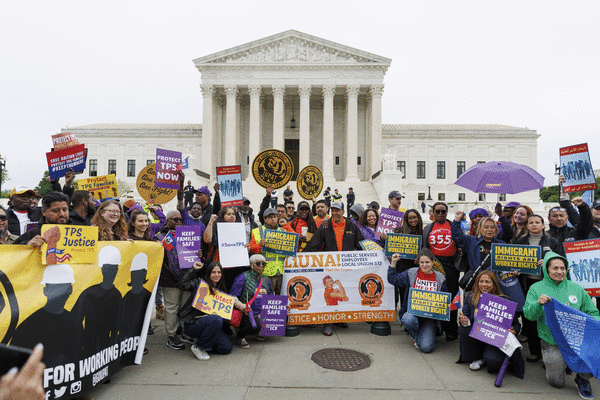
WASHINGTON — The Supreme Court ruled Thursday that the Trump administration could restart an Obama-era policy known as “metering” that prevents immigrants from making asylum claims by halting them from reaching the border with Mexico.
The Trump administration had asked the justices to overturn a ruling from the U.S. Court of Appeals for the 9th Circuit to clear the way for the policy’s potential use.
The 6-3 decision, written by Justice Samuel A. Alito Jr., found a federal law that allows asylum-seekers to present their claims when the claimant “arrives in” the U.S. does not apply to migrants who are still inside Mexico.
“A person arrives in a destination only when he enters it, and that conclusion does not change because someone or something blocks entry. A person arrives in the United States, then, only when he enters it,” Alito wrote.
The ruling means immigration officials could prevent refugees from presenting asylum claims by stopping them from reaching the U.S. border.
Officials began the policy in the Obama administration, and it was continued by the Trump administration amid legal challenges. The Biden administration ended the policy, and while it was stopped, the 9th Circuit ruled against its use.
Justice Sonia Sotomayor, in a dissent joined by Justices Elena Kagan and Ketanji Brown Jackson, wrote that the majority effectively allowed the administration to get around Congress’ purpose in creating the asylum law.
Sotomayor wrote that Congress “could not have been clearer” that it intended the phrase “‘arrives in the United States’ to capture all those in the process of arriving, even before stepping foot onto U.S. soil.”
She wrote that Congress intended to make sure the executive branch could not arbitrarily deny asylum for vulnerable immigrants. Sotomayor read from a portion of her dissent from the bench Thursday, arguing that the majority ignored a portion of the law which treated immigrants who “arrives in” and is “present” in the United States differently, as Thursday’s decision made that portion of the law meaningless.
Sotomayor also said that there were predictable consequences of allowing metering, such as turning refugees back to die in persecution and encouraging dangerous, illegal border crossings for asylum seekers to legally present their claims.
Alito also took the rare step of rebutting Sotomayor from the bench, saying that the policy was adopted by two administrations in response to a surge of immigration at the U.S. border and called it “orderly” and “humane.”
The case is Markwayne Mullin, secretary of Homeland Security, et al. v. Al Otro Lado, a California corporation, et al.
©2026 CQ-Roll Call, Inc., All Rights Reserved. Visit cqrollcall.com. Distributed by Tribune Content Agency, LLC.






Comments