Task force pitches long-term Chicago budget fillers, but many need state buy-in
Published in News & Features
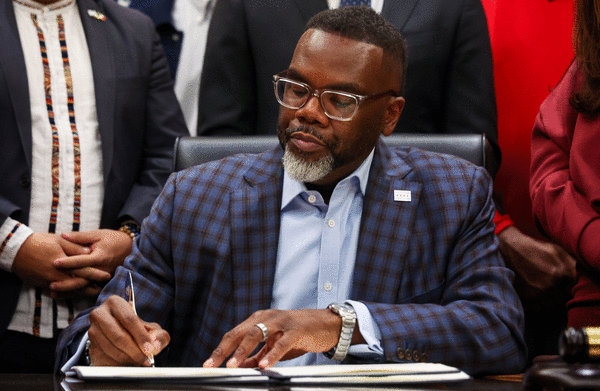
CHICAGO — With the city facing a budget hole estimated at $680 million or more next year, a mayoral task force released its final proposals to strengthen Chicago’s long-term financial future Thursday.
Like last year’s ideas to help close a $1.15 billion gap, most are familiar, some are far-fetched and many have major tradeoffs or will take time to kick in. All are complicated in the short term by the fact the mayor’s office and all 50 City Council seats will be up for election during budget negotiations, and the winners will be seated just a few months after the 2027 package takes effect.
And while the group’s leaders reiterated their independence from Mayor Brandon Johnson, its findings will inevitably be politicized because he picked them and his relationship with aldermen is increasingly acrimonious. The body passed the 2026 budget over his objections, likely setting up an even rockier process for 2027.
Some of the highest-impact ideas call for major state intervention — tweaking income tax rates, taxing services like accounting or landscaping, restructuring electricity tax rates and changing debt collection policies — that has so far been difficult for Johnson’s team to land.
Others have been unpopular among some aldermen, including resuming gradual hikes in the city’s property tax levy to match the rate of inflation, or similarly raising Chicago’s other fines and fees to match its peer cities.
It’s unclear the total budget gap Johnson and the council will have to fill. Last year’s bruising budget battle further soured relations between aldermen and the fifth floor that have rolled over into other debates, most recently video gambling and the sale of the parking meters.
The mayor has already launched a series of listening sessions in preparation for his 2027 proposal.
Johnson convened the 24-member budget working group in the spring of 2025. Last year’s 80-page report had dozens of immediate gap-plugging solutions with dollar values assigned to each. This year’s report instead includes measurements of each idea’s impact, feasibility (high, medium or low) and how long each would likely take (less than a year, one to three years, or more than three years).
The 115-page document is meant to be a roadmap to long-term balance, not to fix the 2027 gap, task force leaders told reporters Wednesday.
One of the group’s co-chairs, Loop Capital founder Jim Reynolds, told reporters they were “impressed” that the mayor used more than half of the recommendations from last year’s report in developing his 2026 budget proposal. “I would be surprised if many of these were not used, so I think we’re all very optimistic that many will be used,” Reynolds said.
Driven in large part by rising pension, debt and payroll costs, Chicago’s budget gap threatens to crowd out government services or make it harder to survive economic downturns, fiscal experts have long warned.
But Johnson and the council’s last three budgets relied on several one-time fixes. That includes sweeping hundreds of millions of dollars out of special taxing districts, borrowing to pay for legal settlements and retroactive pay bumps, and diverting pandemic relief money away from programs and toward payroll instead. Those short-term tweaks, rising costs and council rancor led to dual downgrades from ratings agencies earlier this year.
“Low” feasibility options include trying to get the state to amend the constitution to switch from a flat fee to a graduated income tax. Short of that, lawmakers could raise the current flat rate and offer refundable tax credit to lower- and middle-income people, the task force suggested.
The report recommended the city lobby for a greater share of the “local government distributive fund,” a state pot of income tax money. Municipalities have seen a shrinking cut of that pot in recent years, though municipalities did prevent the share from shrinking more this year. The budget group also said the city should try to reverse state efforts to take a greater share of business taxes as well.
A more feasible proposal would be getting the state to allow higher electricity taxes on high-volume users. Currently, small businesses and homeowners pay higher marginal rates on electricity. A “dissent” within the report notes such a change could hurt the city’s business climate.
On pensions, the task force recommended city officials keep making extra payments to the four funds for public employees “when fiscal conditions allow,” to “consider establishing a goal and process” for Chicago Public Schools to pay back their portion of employee pension costs, and to offer buy-outs for retirees to get a lump sum pension payments instead of future monthly payments.
Those supplemental pension payments were nearly nixed last year because of the yawning budget gap. The $175 million payment from CPS has consistently been one of the more fraught negotiations, too. Insisting CPS pay from its own pocket would exacerbate the district’s own budget problems, the report acknowledges.
Bigger changes to pensions — like a massive borrowing to pump up assets, or trying to change benefits for current or future city employees — were left on the cutting room floor.
“We had to be politically aware that no governor, no legislature has had the fortitude, if you will, to change the Illinois constitution to make some of the changes that need to be made in pensions,” Reynolds said.
The group also said the city should seek a rule change in Springfield to make sure there’s a fiscal impact note whenever lawmakers change the city’s pension benefits, contributions or funding. The city claimed that recent state-mandated pension changes were done without enough consultation or a full accounting of the cost, let alone any help paying for them. Among the most feasible tweaks: making sure leaders meet twice a year to discuss significant pension policy decisions.
Five recommendations center on the Chicago Public Library, which similarly faces a persistent budget gap, but largely operates under the city’s umbrella. The group recommended tailoring hours and staffing “to each neighborhood’s needs” and making sure the system builds a one-stop accounting of its spending and revenue, which is currently split between city-controlled and library-controlled funds.
Three recommendations include artificial intelligence, including using it in “targeted use cases that are backlogged or administratively burdensome,” and ensure existing city workers are “retrained, upskilled and redeployed” so AI “strengthens the workforce rather than displacing it.”
Other long-contemplated proposals made the list, like combining similar city and county offices. Combining offices that handle elections, public health, animal control, ethics and human rights could save some money on executive pay, technology, building space and budget processes, but are rarely taken up over turf war concerns.
A section of the report also dealt with the city’s economic development, recommending leaders double down on existing programs to fill vacant lots, cut red tape, and develop “missing middle” housing that’s bigger than a single house but smaller than a big apartment building.
Resurrecting prior mayoral priorities that have fallen by the wayside also made the list. Courting foreign companies and expanding industry-focused innovation hubs (favorites of Rahm Emanuel), dedicated marketing staff for the city and a focus on neighborhood commercial corridors (like Lori Lightfoot’s Chief Marketing Officer position and INVEST South/West initiative) were among a handful of economic development recommendations designed to expand the city’s tax base.
____
©2026 Chicago Tribune. Visit at chicagotribune.com. Distributed by Tribune Content Agency, LLC.





Comments