Gov. JB Pritzker signs law blocking out-of-state access to Illinois abortion records without patient consent
Published in News & Features
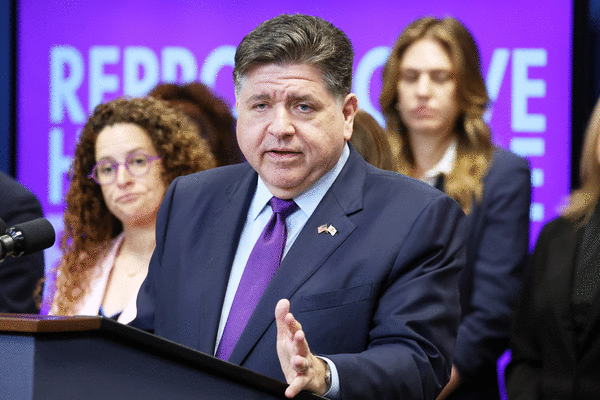
Gov. JB Pritzker signed a measure into law Wednesday shielding patients from having electronic medical records related to abortion and other reproductive health services received in Illinois disclosed without their consent to out-of-state providers.
Marking the fourth anniversary of the U.S. Supreme Court’s “devastating” Dobbs decision that overturned the federal right to abortion, Pritzker promoted the legislation — approved in the Illinois General Assembly in late May largely along party lines — as the latest Democratic effort to push back against restrictions enacted at the federal level and in other states. Some states have enacted criminal penalties for providers and for people who assist patients traveling out of state to receive abortions.
“A woman seeking care should not have to wonder whether her private health information could be used against her,” Pritzker said during a news conference at the state’s West Loop headquarters. “A healthcare provider should not have to fear that patient records will become a tool for political prosecution and persecution, and no state should be allowed to weaponize medical information in an effort to undermine rights that are protected here.”
The new law requires electronic medical records providers, such as Wisconsin-based Epic Systems, which makes MyChart, to segregate data on abortion-related services received in Illinois and prohibit that information from being shared with out-of-state medical providers without patient consent. It takes effect on July 1.
In addition to protections for electronic medical records, Pritzker’s Illinois Department of Public Health expanded a standing medical order that allow strained pharmacists to dispense certain contraceptives without a doctor’s prescription.
The moves come against the backdrop of Pritzker’s campaign for a rare third term as governor and as he considers a possible bid for the 2028 Democratic presidential nomination. In case there was any question about the politics underlying Wednesday’s signing ceremony, Pritzker’s campaign sent out an email blast just as it was beginning, touting the governor’s track record on reproductive rights and criticizing his conservative Republican opponent in the November general election.
“Right now, I am running against an opponent, Darren Bailey, who opposes abortion even in cases of rape and incest,” Pritzker said in the email. “Just recently, he proclaimed that there is no one ‘more pro-life’ than he is. He is too extreme for Illinois.”
In a separate post on Wednesday via his Substack newsletter, Pritzker extolled his record on the issue, including a 2019 measure enshrining abortion as a “fundamental right” under Illinois law and the more recent work of his dark money group, Think Big America, to support abortion-rights ballot measures in other states. Left unmentioned was Pritzker’s unfulfilled call for a state constitutional amendment protecting abortion rights in Illinois.
Bailey responded Wednesday with a social media post that included a video clip from Pritzker’s news conference.
“JB wants this race to be about a made-up culture war,” Bailey wrote. “I want it to be about why Illinois families can’t afford to stay in Illinois. That’s the conversation he’s desperate to avoid.”
In the wake of the Supreme Court’s 2022 Dobbs decision, abortion proved to be a potent issue for Democrats in that year’s midterm elections as Pritzker defeated Bailey in their first matchup and a predicted national Republican wave never materialized. But two years later, support for abortion rights didn’t necessarily translate to support for Democratic Vice President Kamala Harris as she lost the 2024 presidential race to Republican Donald Trump.
Pritzker acknowledged that issues such as the high cost of living and cuts to federal healthcare and food assistance are top of mind for many voters in this midterm election year. But he argued reproductive rights remain a decisive issue.
“I can tell you that it matters a great deal to people in the state of Illinois and across the country about whether their reproductive rights are being protected, and there is, I know, at least in my race for governor, there’s a choice to make between somebody who believes in standing up for women’s reproductive rights and someone who wants to take their rights away,” he said. “I think there are races around the country where that’s the case, and I think that will matter to a whole lot of voters.”
While electronic records companies were involved in negotiations over the new law, Pritzker said some “may not want to make the investment that’s required to change their software, but we’re requiring it because it’s the right thing to do.”
Democratic state Sen. Celina Villanueva of Chicago, who sponsored the legislation, said the law was “about making sure that women across the state don’t live in fear for seeking critical healthcare, especially abortion care, or face persecution if their private health records fall into bad actors’ hands.”
“We cannot and will not allow women to live in fear for exercising their legal rights to choose in Illinois,” Villanueva said, whether they live here or come to the state to receive care.
Separately, Department of Public Health Director Dr. Sameer Vohra signed an expanded order allowing licensed pharmacists to dispense prescription non-hormonal contraceptives and emergency contraceptives without a doctor’s prescription. Illinois pharmacists have been able to dispense some prescription hormonal contraceptives since 2023 under a previous public health order.
Pharmacists must undergo training and require patients to complete a self-screening assessment before dispensing the medications. The expanded order also covers over-the-counter contraceptives, emergency contraceptives, condoms and pregnancy tests, making them eligible for coverage under Medicaid and state-regulated insurance plans, Vohra said.
“At IDPH, the Illinois Department of Public Health, our work is focused on protecting Illinois residents today and preparing them for tomorrow,” Vohra said. “A critical part of this effort is understanding that reproductive health is public health and ensuring our residents have the tools to make informed decisions about their health.”
Making contraceptives more readily available at pharmacies won’t guarantee access statewide, as Illinois has been grappling in recent years with pharmacy closures in both urban and rural communities and with shortages of pharmacists in some places where drugstores do exist.
“It’s true there are pharmacy deserts, and there are people who can’t access pharmacies as easily as others, and we’re doing what we can at the moment” to increase access, Pritzker said. He pointed to a law he shepherded through the legislature last year that aims to rein in pharmacy benefit managers, middlemen in the prescription drug market that are often blamed for squeezing independent pharmacies.
_____
©2026 Chicago Tribune. Visit chicagotribune.com. Distributed by Tribune Content Agency, LLC.






Comments