What happens to a police dog when its officer leaves? A custody battle
Published in News & Features
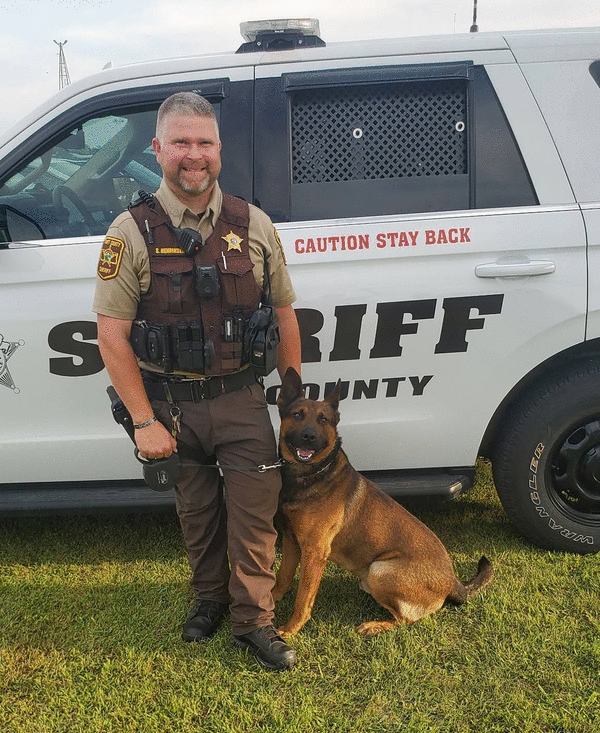
MINNEAPOLIS — A police dog in western Minnesota stood in the heart of an emotionally charged custody battle between the Swift County Sheriff’s Office and one of its deputies who left the force this spring.
Deputy Steve Henriksen resigned from the Sheriff’s Office in May, but he didn’t want to be separated from Red, a police dog from Slovakia that had been assigned to him for more than four years.
So Henriksen asked the County Board to sell the dog to him for one dollar so the 5-year-old Malinois-shepherd mix could continue to live with him and his family.
That request put Henricksen in the doghouse with some county officials, who objected to the idea.
The ordeal raised the question of who gets custody of an expensive, highly trained police dog when an officer leaves. It’s a dilemma that has played out at law enforcement agencies across America, sometimes sparking lawsuits. The resolutions have been mixed, with canines sometimes reassigned to another partner and other times going home with their handlers.
“Separating a working animal at the end of service would be unfair and unnecessarily difficult for the animal,” Henriksen wrote in his resignation letter.
The Sheriff’s Office objected to Henriksen’s proposal, arguing that the county had spent $10,000 to buy Red and $50,000 to take care of him. Giving the dog away for cheap would not be a good use of taxpayer money, Sheriff John Holtz said.
“We understand and appreciate the bond that develops between a handler and a K9 partner,” Holtz said in a statement online. “However, K9 Red is a County asset in the same way the cruiser used by Deputy Henriksen and K9 Red during his service is an asset. When an employee accepts the role of K9 handler, they understand that the canine is an asset of the Sheriff’s Office and property of Swift County.”
Holtz also said Henriksen, a 12-year veteran in law enforcement, did not discuss a transition plan for Red with him before taking a job at another agency.
Henriksen is now with the Stevens County Sheriff’s Office, which has no K-9 unit.
Police dogs can help with various law enforcement tasks including using their sense of smell to find narcotics and explosives. They can cost $8,000 or more to buy and then $12,000 to $15,000 to train, according to the National Police Dog Foundation.
The dogs often end up being part of their handlers’ family, said Herb Bennett, president of the United States Police Canine Association of Ottertail, Minnesota.
But agencies also have to look out for their needs — not just the dog handler’s, Bennett said. “The department probably has a huge amount of money invested in that dog, maintaining that dog,” he added.
The Swift County Board had a few options before its June 2 meeting: assign Red to a new handler at the Sheriff’s Office, sell the dog to another law enforcement agency or allow Henriksen to buy his canine partner at a fair market rate.
Red had been sent to Performance Kennels in Buffalo, Minnesota, where he was evaluated by Steve Pearson, an experienced dog trainer. Pearson deemed Red very friendly, able to identify odors for cocaine, heroin and meth, and a bit overweight. He put the dog’s value at $5,000.
The board unanimously voted to offer Henriksen the chance to buy Red at that price.
“This is a highly emotional subject,” Commissioner Pete Peterson said at the meeting, adding that he felt $5,000 for the dog was way too much.
Henriksen bit and delivered the money.
Meanwhile, the Swift County Sheriff’s Office has placed its canine program on hiatus, and Holtz retired on June 12.
Red has also retired from police work, and he is now a house dog, Henriksen said in a phone call.
He declined to comment further, preferring to let sleeping dogs lie.
_____
©2026 The Minnesota Star Tribune. Visit startribune.com. Distributed by Tribune Content Agency, LLC






Comments