Rubio announces new sanctions on Cuban mining companies and military enterprises
Published in News & Features
Secretary of State Marco Rubio announced new sanctions on two Cuban mining companies and three key enterprises in Cuba’s military conglomerate, GAESA, as the Trump administration continues putting pressure on Cuban leaders to enact significant changes in the country.
Rubio also sanctioned Annalie Lilliam Rueda, the wife of Gen. Alejandro Castro Espín, Raúl Castro’s son, who was the head of Cuban intelligence services and was previously sanctioned this month.
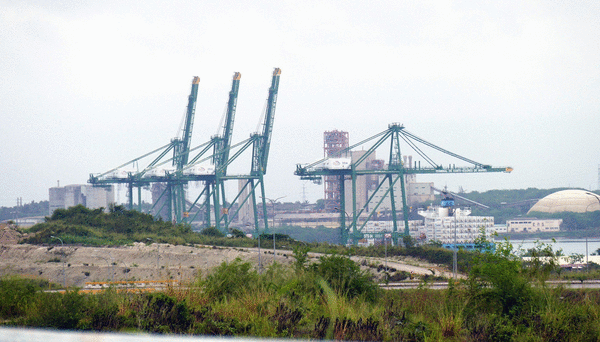
The list of GAESA-sanctioned companies includes Banco Financiero International, which handles the vast majority of transactions involving foreign companies doing business in Cuba; Rafin, another obscure financial institution within the military conglomerate; and Almacenes Universales, a logistics company that controls container traffic at the Port of Mariel Special Development Zone.
Secret GAESA internal documents obtained by the Miami Herald revealed that the conglomerate reported about $18 billion in assets, of which $14 billion were deposited in banks and in Rafin, as of March 2024.
The administration also sanctioned two companies in Cuba’s metals and mining industry:
GEOMINERA, S.A., a state-owned enterprise that manages a joint venture, Minera La Victoria SA, with the Australian-based Antilles Gold. Minera La Victoria S.A. was previously sanctioned earlier this month.
Antillana de Acero, Cuba’s largest raw steel producer, which recently underwent a modernization financed by Russian companies.
The companies and Castro Espín’s wife were designated under new authorities laid out in an executive order signed by President Donald Trump in May that allows sanctions on Cuban companies and individuals linked to government repression and those operating in key sectors.
Previously, the administration used the executive order to sanction GAESA, the conglomerate run by Cuba’s armed forces that controls about 40% of the country’s economy, Cuba’s state energy company, CUPET, and other Cuban mining companies in joint ventures with foreign companies.
While GAESA and its companies had been sanctioned in the past, the new designations under the executive order mean that any foreign company doing business with them may be at risk of U.S. sanctions as well.
The new sanctions come after Cuban leaders announced a sweeping market reform in an effort to fend off U.S. pressure and address the severe humanitarian crisis, and signal the Trump administration will nonetheless continue targeting the Cuban government’s sources of revenue.
More pressure on the Cuban government also came Thursday from the Supreme Court, which sided with Exxon on a lawsuit against Cuba’s energy company CUPET and GAESA’s largest umbrella company, Cimex.
Exxon sued the Cuban companies for “trafficking” in confiscated property and profiting from the use of refineries, gas stations and other facilities owned by Exxon that the Cuban government confiscated without compensation shortly after Fidel Castro took power. Exxon sued the Cuban companies shortly after President Donald Trump, for the first time in 2019, enacted a provision in the 1996 Helms-Burton Act that gives U.S. claimants the right to sue for compensation.
The judges concluded that the law annuls the sovereign immunity defense claimed by the Cuban companies, opening up the door to lawsuits against other Cuban companies using confiscated assets.
_____
©2026 Miami Herald. Visit miamiherald.com. Distributed by Tribune Content Agency, LLC.





Comments