In Illinois, getting oil and gas operators to pay for abandoned wells can take decades
Published in News & Features
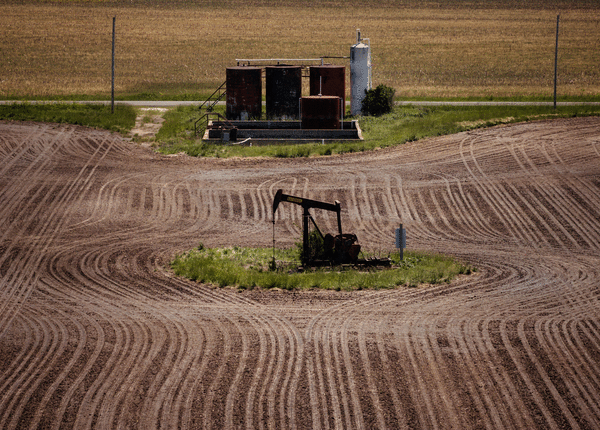
CHRISTIAN COUNTY, Ill. — By James Myers’ estimate, it’s been at least 10 years since the four oil wells on his farmland were abandoned.
That’s 10 years of farming around idle pump jacks and tabulating acres damaged by fluid leaks. Ten years of finding dead animals — birds and, once, a deer — in the open concrete pit the company dug out near its oil storage tanks to hold the salt water it once extracted from below ground.
Ten years of waiting for the company, or the state, to restore his land.
“I’m still waiting,” the 87-year-old said on a Thursday in May, sitting in his truck feet from those storage tanks — now rusted and tagged with graffiti — and that pit, filled with rainwater from a recent storm. “I’ll be dead before it ever happens.”
The wells on Myers’ property are among nearly 200 in central and southern Illinois once operated by Duncan Oil Co., which has been locked in a two-decades-long court case with the state over its repeated failures to plug leaking or unproductive wells.
The Illinois Department of Natural Resources and the Illinois attorney general’s office sued Duncan Oil Co., and the subsequent settlement agreement halted the attempted transfer of those wells from Duncan to Dix Oil Co. Both share the same mailing address in downstate Salem and are led by the same family.
The department touts the still-active case as an example of how it prevented abandoned oil wells from becoming the state’s responsibility to plug.
“Because we were able to catch (the attempted transfer) in time, we negotiated the plugging of most of the wells,” said Dan Brennan, IDNR’s oil and gas director, in an interview earlier this year.
Indeed, most of Duncan’s wells were either plugged or brought back into production under Dix Oil’s operation. But 22 years later, the Tribune has found, 15 of their wells are abandoned and unplugged. Ten of them are, as of this month, on a list of dormant wells that have become the state’s responsibility to clean up, at an estimated cost to taxpayers of $400,000.
All total, the state’s most recent list has nearly 3,900 abandoned or “orphan” wells, so-named because their owners are dead or unidentified, their companies bankrupted by a notoriously volatile global industry punctuated with booms or busts.
The agency calculates the cost to plug them is around $155 million.
An ongoing Tribune investigation has revealed that years of mismanaged fees and inadequate recordkeeping have hobbled the state’s efforts to reduce that number, while companies have been able to evade their legal obligations to plug nonproducing wells, exposing downstate communities to a host of contaminants, above and below ground.
Even when the state attempts to hold known operators accountable, as it did with Duncan Oil, those efforts can drag on for decades, allowing companies — some that are still profiting from oil and gas production, in this state and elsewhere — to potentially shift the cost of plugging their abandoned wells on the state and taxpayers, leaving holes in the ground that subject residents like Myers to a litany of problems.
“All I want to do is see if we can’t force the state to clean up this mess so it won’t be an environmental hazard,” Myers said. “Otherwise, it’ll be here forever.”
James Duncan, the man identified in records as Duncan Oil’s president and Dix Oil’s manager, did not respond to repeated interview requests from the Tribune. Both companies were operational as of June 1, according to Illinois secretary of state online records.
An IDNR spokesperson said Dix Oil would be required to reimburse the department should it plug any of that company’s wells.
The spokesperson called abandoned and orphaned oil and gas wells “a national and complex problem,” and said the department has used federal grant money to plug 737 wells across the state since 2021.
“Illinois is moving at a faster pace now than at any other point in history thanks to the federal funding,” the spokesperson said in an emailed statement. “This is an endeavor that is going to take time, and IDNR is working as fast as it can to plug wells, prioritizing the most urgent and potentially dangerous wells first.”
‘We failed in the past’
The obituary on Page 3 of the Sept. 28, 2021, edition of The Daily Sentinel in Grand Junction, Colorado, memorialized Thomas Vessels as an “oil-and-gas man” who “veered course” to become a “leading advocate in (the) battle against greenhouse gas.”
Vessels’ namesake company, it read, captured methane gas from coal mines in Colorado and turned it into electricity before it could cause deadly explosions under certain circumstances, or escape into the atmosphere, where the powerful gas traps planet-warming heat.
Similar efforts in Pennsylvania earned Vessels Coal Gas Inc. an Environmental Excellence Award in 2011 from that state’s governor, a newspaper there reported.
Fourteen months after Vessels’ death, in Illinois’ Saline County, a state DNR inspector pointed her handheld gas meter at one of at least eight abandoned gas wells in a farm field.
The meter detected gas leaking from the well, which, she wrote on a citizen complaint form, belonged to Vessels Carbon Solutions Inc.
Between 2013 and 2022, Illinois oil regulators fielded public complaints about more than two dozen wells operated by Vessels Coal Gas Inc. or Vessels Carbon Solutions Inc. (the company changed its name in Illinois around 2019), the Tribune found after reviewing department records.
In October 2018, for example, an inspector noted that gas was leaking from a Vessels well at an “explosive limit.”
That same year, state inspectors began recommending that the company’s problematic wells be placed in the state’s plugging fund, in one instance even suggesting a hearing to determine whether all Vessels wells in Saline County had been abandoned.
In the early 2010s, Vessels had acquired close to 150 wells over an abandoned coal mine in southern Illinois, hoping to do something similar to his projects in other states, said Chris Caskey, who joined Vessels Carbon Solutions Inc. around 2020 and became the managing director a year later. The wells were above the underground Brushy Creek Mine, which operated in the 1990s and the early 2000s.
Illinois has some of the largest reserves of coal in the country, with the energy equivalent of Saudi Arabia’s oil, according to the state’s geological survey.
Beginning in the 1820s, coal mining became a vital economic resource in the Illinois Basin, which is a large swath of sunken land under Illinois that extends into parts of Indiana and Kentucky — a geological formation with layers of sediment, such as sand, mud and ash, that accumulated hundreds of millions of years ago. Ancient animal and plant remains within were fossilized by intense heat and pressure, transformed into coal and oil deposits.
Methane is trapped in these coal beds. While attractive due to its proximity to strong local and regional gas markets, exploration for this gas has been sporadic in the basin since the mid-1980s, with experts noting pilot projects were uneconomic, temporarily abandoned or failed.
Such was the case with Vessels’ Illinois project. “Nothing ever panned out,” said Caskey, also a chemist and climate scientist with two other ventures to capture and reduce methane from coal mines in Colorado.
According to IDNR, 142 Vessels wells were deemed abandoned due to nonpayment of annual fees and placed in the plugging fund in late 2018. Using estimates submitted as part of the state’s federal grant application, the cleanup costs for those wells today would’ve been nearly $5.6 million. Caskey told the Tribune that he couldn’t answer with full confidence how those wells ended up on the state’s list.
“Vessels recognizes that we failed in the past in making sure wells weren’t leaking and plugging them in a timely fashion,” Caskey said, “and we take responsibility for that, and have striven to meet all safety and compliance standards.”
In 2020, Vessels plugged 12 wells. The company eventually reached a settlement agreement with the state that prevented public money from being used to clean up its abandoned wells, and in 2022, it began plugging 72 of them. The remaining wells were sold over the past two years, almost a decade after they were first deemed abandoned.
State records show most of the wells sold were transferred this year to Saline Development LLC, based in New York City. Attempts to reach the company’s manager were unsuccessful.
Even as Vessels was abandoning its wells in Illinois, it continued to operate in other states, belying the commonly held narrative that the state’s orphan wells list is populated exclusively by defunct companies.
The company is listed as “active” on the Pennsylvania secretary of state’s website and in “good standing” on Colorado’s secretary of state site. In Colorado, records show, it operates one active well. A second well is listed as inactive and plugged.
Pennsylvania oil regulators began pursuing enforcement action in December 2025 to collect civil penalties against Vessels for 12 unplugged and abandoned gas and coal-bed methane wells in that state, records show.
Caskey said he missed filing annual paperwork, but that the wells have still been actively capturing methane. The company is “now coming into compliance,” he said in April, adding that the wells had been inspected in recent weeks and were not leaking.
‘I just gave up on them’
James Myers was a teenager in the 1950s when the oil wells on his family’s land in central Illinois were drilled thousands of feet through layers of sand, lime and shale. They were named after his father, James David, and his uncle, Earl, who leased the land to Welker Oil Co. Ltd.
Duncan Oil Co. eventually acquired the wells. As was true for many oil companies, Duncan would temporarily shut the wells down when global oil prices fell. But even in those stretches, Myers remembered, he would regularly send the company handwritten statements documenting how much of his land was damaged by its operation: 153,000 square feet one year, 70,000 square feet another.
The company reliably paid those bills, Myers said, until 2021, when they abruptly stopped. That’s also the last time he said he spoke with anyone there.
By then, the company was already embroiled in litigation with the state.
Around 2003, Duncan Oil, which operated hundreds of oil wells in 10 central and southern Illinois counties, wanted to transfer ownership of over 100 wells to Dix Oil.
IDNR flagged the sale. To start, Duncan had repeatedly failed in past years to comply with a state order to plug 34 of its wells, records show, causing the department to spend $30,000 to clean up a small fraction of them, including one that was actively leaking oil and salt water.
The company had by then been the subject of 205 open cases related to violations dating back more than a decade.
“It looked like, obviously, the oil and gas people at IDNR had been dealing with Duncan for quite a while,” said Thomas Davis, who served as chief of the attorney general’s environmental bureau from 1991 to 2014. “They had a 10-county coverage, so they were making a mess here, there and everywhere.”
Then there was the obvious connection between Duncan and Dix: Both companies used the same mailing address in Salem. The former’s president, William Bruce Duncan, and the latter’s manager, James Duncan, are brothers. When William died in 2023, his brother James took over as Duncan Oil’s president.
IDNR and the state’s AG office filed suit. Under a 2004 settlement agreement, Duncan had to pay over $16,000 in civil penalties and reimburse the state almost $22,000 for wells Illinois’ DNR had plugged. Duncan Oil was also ordered to plug almost 70 wells by 2009. In turn, it was allowed to transfer 123 productive wells to Dix Oil.
“Through its failure to obey the law, this company profited unfairly at the state’s expense,” then-Illinois Attorney General Lisa Madigan said in a July 2004 article from the downstate newspaper, The Greenville Advocate. “Duncan Oil must now repay the money it owes Illinois.”
In a statement, Illinois’ DNR told the Tribune the company paid those penalties and reimbursements in full that year.
The company was also allowed to transfer three wells to other operators who returned them to production.
Still, questions linger about the effectiveness of such settlement agreements. Over the past decade, Duncan Oil repeatedly missed deadlines from the state to plug 20 wells that were supposed to be addressed by 2009.
“We’re still working on some of the plugging to this day, but we were able to, I think, stop the worst of it,” Brennan told the Tribune.
The consent order would be updated multiple times to give the company more time to plug remaining wells.
Yet six of the wells Duncan was initially ordered to clean up remain unplugged and inactive 22 years later, and one of them is included on the state’s most recent list of orphan and abandoned wells.
Nine wells that Duncan was allowed to transfer to Dix are also on that list. According to an IDNR spokesperson, they were placed there six years ago after the company defaulted on a 2019 settlement agreement with the state, in which Dix had acknowledged it had abandoned the wells and had committed to cleaning them up.
Four of those transferred wells are on Myers’ family land.
James Myers does not mince words when it comes to the oil company that abandoned them — “If you or I did something like that, we’d be in jail” — or the oil regulators who couldn’t stop it from happening: “They continue to do absolutely nothing except draw salaries.”
Years ago, he said he made repeated trips to IDNR’s Springfield office to ask what they planned to do about the wells. Sometimes, he said, he’d get no further than a receptionist. Other times, someone would come down from the second floor to “give you the runaround.”
After his health made the 84-mile round-trip drive a little too difficult, he started to call.
“But I just gave up on them,” he said.
And so, he and his neighbors face the possibility that the ruins of one oil company’s past will remain indefinite fixtures of the landscape, no different from the telephone poles that line its narrow roads and the trees that break up farm fields.
“God, I hope not,” Myers said of that prospect. “Lord almighty. I mean, this is kind of dangerous.”
_____
©2026 Chicago Tribune. Visit chicagotribune.com. Distributed by Tribune Content Agency, LLC.






Comments