US, Iran meet in Switzerland as fresh Trump threat angers Tehran
Published in News & Features
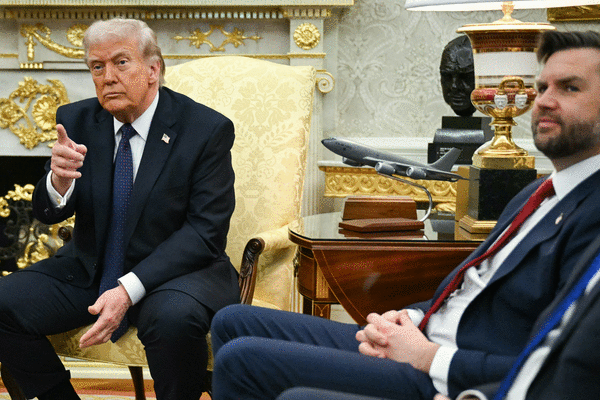
The U.S. and Iran began talks in Switzerland on a peace deal to settle the issue of the Islamic Republic’s nuclear program and permanently reopen the Strait of Hormuz as President Donald Trump once again threatened strikes if Hezbollah keeps attacking Israel.
Things got off to a confusing start Sunday when Iranian media reported that Iran halted talks over Trump’s latest threat, but people familiar with the matter said the talks were continuing.
The first high-level meetings of U.S., Iranian, Qatari and Pakistani representatives opened in the Swiss resort of Bürgenstock, with U.S. Vice President JD Vance and Iranian Foreign Minister Abbas Araghchi among attendees.
As the meetings got underway, Trump said in a social media post that he would strike Iran again if it doesn’t “immediately stop their highly paid PROXIES in Lebanon from causing trouble.”
He also warned Iran that the U.S. might start collecting tolls if there’s no deal. Speaking Sunday to Fox News,Trump said he told Iranian leaders directly that if they close Hormuz, “You won’t even make it back” to Iran, using an expletive.
While a hard-won interim deal has signaled a pause in U.S.-Iran hostilities, Sunday’s discussions are likely just the start of protracted wrangling that will span topics including Iran’s nuclear capabilities and economic relief for Tehran.
“What today really represents is the beginning of a technical negotiation that’s not going to solve every disagreement,” Vance told reporters, speaking alongside officials from Pakistan and Qatar, which are acting as mediators. Jared Kushner and Steve Witkoff, Trump’s global negotiators, have been engaged in ongoing technical talks.
A resolution to the fighting in Lebanon will be decisive for the success of the U.S.-Iran talks in Switzerland, according to an official familiar with the discussions, who asked not to be identified discussing sensitive information. That means a positive outcome in the negotiations ultimately hinge on Israel’s support, the person added, with only a retreat from Lebanon fully ensuring that the intermediate deal can move forward.
Israel was not a party to the talks that led to the interim agreement.
Other issues in focus are the Strait of Hormuz, U.S. sanctions and the return of frozen Iranian assets, the person said. Four-party talks started at 2:45 p.m. local time and were continuing Sunday evening. The Swiss are keeping the venue ready until mid-morning on Monday, allowing negotiations to run until then if necessary.
Iranian envoys are focused on how the meeting will be received at home, the official said. That led to their delegation staying out of the room and refusing to participate in the opening televised remarks before discussions started because they did not want to be seen shaking hands with U.S. delegates before agreements had been reached, the person said.
The official also added that the talks were complicated by attempts to bridge the completely different mentalities and expectations between Iranian and U.S. representatives.
The meeting “is going to allow us to sit together as teams for the first time really in history to figure out what matters most to the respective parties, to settle those issues, to solve those issues, and get to a better tomorrow,” Vance said.
Iran’s semi-official ISNA news agency said the main topics of the talks would be a “comprehensive ceasefire” in Lebanon, including an Israeli withdrawal, and the fate of billions of dollars in Iranian assets frozen overseas.
Tehran on Saturday accused Israel of violating a truce in Lebanon and said the Strait of Hormuz, a key transit point for global energy supplies, would be shut again. Despite the announcement, millions of barrels of oil continued to flow through the waterway.
Under the terms of the memorandum of understanding signed by Trump on Wednesday, the U.S. and Iran have 60 days for negotiations, although the pact allows for an extension.
Iran’s announcement on Hormuz cast a cloud over the talks, but the immediate impact on vessel traffic was unclear. Even before the recent ceasefire, millions of barrels of oil had been quietly escaping the waterway each day.
Three fully laden India-linked supertankers reemerged in the Gulf of Oman on Sunday after signaling an attempt to cross the strait on Friday, according to ship-tracking data compiled by Bloomberg.
The supertankers, each signaling Indian ownership or India-bound cargo, carry nearly 6 million barrels of Iraqi and Kuwaiti oil. Their attempts to sail toward Qeshm island suggest they may have taken a Tehran-approved route.
U.S. Central Command said commercial ship traffic increased in the strait on Saturday, with 55 merchant ships transiting cargo and more than 17 million barrels of oil.
Energy Secretary Chris Wright said on Fox News Sunday that the U.S. was still escorting ships and “demonstrating we can transit the strait with or without” Iran.
Israel, Washington’s partner in the war on Iran that began Feb. 28, has been fighting a parallel campaign against Hezbollah in neighboring Lebanon. Iran has consistently sought to link the conflict there, which has killed thousands and displaced more than 1 million Lebanese, with the broader U.S. negotiations.
Tehran views the U.S. as having “direct responsibility” for the situation in Lebanon and Israel’s military actions, Foreign Ministry spokesman Esmail Baghaei said in comments cited by the IRNA news agency.
Israel has insisted it’ll keep troops on its borders until it’s sure that Hezbollah, designated a terrorist organization by the U.S., is no longer a threat. The Israel Defense Forces said its recent operations are targeting a network of underground bunkers where Hezbollah fighters are believed to be sheltering.
“There has been, and there is, no restriction on IDF soldiers in Lebanon acting to remove threats,” Israeli Defense Minister Israel Katz said on Sunday.
“Our forces remain deployed in the security zone along the Yellow Line in Lebanon and operate from there against terrorists and terrorist infrastructure,” he said, reiterating that Israel would not withdraw.
Trump has expressed frustration with Israeli Prime Minister Benjamin Netanyahu over previous strikes, suggesting they risked undermining the U.S.-Iran talks.
“Israel has the right to defend itself,” Vance told reporters on Thursday. “But fundamentally, the Israelis, just like everybody else, have to respect this peace process that is fundamentally good for them and good for the entire region.”
The U.S.-Iran memorandum led Washington to lift a naval blockade of Iranian ports and promise to waive sanctions that have blocked the sale of Iranian crude. Iran pledged to reopen Hormuz, a conduit for about a fifth of the world’s oil and gas supplies.
Tehran, though, has warned it will require ships to have its permission and mandatory insurance in order to cross. The US, Europe and Gulf Arab states have balked at the idea of Iran imposing fees.
The sides have already made “great progress” over the last few hours, Vance told reporters on Sunday in Switzerland.
“I expect it will make additional progress in the hours to come,” he said.
_____
(With assistance from Sara Gharaibeh, Weilun Soon, Jennifer A. Dlouhy, Dan Williams and Fiona MacDonald.)
_____
©2026 Bloomberg L.P. Visit bloomberg.com. Distributed by Tribune Content Agency, LLC.





Comments