California sues Shasta County -- as expected -- after voters approve measure to eliminate most mail-in voting
Published in News & Features


LOS ANGELES — The painfully slow vote count after California’s June 2 primary attracted national headlines and baseless claims of cheating by President Donald Trump, who was focused on the high-profile races for governor and Los Angeles mayor.
But the fight over election integrity continues to be played out in dramatic terms in rural Shasta County.
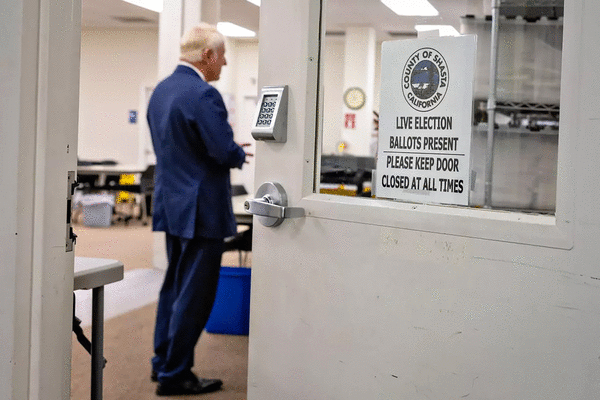
Voters in the Northern California county just approved a measure that eliminates most mail-in voting and requires residents to present government-issued photo identification to vote, among other things.
Both opponents and supporters of the citizens’ initiative, Measure B, told me before the election that they expected the county to be sued over it. And they were right.
California sues Shasta County
On Friday, California Atty. Gen. Rob Bonta and Secretary of State Shirley Weber, the state’s top elections official, sued Shasta County in the 3rd District Court of Appeal, arguing that Measure B violates state election laws and must be struck down before the November election.
“Measure B is legally indefensible. It directly conflicts with state law and threatens to upend the orderly administration of elections,” Bonta said in a statement, adding that “no city or county gets to unilaterally rewrite our election rules.”
Measure B would require elections to be held in person on a single day and create a separate county voter registration system disconnected from the state’s uniform system.
It also would limit voting by mail — the method used by an overwhelming majority of Californians, including in Shasta County— to “the infirm, military, and U.S. citizens living overseas.”
In an email Monday, Shasta County spokesperson Miranda Angel said the county could not comment on ongoing litigation.
A history of election skepticism
In 2023, the Shasta County Board of Supervisors, swept up in unfounded election fraud allegations promoted by Trump, ditched Dominion voting machines and opted to hand-count ballots for the county’s more than 110,000 registered voters — quickly prompting a new state law that banned them from doing so.
Last year, the supervisors appointed Clint Curtis — a Florida-based attorney whose claims about rigged voting machines stretch back to the early 2000s— to be the Shasta County registrar of voters, a position vacated by two previous registrars who resigned for health reasons they said were exacerbated by the stress of the job.
Curtis promptly eliminated nine of the vast county’s 13 ballot drop boxes. He accused his predecessors in the registrar’s office, without evidence, of stuffing ballots to sabotage conservative Republicans. And he called for federal authorities to raid his office and seize ballots.
Curtis also advocated for Measure B and now is named as a defendant in the state’s 65-page lawsuit. He was voted out of office this month and will be replaced in January by Joanna Francescut, the former longtime assistant registrar, whom he fired.
Who is surprised? No one
Richard Gallardo, a leader of the citizens’ group Save Shasta Elections, which wrote Measure B and collected thousands of signatures to get it on the ballot, told me last month that he figured a lawsuit was imminent.
“We don’t like the state laws. We want to enact our own local election reform. … Yes, we do expect the state to sue us,” said Gallardo, an election integrity activist who once tried, unsuccessfully, to place all of the county supervisors under citizen’s arrest during the COVID-19 pandemic.
Gallardo, who is among the “real parties in interest” named in the lawsuit, said that if Measure B passed, the onus was on the county to “fully and fervently” defend it in court because it’s “the will of the voters.”
State prevailed in similar lawsuit and the clock’s ticking
Bonta and Weber previously sued Huntington Beach over its 2024 city charter amendment that would have required voter ID. An appellate court struck down the law, and the California Supreme Court this January declined to hear the city’s appeal.
In their lawsuit against Shasta County, Bonta and Weber argue that Measure B is preempted by California law, which requires uniform election rules across the state.
The lawsuit urges a quick decision because election officials are required by state law to begin mailing voter information guides and ballots for the November election to all active registered voters in September and early October.
©2026 Los Angeles Times. Visit at latimes.com. Distributed by Tribune Content Agency, LLC.






Comments