US and Iran prepare for deal signing with both claiming victory
Published in News & Features
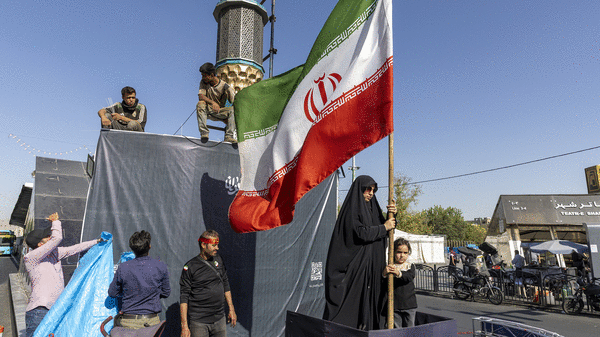
The U.S. and Iran are preparing to formally sign their interim peace deal in Switzerland on Friday, with both sides claiming victory and oil traders and shippers unsure over how quickly the Strait of Hormuz will be reopened.
The text of the so-called memorandum of understanding — a 14-point document that should lead to a two-month ceasefire extension and the start of complicated negotiations over Iran’s nuclear program — has yet to be published.
A senior U.S. official said it’s possible that happens in the next two days, ahead of the signing ceremony in Geneva.
Vice President JD Vance is expected to head the American delegation, while Iran will likely be represented by Parliament Speaker Mohammad Bagher Ghalibaf.
U.S. President Donald Trump is in France for a Group of Seven summit, where the Iran war — which has caused energy prices to soar — is featuring prominently. G7 nations such as France, the U.K. and Italy are likely to play key roles in any de-mining of the strait that’s needed to facilitate its reopening.
Speaking at the summit on Tuesday, Trump said the agreement is a “done deal,” adding the U.S. would not invest money in Iran or pay war reparations. Washington is now dealing with “rational” people in the Islamic Republic, he said, reiterating the country will not be able to develop nuclear weapons.
“They’re going have to prove themselves, I think, before any of us go in there,” Trump said when asked about economic opportunities for Iran.
On Monday, Italian Defense Minister Guido Crosetto and U.S. counterpart Pete Hegseth met in Washington, where they discussed a four-ship flotilla Rome is preparing to send to the Hormuz strait, according to one G7 official familiar with the matter. This includes two mine-sweepers now in Djibouti, where they were dispatched to prepare for the mission, the official said.
Trump was set to hold bilateral meetings with United Arab Emirates President Sheikh Mohamed bin Zayed and Qatar’s Emir Sheikh Tamim bin Hamad on Tuesday as part of the G7 summit. Those countries may play a part in helping create, along with the U.S., a $300 billion development fund for Iran in the aftermath of the conflict.
The U.S. will look to other countries and the private sector to pledge investments in Iran, the American official said. The Islamic Republic, which has a population of 90 million people and some of the world’s biggest oil and natural gas reserves, wanted the fund included in the MOU to help with reconstruction. Iran said the war, which began on Feb. 28 with a U.S.-Israeli bombardment, cost it more than $250 billion in economic damage.
Iranian officials have claimed the MOU will lead to them getting access to tens of billions of dollars of frozen funds held in places such as Qatar. Trump and his administration have consistently said the Islamic Republic will get no funds unfrozen or sanctions lifted on the signing of the agreement. That, they’ve said, will happen in steps, contingent on Tehran fulfilling the terms of the deal.
Oil prices have fallen sharply since Trump said late last week an agreement was imminent. Brent crude dropped 3.6% to just above $80 on Tuesday, falling for a fourth straight day. It’s down from a high of $125 in late April, with traders having anticipated the U.S. and Iran would reach a deal instead of revert to all-out war.
Lower demand in China, as well as the U.S. and other nations running down their emergency petroleum stockpiles, have also helped lower prices. Those reserves will likely need to be rebuilt once the strait is open again.
Many European governments, energy investors and shipping companies doubt Trump’s claim that the Hormuz strait will be fully open on Friday. Beyond the probable need to clear the waterway — through which a significant portion of the world’s supplies of oil, liquefied natural gas and aluminum normally flow — there’s also the question of whether Iran will allow ships free passage.
Tehran has signaled it will charge vessels navigation fees after the 60-day period of the fresh U.S.-Iran negotiations.
Vance defended the deal on Monday, claiming the pact will built around a verification system to ensure Iran follows through on its pledges.
Still, neither the U.S. nor Iran is hiding its distrust of the other and the White House says Trump won’t hesitate to return to strikes if he thinks Tehran’s leaders aren’t abiding by the terms.
“President Trump knows this regime stalls and uses talks to buy time. He will not allow it,” according to a document seen by Bloomberg. “The pressure that brought Iran to the table stays fully loaded, and every option is still on the table.”
Trump’s frustration with the war he launched nearly four months ago has been increasingly visible and his focus has often drifted elsewhere, including to his renovation projects in Washington and festivities surrounding the 250th anniversary of U.S. independence. The president, who turned 80 on Sunday, looked tired when he arrived at the G7 on Monday. He traveled only after attending a mixed martial arts fight at the White House that ended well after midnight in the U.S.
Israel’s war against Iran-backed Hezbollah militants in Lebanon is another potential spoiler to a successful deal. The MOU is likely to state there must be a ceasefire on “all fronts,” including Lebanon.
Israeli politicians have balked at that, believing in the need to carry on fighting a group that has fired missiles and drones on their territory in support of Iran.
Prime Minister Benjamin Netanyahu has been criticized by Israelis for the deal, which they also see as conceding too much to Iran, an arch-enemy of the Jewish state, and not restricting its ballistic-missile program. Netanyahu had no direct say in the U.S.-Iran talks, mediated by Qatar and Pakistan, and his relationship with Trump has come under plenty of strain as those have advanced.
On Tuesday at the G7, Trump criticized Israel’s handling of Hezbollah and again said the conflict in Lebanon has hindered the talks with Iran.
“I suggested to Israel to let Syria take care of Hezbollah,” Trump said. “I’m not happy with the way Israel has handled themselves with Lebanon and with Hezbollah. They should have been able to do the job faster. It just goes on forever, and when that happens, it throws a negative light on the big deal, and that’s the deal with Iran.”
There is “still a lot of work to be done” to fully end the Middle East conflict, Qatar’s emir said in France on Tuesday, speaking alongside Trump. There will be “huge opportunities” for investment in Iran but the recent target for all sides has been to reach a deal, he said.
©2026 Bloomberg L.P. Visit bloomberg.com. Distributed by Tribune Content Agency, LLC.






Comments