Trump insists Iran deal is close after scrapping new strikes
Published in News & Features
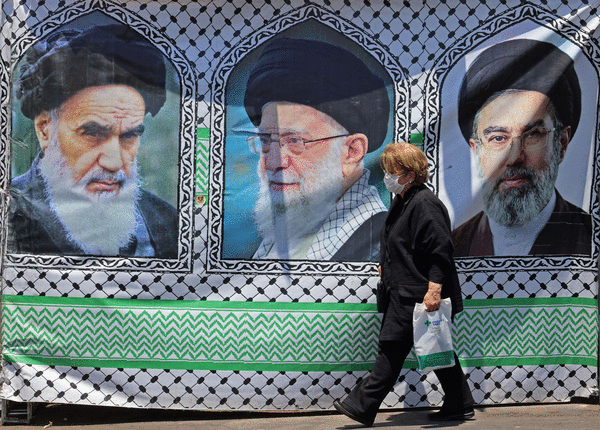
WASHINGTON — President Donald Trump pulled back threatened military strikes against Iran, a stark reversal that came just hours after he vowed to hit the Islamic Republic “VERY HARD” and threatened to seize its oil infrastructure.
U.S. forces had already pounded Iran with airstrikes for two straight days when Trump on Thursday morning said they would do so for a third. But then in the afternoon, Trump announced on social media the attacks were off, claiming again that a deal was close — without any confirmation from Iran.
Trump told reporters in the Oval Office that a signing could take place as soon as this weekend in Europe and that Vice President JD Vance would attend if it materializes. He also said Iran’s supreme leader had agreed to a deal, though he cautioned the pact was not finalized. The president described it as “a very strong memorandum of understanding that is a little conceptual,” which would restart shipping in the Strait of Hormuz and include commitments from Tehran to not pursue a nuclear weapon.
“We ended the war with Iran today,” Trump told an evening tele-rally for Burt Jones, who’s running for the U.S. Senate in Georgia. During another tele-rally for Barry Moore, a Senate candidate in Alabama, the president said, “We made a great deal. There’ll be no nuclear weapons. People will start coming home very soon. It’s pretty much, pretty much completed. We got everything we wanted.”
Iran’s semi-official news agency Fars, however, said earlier Thursday that officials had not yet approved the text of any agreement with the U.S., citing an unnamed source. Iran’s nuclear program and its frozen assets have long been sticking points in the talks.
“It’s something that’s going to get done,” Trump said. “They want to sign it as much as I do, or more.”
Oil plunged while stocks rebounded on Trump’s comments. West Texas Intermediate fell almost 3% toward $85 a barrel, while Brent dropped 1.8%.
Trump’s announcement is the latest in a series of mixed signals about the war since it began in February. The conflict, which he initially said would last four to six weeks, is now in its fourth month and has become increasingly unpopular with Americans facing higher fuel prices.
The U.S. president has insisted a deal was within reach dozens of times, but none has yet materialized. The new promise of an impending deal came days after a two-month-long ceasefire collapsed amid a wave of tit-for-tat strikes.
People familiar with the diplomacy have said talks between the U.S. and Iran — with Qatar playing an increasingly important role as a mediator — have continued and progressed despite the violence. Each side is using the exchanges of fire as a way to try to pressure the other and gain better terms in the negotiations, one of the people said.
Trump said he spoke to Israeli Prime Minister Benjamin Netanyahu and the leaders of the United Arab Emirates, Saudi Arabia, Bahrain and Kuwait, and planned to speak with Turkish President Recep Tayyip Erdogan. Iran was notably absent from an earlier list of countries that Trump claimed had agreed to a deal framework.
In a statement about the call, Netanyahu’s office said “the prime minister expressed his appreciation for President Trump’s commitment that the final agreement at the conclusion of negotiations will include the removal of enriched material, the dismantling of enrichment infrastructure, limits on missile production, and the cessation of Iran’s support for its terrorist proxies in the region.”
Earlier Thursday, Trump promised a major escalation by saying that U.S. forces would seize Kharg Island, a crucial energy hub for Iran, a move that would likely require American ground troops.
He expressed reservations about that plan almost immediately, saying on Fox News that he was “not sure America has the appetite” for that. Asked later in the Oval Office whether the operation was off the table, Trump said “if we sign this agreement, it would be.”
The president added in his earlier social media post that the U.S. naval blockade of Iran “will remain in full force and effect until this Transaction is finalized.”
On Wednesday, Iran said Hormuz would be closed to all types of vessels, suggesting it would tighten its grip on the waterway. Their claim came the same day Trump said the U.S. military had supported the passage of “more than 200 commercial ships” through the strait, resulting in “more than 100 million barrels of oil” making it to market. He went on to claim the U.S. controls the strait, “not Iran.”
Talks between the warring sides have been stuck on several crucial points. Tehran insists the U.S. unfreeze billions of dollars of Iranian funds held in countries such as Qatar, and Trump is demanding the Islamic Republic relinquish or destroy its stockpiles of highly enriched uranium. Iran also wants a ceasefire in Lebanon, where Israel is fighting Hezbollah, a key ally of Tehran.
Trump told Fox News on Thursday that he has spoken to Iranian officials directly, telling them to stop bombing U.S. assets. He didn’t say who he spoke to, in what would be a very rare instance of a U.S. president conversing directly with Iranian authorities.
(Devika Krishna Kumar, Skylar Woodhouse, Patrick Sykes, Omar Tamo, Nicholas Lua, John Harney and Jon Herskovitz contributed to this report.)
©2026 Bloomberg L.P. Visit bloomberg.com. Distributed by Tribune Content Agency, LLC.





Comments