Trump vows immediate attacks on Iran, straining ceasefire
Published in News & Features
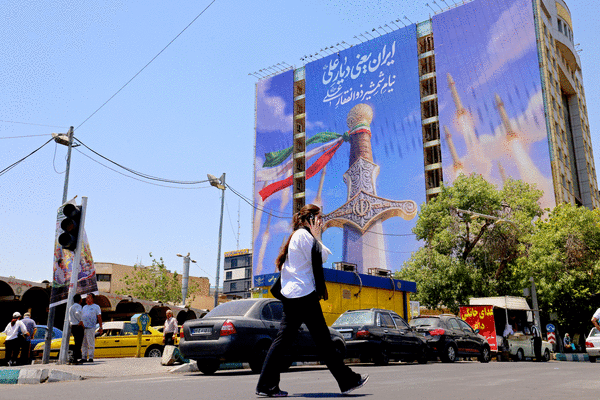
WASHINGTON — U.S. President Donald Trump pledged fresh strikes on Iran after accusing the country of dragging out talks on an interim peace deal, putting further strain on a fragile two-month truce.
The U.S. renewed its attacks overnight on the Islamic Republic and Trump’s latest comments opened the door to Washington’s most sustained military offensive since the two sides agreed to a ceasefire in April.
“We’re going to be attacking them, attacking them very hard,” Trump told reporters at the White House Wednesday. “We hit them hard yesterday, and we’re going to hit them hard again today.”
For months, Trump has vacillated between threats of intensified attacks and boasting that a peace deal is within reach. Yet neither scenario has materialized, with few signs Washington and Tehran have resolved major sticking points. That dynamic has prolonged the conflict and left its resolution unclear.
Trump declined to say what targets U.S. forces would hit. The Iranian Foreign Ministry later accused the U.S. of striking civilian water infrastructure. U.S. Central Command did not immediately respond to a request for comment on that claim.
The S&P extended its decline to more than 1% and oil prices climbed more than 2%, with Brent crude trading at above $93 a barrel after Trump’s comments.
Trump also offered comments that appeared designed to calm markets, confirming that the U.S. is helping get oil tankers through the Strait of Hormuz and crediting the move with keeping oil prices relatively low.
Later Wednesday, Trump posted that the U.S. military had supported the passage of “more than 200 commercial ships” through the key waterway, resulting in “more than 100 million barrels of oil” making it to market. He went on to claim the U.S. controls the strait, “not Iran.”
Before Trump spoke, a White House official said talks are still ongoing but vowed that the U.S. will exert maximum pressure until a deal is reached. The semi-official Iranian Students’ News Agency reported that a Qatari delegation arrived in Tehran on Wednesday to discuss the diplomatic process to end the war.
Since the ceasefire was announced, armed hostilities have slowed but not stopped entirely. Yet this week’s developments mark the most intense fighting between the U.S. and Iran in weeks. A further escalation risks derailing intermittent, indirect talks between Iran and the U.S. The overnight clashes followed a direct confrontation between Iran and Israel earlier this week, but halted after Trump called on both sides to stop.
Trump has often made conflicting statements about the status of negotiations and if full-scale fighting should resume.
“I think the war hasn’t really stopped,” said U.S. Senator Brian Schatz, a Democrat from Hawaii. “There’s no real evidence that a deal is in there.”
Nikki Haley, Trump’s ambassador to the United Nations in his first term, told Bloomberg she was skeptical a deal could be reached. “Iran was never going to do a deal,” she said.
Trump said he ordered retaliation against the Islamic Republic for shooting down a U.S. Apache helicopter near the Strait of Hormuz. Tehran has not confirmed downing the aircraft and said it was reconsidering whether to persist with negotiations in light of the U.S. attacks.
“The diplomatic process doesn’t happen in a vacuum and to advance any diplomatic process you need a minimum space to be able to move forward,” Esmail Baghaei, a spokesman for Iran’s Foreign Ministry, was cited by the state-run Islamic Republic News Agency as saying. “Wherever necessary, our armed forces will respond to the enemy with authority.”
The U.S. military said it had completed an operation that saw fighter jets strike Iranian air defenses, ground control stations and radar sites near Hormuz.
The Islamic Revolutionary Guard Corps launched missiles on four American targets, including shelters housing F-35 fighter jets and a command center for the U.S. military at Al-Azraq Air Base in Jordan, state-run IRIB News said on Wednesday.
Iran also said it fired drones at the main U.S. naval base in the Middle East, located in Bahrain, and struck Ali Al Salem air base in Kuwait. Kuwait’s defense ministry said it had intercepted projectiles early Wednesday, while Jordan said it had intercepted five Iranian missiles.
Tehran said it had exercised its “inherent right to legitimate self defense” and warned regional states not to allow the U.S. and Israel to use their territory as a staging post for strikes on the Islamic Republic.
There were no immediate reports of casualties in any of the attacks.
“This is how both sides are trying to shape the ceasefire, and such bouts of fighting are a function of protracted war,” Bloomberg Economics’ Dina Esfandiary, Becca Wasser and Ziad Daoud said. “The truce isn’t dead, but this is the new normal: a ceasefire that’s constantly being tested.”
Key hurdles in the negotiations include Tehran’s demand that Washington unfreeze more than $10 billion of funds held in foreign countries. It’s also unclear whether Iran would agree to diluting its stocks of highly enriched uranium or sending them to another country such as China.
Lebanon, where Israel is fighting Hezbollah, is another sticking point. Iran fired missiles at Israel days ago after the Jewish state targeted the Iran-backed militia and infrastructure in Beirut, the Lebanese capital. Israel retaliated despite Trump urging Prime Minister Benjamin Netanyahu not to.
Then on Monday, Iran and Israel agreed to stop attacking each other. Tehran reported that some military personnel were killed in Israel’s attacks, while Israel intercepted incoming missiles.
Iran and the U.S. have been negotiating mainly via Pakistan and other states including Qatar. Pakistani-led intermediaries were continuing discussions with both sides this week, according to people familiar with the matter, who asked not to be identified due to the sensitivity of the subject.
_____
With assistance from Brendan Fagan, Vivien Ngo, Devika Krishna Kumar, Mike Cohen, Jennifer A. Dlouhy, Erik Wasson, Tony Capaccio, Michelle Jamrisko and Jordan Fabian.
_____
©2026 Bloomberg L.P. Visit bloomberg.com. Distributed by Tribune Content Agency, LLC.






Comments