Sen. Mark Warner listens to military families, service providers about challenges
Published in News & Features
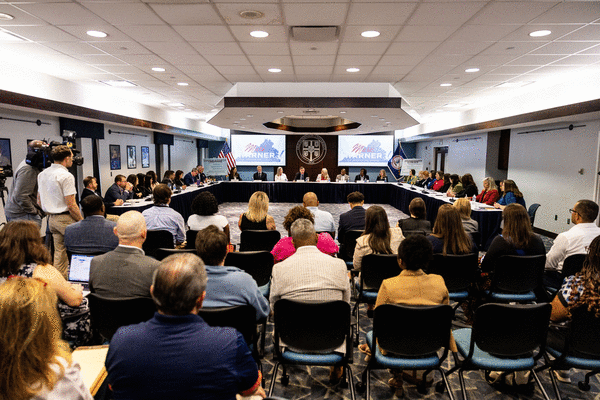
NORFOLK, Va. — In the aftermath of attacks resuming Sunday and Monday in the Middle East, U.S. Sen. Mark Warner gathered representatives from veterans organizations and families of sailors who recently returned from the USS Gerald R. Ford Carrier Strike Group’s 11-month deployment — where they were supporting conflict operations — to discuss ways the federal government can support military families.
Thanks to several extensions, the 326-day deployment was the longest of any strike group since the Vietnam War. It included being rerouted to support operations near Venezuela in the fall and to the Middle East in February — and was marked by significant plumbing issues and a fire that resulted in hundreds of sailors losing their bedding.
Back home, military spouses were faced with their own challenges. Those present for the roundtable at Old Dominion University raised the issues of affordable childcare, connecting servicemembers to jobs and education and more.
Warner, a Democrat, opened the discussion by addressing the Iran war, calling it a “war of choice” because “there was no imminent threat from Iran.” The senator criticized the Trump administration’s handling of the war and specifically referenced an Axios report that the administration rejected an offer in August from Ukraine to provide significantly cheaper means of combating Iran’s drones.
“When you start a war of choice, you sure ought to be prepared for that,” Warner said. “I just worry about the kind of stress that puts on those deployed and those at home. I worry that there’s going to be a lot of people that may not (return to military service).”
Addressing childcare, Warner noted that he and fellow Virginia Sen. Tim Kaine had put about $110 million into funding for brick and mortar childcare facilities and are looking to add about $300 million more. Janet Days, the former commanding officer of Naval Station Norfolk and now Suffolk’s director of economic development, said building these facilities takes time and suggested a quicker option would be what’s been done in Suffolk: establishing grants for in-home childcare providers to help providers pay for conditional use permits.
“When I was at Naval Station Norfolk, I think we always had not short of maybe 550-600 families on the waiting list for daycare here in this region, the largest naval installation,” Days said. “There just is not enough.”
Natalie Spangler, a Navy veteran, reservist and mother of four homeschooled children whose husband was on the USS Bainbridge as part of the Ford strike group, said finding care during the day that worked with her schedule was “impossible.”
“My biggest issue was not only finding the resources but making it available and known, because I know there were options (for childcare) but I didn’t find out about them until the end of the deployment,” Spangler said.
Rasheeda Senger, a federal employee whose husband is a 12-year Air Force veteran who just returned from an extended 7-month deployment, said she was fired by Elon Musk’s Department of Government Efficiency and summarily rehired. She said the military’s pilot program to provide in-home nannies and the exemption from working in the office available to military spouses has been critical to her being able to manage work and childcare.
“Please keep fighting for that telework exemption, don’t let that change,” Senger said. “It’s really working for our family and I know it’s working for others.”
Tessa Davis, director of child and youth programs with Armed Services YMCA and a military spouse, said the YMCA’s food pantry, which opened during the pandemic, has had hourslong lines for food and has been forced to close on Tuesdays and Thursdays to restock from full days of appointments.
“It’s heartbreaking,” Davis said.
Kayla LaFond, the Virginia Military Spouse Liaison for the Department of Veterans Services whose husband was deployed on the USS Bainbridge, said more needs to be done to support families of service members. Critical to that, she said, is “fixing TRICARE.
“I don’t think we put enough emphasis on the families that are the ones holding all of this, all of the focus is on veterans, on transitioning servicemembers, and they’re doing their job, but no one is taking care of us. If we can pay (TRICARE providers) what they deserve then we’ll have more options to take care of ourselves and our families.”
Warner expressed gratitude for the specificity of the requests each panelist and speaker gave to improve efficiencies in the services offered to military families, and committed to making progress on addressing their concerns.
At the end, with people still trying to get their questions out, Warner suggested having another discussion in 90 days. When asked who in the room would return, nearly everyone raised their hands.
©2026 The Virginian-Pilot. Visit at pilotonline.com. Distributed by Tribune Content Agency, LLC.






Comments