Despite Blue Origin explosion, SpaceX knocks out launch, ULA still to go today
Published in News & Features
Even though Blue Origin suffered a massive explosion of its New Glenn rocket at Cape Canaveral Space Force Station on Thursday night, two other launch providers pushed forward with missions Friday on the Space Coast.
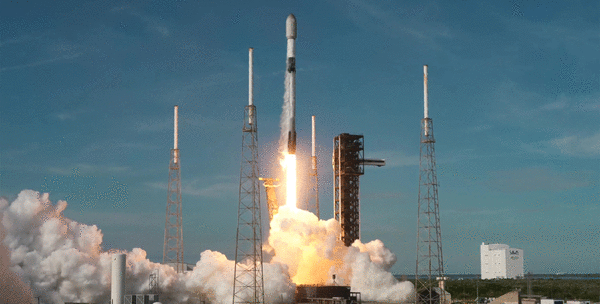
First up was SpaceX with a Falcon 9 rocket on the Starlink 10-53 mission carrying 29 Starlink satellites from Canaveral’s Space Launch Complex 40 launching at 8:57 a.m.
The first-stage booster flew for the 16th time and made a recovery landing downrange in the Atlantic on the droneship A Shortfall of Gravitas.
Then on Friday evening, a United Launch Alliance Atlas V is set to lift off on the Amazon Leo 7 mission with 29 satellites for Amazon’s growing broadband internet constellation headed for low-Earth orbit launching from Space Launch Complex 41 during a window that runs from 7:33-8:02 p.m.
Of note, after this launch, ULA will have only seven more Atlas V rockets available, with one set aside for its final Amazon mission and the rest contracted to fly Boeing Starliner spacecraft.
The two launch complexes are on the north end of Cape Canaveral Space Force Station while Blue Origin’s Launch Complex 36 is on the south end of the complex more than 6 miles away. The first stage of its New Glenn rocket was on the pad Thursday night for a static fire test, during which the rocket would light its engines while locked down to the pad. The 9 p.m. incident saw the rocket hardware engulfed in a massive fireball destroying it and damaging much of the launch pad.
New Kennedy Space Center Director and NASA’s senior director of launch operations Brian Hughes weighed in after SpaceX’s launch less than 12 hours after the Blue Origin explosion.
“Less than 12 hours after a Blue Origin anomaly event at the Cape, SpaceX just had a successful Falcon 9 launch,” he wrote on X. “Space is hard, but NASA and Space Force will continue working with Blue, SpaceX and all our commercial partners at the Cape to keep our nation leading the world in space. Ad Astra.”
The SpaceX launch was the 36th and ULA’s mission, if it flies, would be the 37th orbital launch from the Space Coast in 2026. SpaceX has flown 31 of those while ULA will have flown four.
Blue Origin managed one launch in April of New Glenn while NASA’s Space Launch System on the Artemis II mission also flew this year.
Blue Origin had been aiming to fly at least eight missions this year, but damage to the pad at Launch Complex 36 will mean months of delays before Jeff Bezos’ big rocket can get back in space.
It was gearing up for its own Amazon satellite launch as soon as next week. The booster static fire was in preparation for that launch. Amazon has 24 missions planned on New Glenn, which has the largest capacity of all of the rockets with which Amazon has contracted. The now-delayed mission was going to fly up 48 of the Amazon Leo satellites compared to the 24 flown on SpaceX Falcon 9, 29 flown on ULA Atlas V, 32 on Arianespace Ariane 6 rockets and 40 that can fly on ULA Vulcan rockets.
ULA has been relying on its dwindling supply of Atlas V rockets to support Amazon’s plans as its new Vulcan rocket, which has only flown four times, goes through its own issues related to the solid rocket boosters it uses. On its last launch, one of the booster’s nozzles burned off, which is a similar problem seen on Vulcan’s second flight. The Space Force announced it would not fly again on Vulcan until that issue is resolved.
Of note, Vulcan uses the same BE-4 engines on its core stage supplied by Blue Origin that are used on New Glenn, which uses seven BE-4 engines. It’s not known yet why Blue Origin’s rocket stage suffered the explosion, but if it’s related to the engines, that may also further delay Vulcan’s return.
Space Launch Delta 45 said in a press release it was prepared to support the launches despite the explosion.
“The Eastern Range serves as a Department of Defense test and training range supporting critical development, testing, evaluation, and launch activities that advance national security and space capabilities,” according to the release. “These operations often involve developmental systems and emerging technologies, and the nature of such testing carries inherent risk, including the potential for anomalies.”
The group that manages all launches from Florida and the range out over the Atlantic said it “remains fully mission capable and continues to support operations at all other launch complexes.”
“Space Launch Delta 45 remains committed to ensuring the safety of personnel, protecting critical infrastructure and supporting continued access to space for the nation,” it stated.
------------
©2026 Orlando Sentinel. Visit at orlandosentinel.com. Distributed by Tribune Content Agency, LLC.






Comments