NASA announces lunar rover, other moon base mission providers
Published in News & Features
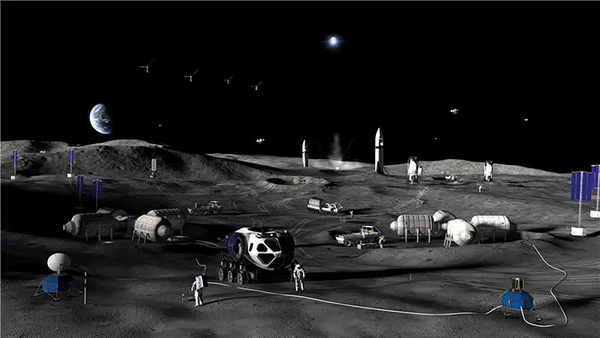
NASA announced which two companies would be tasked to build lunar rovers for its future moon base — as well as the company that will fly them there — among other plans during an event from its Washington headquarters Tuesday.
Blue Origin’s uncrewed Blue Moon MK1 lander, which will launch from Cape Canaveral atop a New Glenn rocket, was given the go to carry a pair of “lunar terrain vehicles,” or rovers, for missions that are part of NASA’s plans to launch before 2030.
Those lunar rovers will be provided by Hawthorne, California-based Venturi Astrolab with its FLEX rover, and Golden, Colorado-based Lunar Outpost with its Pegasus rover, a smaller version of the Eagle rover that made a stop at Kennedy Space Center Visitor Center last year.
Astrolab is partnered with Axiom Space, Interlune and Odyssey Space Research while Lunar Outpost is partnered with General Motors, Goodyear and Leidos.
“What we are embarking upon is extremely challenging, and we know so little from what is a combined 80 hours of lunar astronaut EVA time across the Apollo missions, and that was more than a half century ago,” said NASA Administrator Jared Isaacman. “So we are not jumping right into the glass dome moon base as a service.”
The rover awards were originally expected to be announced last fall, but the Artemis program and plans for a moon base have shifted since Isaacman’s confirmation as the head of the agency in December. In March, he held an event called “Ignition” that outlined NASA priorities, including the moon base, which aims to spend an additional $40 billion into next decade.
“We intend to take an iterative approach, sending a demand signal to industry for a lot of landers and rovers and tech demonstrations and all the scientific payloads these missions can accommodate,” he said.
NASA launched a new website at nasa.gov/moonbase to track moon base announcements.
The rovers are part of Phase 1 of the moon base plans, with missions through 2029 that aim to secure reliable access to the lunar surface and experiment with technology. NASA so far has announced plans for this phase to feature 25 launches, 21 landings carrying 4 metric tons of hardware.
Phase 2, which will establish an initial moon base operating capability, will increase that to 60 metric tons for missions flown from 2029-2032. Phase 3 beyond 2032 will expand that to 150 metric tons with a goal of a semi-permanent crew presence on the moon.
The two rovers will be able to travel a little over 6 mph and have a range of about 200 miles each, which allow for them to travel farther than any previous rover, including those on the moon or Mars.
Carlos García-Galán, NASA’s moon base program executive, said the goal would be to have them there ahead of any crewed landings.
“We’ll certainly try to line it up, so that crew has an LTV to go explore around, so it’s absolutely an objective,” he said.
Blue Origin’s two launches, one for each rover, are worth a total of $468 million while each rover company was awarded $220 million.
Texas-based Intuitive Machines was the odd company out for NASA’s initial rover task orders, although it has several lander mission contract already in play as part of NASA’s Commercial Lunar Payload Services (CLPS) program and several more CLPS task orders are expected later this year.
One other moon base-related program announced was about which company would provide the spacecraft to deliver four “MoonFall” drones being managed by NASA’s Jet Propulsion Laboratory, built on the technology used to construct the Ingenuity Mars helicopter. They will deploy together, but then explore the South Pole independently targeting areas that would be too difficult for rovers to access.
Cedar Park, Texas-based Firefly Aerospace won the award to ferry the drones. It will develop a version of its Dark Elytra spacecraft, the first version of which is already developed and awaiting launch on the company’s next CLPS mission. Firefly was successful with its Blue Ghost lunar lander in 2025 and has its second lander along with the Dark Elytra orbiting transfer vehicle set to launch on the far side of the moon before the end of the year.
NASA also relabeled several existing CLPS missions set to launch this year as “Moon Base 1,” “Moon Base 2” and “Moon Base 3.”
Moon Base 1 is Blue Origin’s first Blue Moon MK1 lander, named Endurance, which is carrying two NASA instruments, and is now targeting launch this fall.
Moon Base 2 is Astrobotic Technology’s Griffin lander launching on a SpaceX Falcon Heavy with what would be the largest lander ever launched. One of its payloads will be Astrolab’s FLIP rover.
Moon Base 3 is Intuitive Machines’ Nova-C lander on its third CLPS mission. The first two were able to make it to the moon, but both tipped over during landing and had limited success. This mission will carry PRISM, which is four NASA payloads headed to the moon’s Reiner Gamma region. Also on board will be a rover and a data relay satellite.
Isaacman highlighted the importance of Blue Origin’s Blue Moon MK1 lander’s initial mission, which is headed to the Shackleton Connecting Ridge, and could help inform where future Artemis missions might land in on the lunar south pole.
It’s also a pathfinder for Blue Origin’s Blue Moon MK2 lander, which is competing with SpaceX’s Starship to be the chosen lander for the human moon landing Artemis IV mission that could fly in 2028.
“The mission objective is to demonstrate critical capabilities that reduce risk for the human landing system missions,” he said. “On that note, every mission in support of the lunar base helps us learn and de-risk crewed missions, but this one is especially important because of the role Blue Origin plays in the Artemis program.”
_____
©2026 Orlando Sentinel. Visit orlandosentinel.com. Distributed by Tribune Content Agency, LLC.



Comments