As Miami federal case unfolds, Alex Saab could become Maduro's biggest problem
Published in News & Features
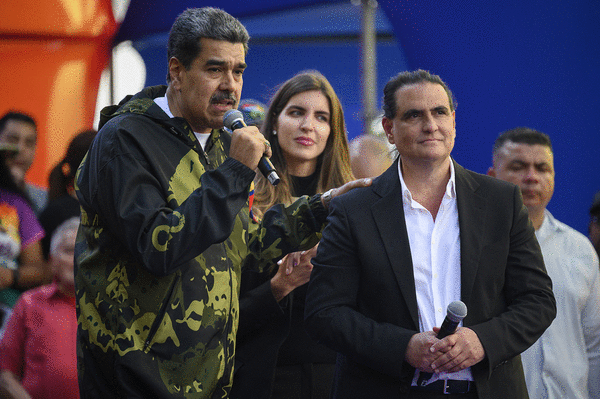
MIAMI — For years, Alex Saab served as Nicolás Maduro’s fixer — the businessman trusted to navigate U.S. sanctions, secure deals and keep money moving as Venezuela’s economy collapsed under international pressure.
Now, as the former Venezuelan minister returns to federal custody in Miami on new money-laundering charges, U.S. investigators are examining whether the man once tasked with shielding Maduro’s financial empire could become the Justice Department’s most valuable weapon against the captured former strongman.
Federal prosecutors and agents have shown significant interest in Saab because they believe he possesses detailed knowledge of Maduro’s financial structure, people familiar with ongoing investigations told the Miami Herald.
That interest comes as the Justice Department pursues a second criminal investigation targeting Maduro, one being conducted out of South Florida and centered in part on potential financial crimes.
The Miami-based probe, under way for months, raises the possibility that Maduro could face additional charges beyond the narcoterrorism and firearms allegations already pending against him in federal court in New York.
Saab, a Colombian businessman who became one of Maduro’s closest commercial partners before serving as Venezuela’s minister of industry and national production, appeared last week in federal court in downtown Miami after being deported from Venezuela.
The new indictment
Prosecutors in the federal Southern District of Florida unsealed a new indictment accusing Saab of participating in a money-laundering conspiracy tied to Venezuela’s CLAP food distribution program — a state-run welfare initiative that U.S. authorities have long alleged became a vehicle for corruption and illicit enrichment.
The single-count indictment builds on earlier allegations surrounding CLAP and extends the alleged criminal conduct through January.
Saab’s return places him once again at the center of a legal and political saga that has spanned several countries and administrations.
He previously spent two years in U.S. custody after being extradited from Cape Verde on money-laundering charges before receiving a presidential pardon from Joe Biden in 2023 and being returned to Venezuela as part of a prisoner exchange with Maduro’s government.
Now, with Maduro himself in U.S. custody and awaiting trial in New York, investigators appear to be reassessing Saab’s potential value.
According to people familiar with the matter quoted by Reuters and CBS News, senior Justice Department officials directed prosecutors in Miami earlier this year to open a new criminal case involving Maduro.
The investigation reportedly began after Maduro had already been brought to the United States following the Jan. 3 military operation that led to his capture alongside his wife, Cilia Flores.
The inquiry is being overseen by veteran Miami prosecutor Michael Berger, who specializes in international criminal matters, working alongside agents from the FBI, Homeland Security Investigations and IRS Criminal Investigation, according to people familiar with the case.
Stronger case against Maduro?
The existence of the South Florida probe has fueled speculation among legal observers that federal authorities may be seeking to strengthen or complement the case already pending against Maduro in Manhattan.
The New York indictment, originally filed in 2020, accuses Maduro of narcoterrorism conspiracy, cocaine importation and weapons-related offenses. Prosecutors claim he provided diplomatic protection and logistical assistance to traffickers involved in moving narcotics.
Maduro has pleaded not guilty.
But some analysts and former officials have questioned the breadth of the narcotics-centered case, noting that much of the cocaine entering the United States bypasses Venezuela and originates elsewhere in the region.
Those concerns, according to people familiar with internal discussions, may help explain why federal authorities have pursued a parallel investigation centered on financial crimes.
One issue privately raised by some Justice Department and White House officials, according to a source familiar with the matter, is that the New York indictment does not include money-laundering charges.
For investigators in South Florida, that omission carries particular significance.
Federal prosecutors in Miami have spent years trying to connect senior Venezuelan officials to illicit financial activity routed through U.S. institutions, though those efforts have often been hindered by the difficulty of tracing shell companies, offshore accounts and international transactions directly to political leaders.
Among the highest-ranking Venezuelan officials successfully prosecuted in Miami was former national treasurer Alejandro Andrade, who in 2018 was sentenced for his role in a billion-dollar bribery and money-laundering scheme tied to Venezuela’s currency controls.
‘Loyal to no one now’
One person familiar with the situation, speaking on condition of anonymity because of the sensitivity of the investigations, said Saab’s latest return to U.S. custody differs sharply from his earlier extradition from Cape Verde.
“The first time, the United States brought him over from Africa while the Venezuelan state was protecting him,” the source said. “This time, the Venezuelan state handed him over — and the Venezuelan state is made up of his partners.”
That reversal, the source said, could fundamentally alter Saab’s calculations as he confronts renewed criminal exposure in Miami.
During his earlier prosecution, Saab ultimately received a presidential pardon and was returned to Venezuela as part of a negotiated prisoner exchange. This time, however, the source said Saab may see far fewer political avenues available.
“He’s loyal to no one now,” the source said. “There are no more bargaining chips left.”
According to the source, Saab understands that the type of political arrangement that secured his release before is unlikely to materialize again.
“A presidential pardon negotiated by Caracas isn’t going to save him this time,” the source said, arguing that Saab may instead pursue the kind of cooperation agreements often sought by defendants facing lengthy federal prison sentences. “The only thing left is to cut a deal.”
The source described Saab as far more than a commercial intermediary, portraying him instead as a central figure in Maduro-era financial and geopolitical dealings whose knowledge could extend well beyond the allegations in the current indictment.
“Alex Saab is Maduro’s front man,” the source said. “He has all the details, all the dirt. He knows everything — the negotiations with Iran, for example.”
The source also pointed to alleged links between Saab’s Mexico-based food procurement operations and broader criminal networks — allegations that have not been charged in the current Miami indictment and remain unproven in court.
According to the source, investigators are interested in whether Saab possesses information about logistics, financial flows and international relationships tied to the CLAP program and related operations.
“He personally ran the operation,” the source said, referring to procurement networks associated with the food program.
Business empire
Saab’s alleged role in Maduro-era business operations has long drawn the attention of investigators.
He was previously identified as an unindicted co-conspirator in a 2021 South Florida case involving bribery and money laundering tied to the CLAP program, according to people familiar with the matter.
For prosecutors, Saab represents more than just another defendant.
He occupies a potentially rare position inside a financial and political system that U.S. investigators have struggled for years to penetrate.
His business empire stretched across food imports, commodities, international contracting and sanctions-era commerce, frequently operating through complex arrangements that investigators believe may hold clues to how money moved through Maduro’s government.
Whether Saab ultimately cooperates or provides information remains unclear. But his renewed legal exposure — combined with the parallel Miami investigation into Maduro — has sharpened attention on what he knows and whether that knowledge could shape the next phase of Washington’s case against Venezuela’s former strongman.
©2026 Miami Herald. Visit at miamiherald.com. Distributed by Tribune Content Agency, LLC.






Comments