Starmer's lame duck status risks policymaking paralysis in UK
Published in News & Features
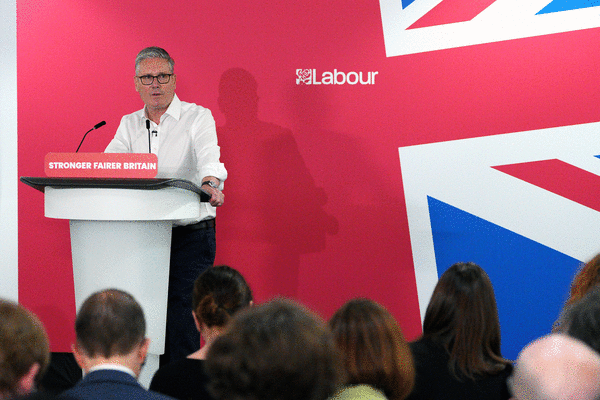
Britain will have to wait weeks, if not months, for confirmation that it’s getting a new prime minister. And the gears of government are starting to slow as the political drama plays out in Westminster.
While the U.K.’s embattled leader, Keir Starmer, has pressed ahead with a new legislative program and a flurry of announcements meant to blunt the impact of inflation, there are doubts in Whitehall about the sustainability of his agenda amid open talk of a leadership challenge. Many are already comparing Starmer’s policy goals against those of leading rivals, such as Greater Manchester Mayor Andy Burnham, and weighing up their chances of surviving a change at the top.
“Nothing very major is going to happen in government until this leadership crisis is resolved,” said Philip Rutnam, a former chief civil servant in the Home Office and current chair of the advisory board at WA Communications, told a panel event in London. “Secretaries of state will be focused on leadership and positioning and their future jobs, rather than the vast volume of papers or stuff the department will give them. That is going to go on for as long as the leadership crisis lasts.”
Starmer’s political support has collapsed in the wake of a devastating round of local elections for his governing Labour Party this month, prompting more than one-fifth of his lawmakers and some in his cabinet to urge him to go. Starmer has vowed to serve the remaining three years of his term, but with bookmakers putting the odds of his departure this year around 70%, many in Parliament and the civil service are looking past him.
One official said that Downing Street had been largely focused on keeping Starmer in place day to day rather than any longer-term planning. Efforts to respond to the Iran war have been set back, for instance, with a crisis meeting between senior ministers canceled at short notice because then-Health Secretary Wes Streeting was preparing to resign, according to people familiar with the matter.
The target date for a summit with the European Union to deepen ties has slipped into July, Bloomberg reported on Friday, amid concern about Starmer’s ability to deliver. One Labour member of Parliament said that Starmer’s controversial visa overhaul, which among other things, would slash the time that highly paid City of London workers must wait to qualify for permanent residency, will likely be frozen until the leadership question is settled.
On Friday, Burnham launched his campaign for the vacant House of Commons seat he needs to challenge Starmer. If successful in the June 18 by-election, he could immediately prompt a contest for leadership of the Labour Party. That could take weeks, especially if the prime minister makes good on his promise to fight.
The result is an extended period of uncertainty similar to mid-2022, when the Conservative government cycled through three prime ministers — Boris Johnson, Liz Truss and Rishi Sunak — in a rolling series of crises. By comparison the lame-duck period in the U.S. between the presidential election and inauguration is about two and a half months.
The yield on 30-year U.K. bonds hit 5.86% earlier this week, its highest level since 1998, reflecting concerns over a new wave of inflation from the energy shock and the fiscal policies of any new prime minister. While gilts staged a recovery, helped by lower oil prices and weaker economic data, the ongoing political uncertainty may curb how far the rally can run.
One official said they were concerned that ministers are not paying adequate attention to the looming increase in food prices and the supply of jet fuel amid the leadership ructions. Both were serious problems that the public does not yet grasp, the official said, and that the political distractions are unhelpful for planning.
Energy Secretary Ed Miliband, who oversees the industries most directly impacted by the closure of the Strait of Hormuz, has emerged as a key player in the efforts to shake up the Labour leadership. Streeting quit shortly after announcing that the government’s efforts to bring down National Health Service waiting lists was bearing new fruit.
Defense Secretary John Healey, a Starmer ally, last week made an usual plea for those in government to put the country’s security before politics. “It’s not about us, not about the insiders of politics, it’s about the interests of the country,” Healey said in a speech.
Upcoming travel for the prime minister and other cabinet members, and planning for foreign summits such Group of Seven and NATO gatherings, has been disrupted too, officials said. It wasn’t possible to seriously prepare for talks with the E.U. about trade relations when Brussels didn’t believe this government would be in place for more than a few weeks, one said.
Last week, Streeting, who has vowed to contest any leadership election, came out in favor a rejoining the E.U., going beyond Starmer’s offer. One senior Labour figure said the former health secretary’s intervention had complicated talks with Brussels.
Starmer intends to use the window before the Makerfield by-election to reassert his authority, touting the cost-of-living package and detailing plans to boost defense spending, according to people familiar with the matter, speaking on condition of anonymity. He’s also due to return to the question of social media regulation and will respond to a review by former cabinet minister Alan Milburn into youth unemployment, the people said.
Still, the threat of paralysis hangs over Whitehall. One official, speaking on condition of anonymity, said civil servants have been debating whether to push policy initiatives through in the dying days of the Starmer administration or whether they should wait for the new leader. An executive for a private rail company, also speaking on condition of anonymity, said there was now a total stop on their interactions with the government. Nothing is happening, the executive said.
Five ministers including Streeting resigned from Starmer’s government this month, along with some ministerial aides. Sorcha Eastwood, an MP for the opposition Alliance Party, was due to meet one of Starmer’s health ministers, Zubir Ahmed, to discuss data-sharing on cancer statistics, but the meeting was canceled when Ahmed quit his post.
“Nothing concrete will happen on delivering sensible policy reforms which are so desperately needed,” said Rupert Yorke, a former deputy chief of staff in 10 Downing Street and now partner at Forward Global. “This is the visible dissipation of power we have seen so many times before.”
____
(With assistance from Ellen Milligan and Alice Gledhill.)
©2026 Bloomberg L.P. Visit bloomberg.com. Distributed by Tribune Content Agency, LLC.




Comments