Thousands evacuated around leaking chemical tank in California's Orange County: 'It fails, or it blows up'
Published in News & Features

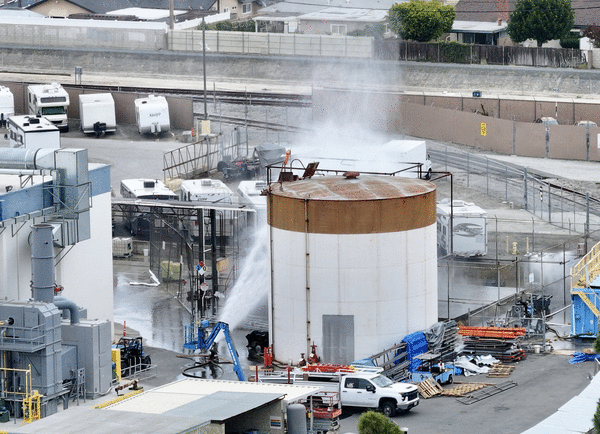

LOS ANGELES — A leaking chemical tank is going to fail or explode in an “unprecedented” event that saw officials order thousands of Orange County residents to evacuate parts of six cities until it happens, authorities announced Friday afternoon.
“At that point, we know the tank is going into thermal runaway,” Orange County Fire Authority Division Chief Craig Covey said during a news conference Friday. “And we’re going to pull everybody out of the area, make sure it’s safe and let the tank do what it’s going to do.”
The fire authority’s hazardous materials response team began dousing the tanks at a Garden Grove facility Thursday, prompting an initial evacuation order that was lifted later that day. But on Friday morning, officials said a faulty valve and the inability to remove and neutralize the toxic chemical inside the tank had escalated the incident and left them certain that the large tank would, at some point, either fail, leaking thousands of gallons, or explode.
“People need to get out of their houses and get into a safe space,” Covey said.
Evacuations around the failing tank in Garden Grove expanded to include tens of thousands of residents in six Orange County cities: Garden Grove, Cypress, Stanton, Anaheim, Buena Park and Westminster.
“We are setting up these evacuations in preparation for these two options: It fails, or it blows up,” Covey said in a video update. “Please follow our requests and orders for evacuations.”
The tank, holding about 6,000 to 7,000 gallons of chemicals, was described as being “in crisis” Friday.
“There are literally two options left remaining,” Covey said. “The tank fails and spills a total of about six to 7,000 gallons of very bad chemicals into the parking lot in that area. Or, two, the tank goes into a thermal runaway and blows up, affecting the tanks around them that have fuel or chemicals in them as well.”
During the news conference Friday, Covey said officials have set up sandbags and other measures to attempt to contain the chemical if it spills, a situation that he described as the current best outcome.
“We’ve done our efforts to keep it from going into the storm drains,” Covey said. “In a weird world, that’s the best case scenario, believe it or not.”
Officials expanded the evacuation zone Friday morning from Ball Road to the north, Trask Avenue to the south, Valley View Street to the west and Dale Street to the east.
Officials urged residents to adhere to the evacuation order for their safety.
While there was no effect to the air on Friday afternoon, officials are continuing to monitor the situation.
The U.S. Environmental Protection Agency deployed stationary air monitors around the facility to measure levels of airborne chemicals. An EPA spokesperson did not immediately respond to an inquiry about whether those monitors had detected methyl methacrylate, the chemical inside the tanks.
South Coast Air Quality Management District staff is also driving its air-monitoring van along the perimeter of the evacuation zone to collect real-time measurements and ensure there are no elevated levels of airborne chemicals in farther-flung areas.
“This information is being shared directly with Orange County Fire Authority to help them assess conditions on the ground, confirm the safety of the current evacuation area, and determine whether any changes to the evacuation zone are necessary,” said Nahal Mogharabi, a spokesperson for the air district.
The air district is also tracking wind conditions and weather patterns that will be critical in determining what areas may be downwind in the event of a chemical release. As of Friday afternoon, the National Weather Service reported light southwesterly winds in the area.
Gov. Gavin Newsom’s news office wrote on X that he had been briefed on the chemical leak and that multiple state agencies have been coordinating with local authorities since Thursday night.
The current plan, Covey said, was for hazmat crews to monitor the temperature of the tank. Officials have recognized a set temperature at which they will pull all crews away from the area.
The tank will then either explode or leak as it expands, ripping the tank.
“We understand that this is frightening,” Garden Grove Mayor Stephanie Klopfenstein said at the news conference. “But the evacuation orders are in place for your safety.”
The chemical leak also prompted the closure of several schools in the Garden Grove Unified School District on Friday, including Rancho Alamitos and Pacifica high schools.
The district also canceled outdoor activities for schools adjacent to the evacuation area, according to a district statement.
The Orange County Fire Authority initially responded to reports of a hazardous materials incident at a business in the 12000 block of Western Avenue at 3:30 p.m. Thursday, according to agency spokesperson Larry Kurtz. Upon arriving at the scene, they determined that methyl methacrylate, a volatile liquid used to make plastic, was leaking out of a 34,000-gallon vat.
Nearby streets were evacuated that afternoon, and residents were allowed to return around 8:30 p.m. However, officials reissued evacuation orders for areas north of Garden Grove Boulevard, east of Springdale Avenue, west of Dale Avenue and south of Orangewood Avenue at 6 a.m. Friday, according to the Orange County Fire Authority.
Crews worked overnight hoping to mitigate the leak, said fire authority Chief TJ McGovern, but whatever progress was made going into Friday morning ultimately wasn’t enough.
“We have a tank that is actively in crisis, for lack of a better word,” Covey said. “The tank that is in the biggest crisis is, in fact, unable to be secured and mitigated.”
McGovern said crews were notified when vapor began to be released from one of the tanks, suggesting the chemical inside was experiencing a rise in temperature and volatility.
Crews were able to use a chemical to neutralize one of three tanks. A second tank was not in crisis but a third, heated to a point that the tank bulged, Covey said.
The valves in that tank, he said, were “gummed up with agent,” and crews have been unable to remove the material or use another chemical to neutralize it.
“There’s nothing else they are capable of doing to mitigate that tank that’s in crisis,” Covey said.
In a Friday morning statement, the agency said it recognized the burdens the evacuations placed on the community and noted that Thursday’s operation to cool the leaking chemical was successful with crews making progress in removing the product.
“However, an inoperable valve on the tank has created additional operational challenges, preventing complete mitigation at this time,” the agency stated.
The incident took place at GKN Aerospace, which builds engine structures, landing gear and other products for commercial and military aircraft.
“The company actually creates acrylic plastics for the aerospace industry, and that’s the reason for the chemical,” Kurtz said. “The problem with this chemical is it is a possible flammable liquid, and it does have exothermic properties.” This means that the chemical can release heat when a reaction is triggered.
A spokesperson for GKN Aerospace said that they are responding to the situation and working with fire crews and specialized hazardous materials teams.
“There are no reports of injuries at this time, and our priority remains the safety of our employees, responders, and the surrounding community,” the spokesperson said. “The situation at our Garden Grove site remains ongoing, and we are fully focused on working with emergency services and the relevant authorities to ensure the safety of our employees and the local community.”
©2026 Los Angeles Times. Visit at latimes.com. Distributed by Tribune Content Agency, LLC.






Comments