NATO welcomes Trump troop pledge as allies caught off guard
Published in News & Features
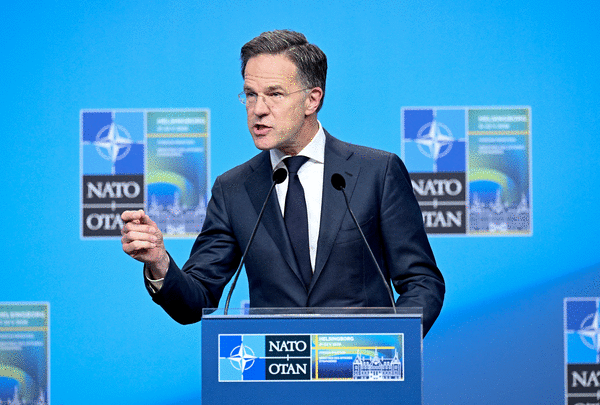
NATO welcomed an abrupt announcement by President Donald Trump to send an additional 5,000 troops to Poland even as the alliance’s top envoys braced for cuts in U.S. military resources.
As allies process the latest White House policy shift, Secretary General Mark Rutte said focus remained on boosting spending to be able to defend European security as the U.S. demands other nations work to protect themselves instead of relying on Washington.
“The money is really coming in,” Rutte told reporters in Helsinborg, Sweden on Friday as NATO foreign ministers gathered. Europeans are meeting their commitment to ratchet up investment to 5% of economic output on defense-related spending, he said.
European allies have been rattled by sudden U.S. decisions on troop reductions in Germany and Poland as a result of Trump’s anger at what he perceives as European reluctance to support his war in Iran. The 5,000 now announced for Poland will be redeployed from U.S. contingents in Germany, according to U.S. Congressman Mike Rogers.
“He’s moving them over,” Rogers, a Republican who chairs the House Armed Services Committee, told Bloomberg. “I’ve been pushing for that for years.”
Trump’s social media announcement Thursday on the new troops that will be sent to Poland — reversing a previous plan to suspend an Army deployment — spurred some relief among NATO members, even if it increased a sense of uncertainty within the alliance.
“It is confusing, indeed — and not always easy to navigate,” Swedish Foreign Minister Maria Malmer Stenergard told reporters on the latest announcement. Several ministers said that they would prefer U.S. moves to be coordinated.
U.S. Secretary of State Marco Rubio said any decisions on drawdowns will take place in the context of “some of the frictions that we’ve had in recent months.” He cited some European governments’ refusal on basing rights as part of the U.S. campaign in Iran.
“When some of those bases are denied to you during a conflict that we’re involved in, then you question whether that value is still there,” Rubio told reporters after the meeting.
Trump said the move on Poland was tied to the country’s election last year of a nationalist president, Karol Nawrocki. The Polish head of state, a Trump ally, had been blindsided by the U.S. announcement that it was suspending the deployment of a brigade combat team to Poland.
Asked about the unpredictable nature of Trump’s decision making, Poland’s foreign minister, Radoslaw Sikorski, responded that it has the effect of making Russian President Vladimir Putin “very uncomfortable.” The defense minister, Wladyslaw Kosiniak-Kamysz, said planning for a new deployment will take two to four weeks.
Trump’s decision marked a U-turn a week after the Pentagon paused plans to send about 4,000 Army soldiers to Poland even though some of them, stationed at Fort Hood, Texas, were already on their way.
Trump had earlier threatened to pull at least 5,000 troops from Germany and suggested a broader drawdown of the U.S.’s 85,000 military personnel in Europe was in the works. That followed a war of words with German Chancellor Friedrich Merz, who said last month that the U.S. was being “humiliated” by Iranian negotiators.
The Pentagon and U.S. European Command didn’t immediately respond to requests for comment on Rogers’s assertion.
Foreign ministers were laying the groundwork for a July 7-8 NATO leaders summit in Ankara, where the alliance plans to showcase increased military capabilities from European allies. Trump, who has repeatedly thrown the U.S. commitment to NATO into question, has made greater spending among allies central to his approach to the alliance.
Canadian Foreign Minister Anita Anand said the meeting made progress in setting up the summit.
“There was a feeling of unity and solidarity in the room,” Anand told Bloomberg, citing NATO’s top military commander as saying the alliance must focus on capabilities rather than troop numbers. He and Rubio “indicated that the U.S. commitment remains steadfast,” she said.
On Friday, the U.S. was expected to announce adjustments to its allies at a meeting in Brussels regarding the U.S. forces set to be made available in case of crisis or war, according to people familiar with the matter. Washington is now expected to cut the troops in NATO’s force model, which isn’t expected to immediately affect troops currently in Europe.
Colonel Martin O’Donnell, a senior U.S. Army officer and spokesman for NATO’s Supreme Headquarters Allied Powers Europe, told Bloomberg that the U.S. announcement would focus on areas where it views Europeans as able to replace capabilities.
----------
—With assistance from Milda Seputyte, Eric Martin and Courtney McBride.
©2026 Bloomberg L.P. Visit bloomberg.com. Distributed by Tribune Content Agency, LLC.





Comments