US sends aircraft carrier Nimitz to the Caribbean as pressure mounts on Cuba
Published in News & Features
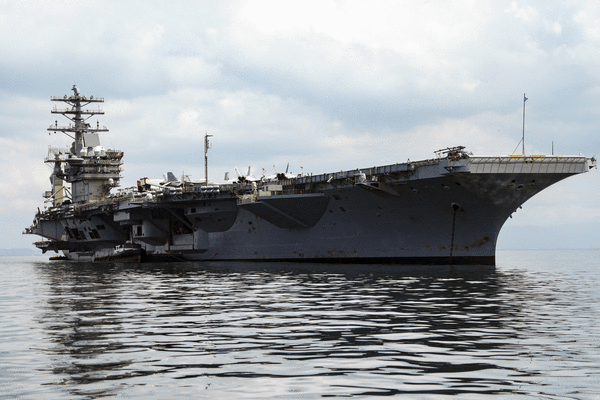
In what appears to be a carefully calibrated show of force, the United States deployed the aircraft carrier USS Nimitz and its accompanying strike group into Caribbean waters this week, a move that coincided with the unsealing of murder charges against former Cuban leader Raúl Castro on Wednesday and an intensifying pressure campaign by the Trump administration against Havana.
The Doral, Florida-based U.S. Southern Command confirmed Wednesday that the Nimitz Carrier Strike Group had entered the region, describing the deployment as a demonstration of American “readiness and presence, unmatched reach and lethality, and strategic advantage.
“Welcome to the Caribbean, Nimitz Carrier Strike Group!” the command posted on social media.
The strike group is centered around the nuclear-powered Nimitz and includes Carrier Air Wing 17, the guided-missile destroyer USS Gridley and the replenishment oiler USNS Patuxent. Its air wing includes F/A-18 Super Hornets, EA-18G Growlers, E-2D Hawkeyes and MH-60 Seahawk helicopters.
The deployment came the same day the U.S. Justice Department unsealed an indictment charging Castro and several other officials with murder and conspiracy in connection with the 1996 shoot-down of two civilian aircraft operated by the Miami-based humanitarian group Brothers to the Rescue.
The attack, which occurred over international waters, killed four men, including three U.S. citizens.
During remarks to reporters Wednesday, President Donald Trump linked the indictment to his administration’s broader focus on Cuba.
“Cuba is on our mind,” Trump said. “It’s very important. It was a very big moment for people, not only Cuban Americans, but people who came from Cuba, that want to go back to Cuba, see their family in Cuba.”
The arrival of the Nimitz has fueled speculation that Washington may be preparing additional measures against Havana, particularly after the January military operation in Caracas that led to the capture of Venezuelan strongman Nicolás Maduro and his wife, Cilia Flores, who were transferred to the United States to face narcoterrorism charges they deny. The aircraft carrier USS Gerald R. Ford played a major role in that operation.
The deployment also comes as the Trump administration quietly pursues negotiations with Havana aimed at securing concessions on political prisoners, migration and economic reforms while simultaneously tightening sanctions and increasing military pressure.
U.S. officials and people familiar with the discussions say Washington has sought to leverage Cuba’s worsening economic crisis — marked by fuel shortages, rolling blackouts and growing social unrest — to extract broader concessions from the island’s communist leadership.
Those efforts intensified in recent weeks after CIA Director John Ratcliffe traveled to Havana for talks with senior Cuban officials, a rare high-level contact between the two governments despite increasingly confrontational rhetoric from Washington. According to people familiar with the discussions, the talks have centered on possible prisoner releases, limited economic openings and security guarantees aimed at avoiding direct military confrontation.
Analysts say the Trump administration appears to be applying a strategy similar to the one used earlier this year against Venezuela’s post-Maduro leadership: combining sanctions, legal pressure, diplomatic contacts and visible military deployments to negotiate from a position of overwhelming leverage. Cuban officials have publicly denounced the approach as coercive while privately signaling interest in easing tensions as the island’s economic crisis deepens.
Havana condemned the indictment against Castro as a “despicable accusation” and accused Washington of using the charges as a pretext for possible military action.
U.S. officials cited by American news outlets said the administration plans to keep the strike group in the Caribbean for several days primarily as a “show of force,” with no immediate combat operation planned. Still, reports that the Pentagon has developed contingency options for possible military action against Cuba have heightened tensions across the region.
Before entering the Caribbean, the Nimitz had been operating off South America as part of Southern Seas 2026, a preplanned deployment involving joint exercises with regional allies including Brazil. The carrier entered the Southern Command’s area of responsibility while sailing from its longtime home port in Washington state toward Norfolk, Virginia, where it is expected to complete its final years of service before decommissioning in 2027.
Despite being more than five decades old, the Nimitz remains one of the Navy’s most powerful ships and is now the longest-serving aircraft carrier in U.S. history.
©2026 Miami Herald. Visit at miamiherald.com. Distributed by Tribune Content Agency, LLC.





Comments