As Islamic Center reopens after deadly attack, San Diego Muslims express uneasiness, defiance
Published in News & Features
SAN DIEGO — San Diego County religious leaders remain on edge in the wake of Monday’s deadly attack at the Islamic Center of San Diego, even as law enforcement officials said they were increasing patrols around houses of worship.
Muslims, in particular, said they felt vulnerable given that the teenage shooters targeted a mosque, violence that came amid recent nationwide increases in Islamophobic threats and rhetoric. But Muslim leaders both locally and nationally also promised to continue practicing their faith with courage, while at the same time preparing for the next hate-fueled attack, which one Muslim security expert acknowledged is “not a matter of ‘if,’ it’s a matter of ‘when.’”
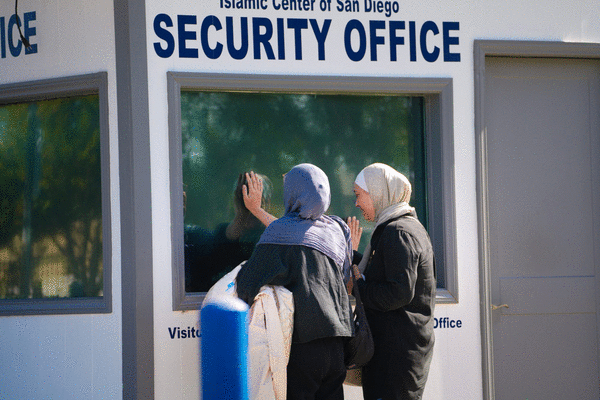
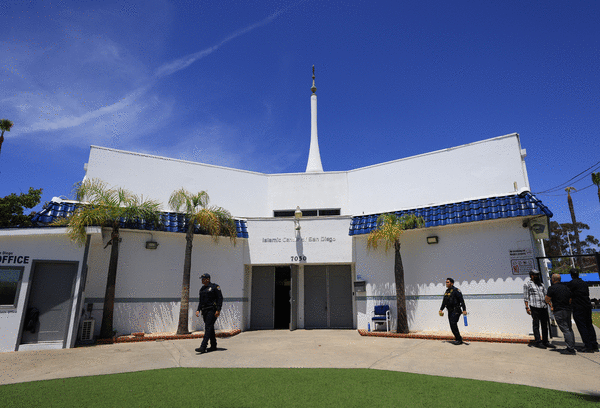
The Islamic Center, located in Clairemont, reopened Wednesday, and worshippers streamed into the mosque in the evening for a sundown prayer. As they entered the center by the hundreds, passing a sidewalk covered in flowers and candles, the mosque’s security officers and at least two San Diego police vehicles were parked outside the building.
Monday’s attack claimed the lives of Mansour Kaziha, a 78-year-old founding member of the center; Nader Awad, 57, who lived across the street and rushed to the center, where his wife is a teacher, when he heard gunfire; and the center’s security guard, 51-year-old Amin Abdullah, who authorities have credited with saving scores of lives by exchanging gunfire with the suspects while initiating lockdown protocols.
Prayer services for the three men were planned for Thursday at Snapdragon Stadium, with burial services to follow.
San Diego police on Wednesday did not provide any new details into their investigation of the shooting, which they are handling as a suspected hate crime.
The attackers, Caleb Liam Vazquez, 18, and Cain Lee Clark, 17, met each other and became radicalized online, according to San Diego police and the FBI. The teens apparently took their own lives a short time after the attack.
Religious site security
Authorities across San Diego County have promised in the wake of Monday’s attack to increase patrols and law enforcement visibility around mosques, synagogues and other places of worship.
“We are one community,” San Diego police Chief Scott Wahl said in a news conference Tuesday. “You’re going to see a visible presence at places of worship throughout our county. Law enforcement is banding together to make sure that there is a feeling of being safe at every place of worship.”
San Diego police did not respond to questions Wednesday about how exactly they’ve gone about increasing law enforcement presence at such sites.
A sheriff’s spokesperson said deputies are “conducting increased patrols near houses of worship, including mosques,” out of an abundance of caution.
“While we cannot discuss specific security tactics, we can assure you that the San Diego County Sheriff’s Office is working closely with our local, state and federal law enforcement partners to evaluate and react to any potential threats,” the spokesperson said in a statement.
El Cajon has long served as a hub for Muslim families, mosques and community-based cultural centers, and is home to one of the largest concentrations of Arab Americans and Iraqi immigrant communities in the country. A police spokesperson said the El Cajon Police Department has assigned a liaison to remain in contact with Muslim leaders across the city.
Congregations can request additional patrols and support through the police liaison if necessary, Lt. Nick Sprecco said, adding that with prayer events planned for Friday at mosques across the city, it is the Police Department’s priority to provide “reassurance and services.”
Still, some Muslim community members in El Cajon are feeling uneasy.
“I’m not feeling safe at all,” said Tasnim Saleh, an office administrator at the Islamic Center of San Diego’s East County location in El Cajon. She said the center has been “almost empty” since Monday’s shooting.
Saleh said the center has no security guard during the week — only on weekends, when large groups gather for prayer and weekend school. The lack of security has left her worried about what could happen ahead of Friday prayers, which she said normally draws the attendance of more than 1,000 people.
“Everyone, especially women, are afraid to leave their homes because we are identified by what we are wearing,” Saleh said, adding that many regular attendees have already expressed that they plan to stay home this weekend.
Escondido police Capt. Erik Witholt said his department has contacted mosques and other prominent religious facilities in the city.
“We’ve ... let them know that we’re going to do extra patrols, and to obviously be vigilant and encourage them to report things that they may not normally report as suspicious,” Witholt said.
He added that the department has an existing faith leaders group that meets on a monthly basis. “We have lines of communication so that they can reach out to us, we can reach out to them,” he said.
While the shooters targeted Muslims, they also authored manifestos expressing hate toward a wide range of ethnic minorities and religions.
In Bankers Hill, Rabbi Scott Meltzer of Ohr Shalom Synagogue said his congregation has increased its security procedures since Monday’s shooting and is taking extra steps to protect worshippers as they continue to offer regularly scheduled prayer services. He said the synagogue is planning to hold an emergency security drill soon.
“We continue to be in close contact with law enforcement,” Meltzer said in a statement. “We’re very fortunate, we have a guard posted ... We’ve also continued to work toward better security in our larger spaces.”
‘He is a warrior’
On Wednesday evening, the Council on American-Islamic Relations, the nation’s largest Muslim civil rights organization, held a nationwide virtual gathering for what one of CAIR’s leaders described as a tough but necessary conversation “about security and self-defense.”
The leaders spoke bluntly about preparing for similar attacks now and in the future.
Nezar Hamze, a sheriff’s deputy in Florida and an expert on mosque security, told the gathered leaders that the top priority for a mosque or any other religious gathering place should be properly trained security personnel.
Before Hamze addressed that and other practical steps that Muslim communities can take to protect their places of worship, the sheriff’s deputy took a moment to praise Abdullah, the guard killed Monday while protecting the Islamic Center of San Diego.
“He is in no way, shape or form a victim; he is a warrior,” Hamze said. He also praised the San Diego mosque for having a safety plan that included an armed guard. “(The plan) was executed, and it worked.”
Nihad Awad, CAIR’s national executive director, also lauded Abdullah, Kaziha and Awad, who authorities said drew the attention of the attackers away from the schoolchildren hiding in the mosque.
“Bless the souls of these three martyrs,” Awad said, warning the other leaders on the call: “We have to be prepared.”
Anti-Islamic sentiment
Monday’s shooting came amid increased reports of threats and crimes against Muslims in the U.S. and worldwide. Israel’s war in Gaza contributed to an uptick in both anti-Muslim and antisemitic sentiment, according to experts, while the U.S.-Israel war in Iran has stirred further anti-Islamic rhetoric.
Last year, CAIR fielded 8,683 discrimination complaints involving Muslims nationwide, according to its latest annual report — the most it had recorded in a year since it started tracking them in 1996.
Just last week, CAIR condemned Republican members of the House Judiciary subcommittee for holding a hearing called “Sharia-Free America: Why Political Islam & Sharia Law are Incompatible with the U.S. Constitution.” CAIR accused Republican Congress members and witnesses of “anti-Muslim fearmongering and dangerous smear tactics.”
Abdullah Tahiri, president of the Muslim Leadership Council of San Diego, said at a news conference Tuesday that the Muslim community was “horrified” by the tragic shooting, but not surprised.
“This bloodshed is the direct and predictable consequence of a political climate that has tolerated ... and actively weaponized anti-Muslim sentiments,” Tahiri said.
President Donald Trump called the shooting “terrible” on Monday as details were still emerging but has not commented publicly on it since. One of his advisers, Laura Loomer, called the Islamic Center of San Diego “evil” following Monday’s shooting, including in her social media post a screenshot of an internet search showing that two of the Sept. 11, 2001, hijackers had worshipped at the Islamic Center of San Diego in 2000.
A report by the 9/11 Commission found that members of the mosque who helped Nawaf al-Hazmi and Khalid al-Mihdhar navigate their new surroundings in the U.S. were “well-meaning” and did not know of their plans.
In 2025, the city of San Diego experienced a 32% decrease in hate crimes overall. But it saw a 150% increase in hate crimes based on religion, from eight in 2024 to 20 in 2025.
The San Diego County district attorney’s office filed 14 hate crime cases last year, down from 20 in 2024 and 30 in 2023. In the last five years, three of the hate crime cases were anti-Muslim.
Still, despite Monday’s attack and the increased hate that Muslims have been experiencing, leaders such as Yusef Miller, a member of the North County Equity and Justice Coalition, said the Islamic community is shaken but resolute.
A frequent critic of overpolicing and excessive law enforcement use of force, Miller said there is a fine balance between protecting mosques but not making them feel militarized.
“It’s a double-edged sword where we have to protect the people who come to the mosque and our wider community,” Miller said. “At the same time, we can’t be deterred by racist and bigoted attacks, anti-Islamic rhetoric or harm. We still will not be deterred from our religious practices.”
_____
(San Diego Union-Tribune staff writer Caleb Lunetta contributed to this report.)
_____
©2026 The San Diego Union-Tribune. Visit sandiegouniontribune.com. Distributed by Tribune Content Agency, LLC.






Comments