Iran threatens to retaliate beyond Middle East if US attacks
Published in News & Features
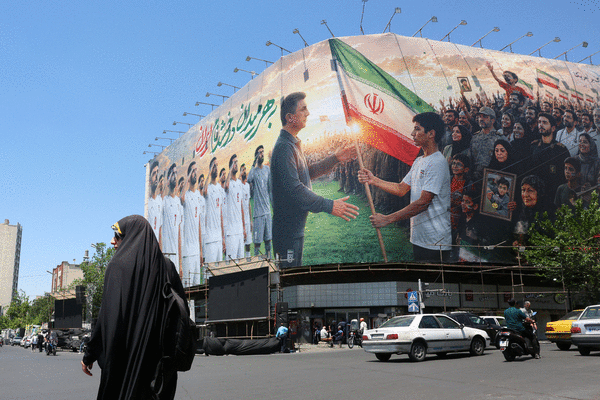
Iran warned it would retaliate beyond the Middle East if the U.S. or Israel attacks it again, following renewed threats from President Donald Trump.
The U.S. and Iran seem deadlocked over how to turn their fragile ceasefire into a more permanent peace, with neither side toning down its belligerent rhetoric in recent days.
Trump said late Tuesday he might order a new round of strikes in the coming days as he tries to force Iran to make concessions over its nuclear program and reopen the Strait of Hormuz to lower energy prices.
“If aggression against Iran is repeated, the regional war that had been promised will this time extend beyond the region,” the Islamic Revolutionary Guard Corps said on Wednesday, according to the semi-official Tasnim news agency. The IRGC, which has gained even more influence over Iranian decision-making since the war erupted in late February, vowed “crushing blows in places you do not expect.”
Iran fired drones and missiles at several countries when the U.S. and Israel began the war. As well as Israel and Gulf Arab states, they included Turkey and Cyprus. While Tehran’s military was battered by airstrikes until a truce was agreed on April 8, it still has the ability to attack other countries.
Iran’s speaker of parliament, Mohammad Bagher Ghalibaf, said the country made the “best use of the ceasefire opportunity” to rebuild its capabilities, according to the semi-official Fars news agency. Iran must “strengthen readiness” for possible attacks, while also boosting economic resilience, he said.
“I hope we don’t have to do the war, but we may have to give them another big hit,” Trump told reporters. When asked how long he would wait, he said: “Two or three days, maybe Friday, Saturday, Sunday. Something maybe early next week.”
On Wednesday, he said he was “in no hurry” to reach a deal with Iran. With regards to Israel, which has signaled it wants another round of attacks on the Islamic Republic at some stage, Trump said Prime Minister Benjamin Netanyahu would “do whatever I want him to do.”
Oil prices fell 3.5% on Wednesday and Brent traded around $107 a barrel. But they remain 75% higher this year. That’s helped trigger a selloff in government bonds across the world in the past week, with traders increasingly concerned about inflation.
Iran has so far refused Trump’s demands to relinquish its highly-enriched uranium or agree to never again process the radioactive metal. Tehran insists on enriching uranium for nuclear energy, while Washington fears it wants to build an atomic bomb, something Iran’s leaders have always denied.
A double naval blockade is also a key point of contention. Tehran wants the U.S. to end its blockade of Iranian ports before it reopens the Strait of Hormuz to commercial traffic, including oil and liquefied natural gas tankers.
“After almost three months of war, Trump’s aims are seemingly far from being achieved, and Iran is emerging bruised but emboldened with newfound global leverage,” Bloomberg Economics analysts Dina Esfandiary, Becca Wasser and Ziad Daoud said. “The risk of further escalation remains as both sides remain too far apart for a deal — but further fighting is unlikely to result in a strategic breakthrough.”
U.S. Vice President JD Vance projected a slightly more positive tone on the negotiations, which Pakistan is mostly mediating, though he said a new round of fighting is possible.
“We think that we’ve made a lot of progress; we think the Iranians want to make a deal,” he said on Tuesday.
Restarting the military campaign is “option B,” Vance said. “But that’s not what the president wants. And I don’t think it’s what the Iranians want either.”
Pakistan’s Interior Minister Mohsin Naqvi is in Tehran for the second time in less than a week for talks with Iranian officials, the state-run Islamic Republic News Agency reported, citing a Pakistani diplomatic source.
On Monday, Trump said he held off fresh strikes at the request of Saudi Arabia, Qatar and the United Arab Emirates — three key U.S. allies in the Middle East.
Iran claimed that 26 ships — tankers, container vessels and others — passed through the Hormuz strait in the last day “with the coordination of and security provided by the IRGC Navy.” That would be an unusually high number for recent weeks, though still far below pre-war levels of traffic. It underscores Iran’s desire to control which ships can and can’t move through the waterway.
The IRGC, which posted a statement on X, didn’t specify where the vessels were headed from, which countries they were going to, or offer evidence for the claim. Earlier, Iranian media said that South Korea had followed China by coordinating with the IRGC to get its ships through the strait safely.
Here’s more related to the Iran war:
•Chinese President Xi Jinping again warned against a resumption of hostilities. “A comprehensive ceasefire is imperative, restarting war is even more unacceptable, and adhering to negotiations is particularly important,” Xi said in Beijing on Wednesday, as he met Russian counterpart Vladimir Putin.
•NATO is discussing the possibility of helping ships pass through the blocked Strait of Hormuz if the waterway isn’t reopened by early July, according to a senior official in the military alliance.
©2026 Bloomberg L.P. Visit bloomberg.com. Distributed by Tribune Content Agency, LLC.




Comments