NYC free preschool applications dip, but more families receive offers close to home
Published in News & Features
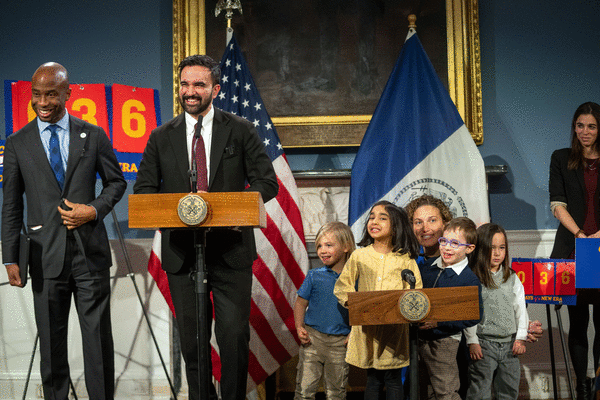
NEW YORK — Fewer New York City families applied for free preschool at the outset of this year’s admissions cycle, despite a full-court press by Mayor Mamdani to encourage more parents to sign up their children.
At the same time, more families received offers from 3-K and pre-K programs that they ranked on their applications, increasing the likelihood parents ultimately enroll their children this fall, according to new data released by Mayor Zohran Mamdani at a press conference Tuesday with Gov. Kathy Hochul.
And even families that did not get a provider they ranked on their list, on average, live closer to that program than in previous years.
“Working parents have frequently had to choose between traveling a significant distance for free childcare or spending more than $20,000 per child per year to stay closer to home,” Mamdani said at the Garden School in Jackson Heights, Queens.
“We want these improvements to serve as examples. Examples that our efforts to rebuild New York City’s childcare system are working. Examples that we can make it easier to raise a child in the city you love without being forced out by rising costs and rising stress.”
The city released initial 3-K offers on Tuesday afternoon, while pre-K offers went out last week. Mamdani is also in the process of opening new 3-K programs, which families can keep signing up for and could reduce commute times even further.
In total, the city has extended more than 99,900 offers so far for free preschool, including to parents who registered after the application deadline.
“We want people who want to be here to be able to afford to stay here,” said Hochul, who allocated $100 million in this year’s budget for the city’s 3-K program, alongside funding to launch a similar initiative for 2-year-olds.
“We’re going to get this done,” she said. “We’re not backing out, and I’m here to commit state resources.”
Parents submitted more than 94,400 applications during the regular admissions cycle, about 400 fewer than last year, the data showed. Given falling birth rates and an exodus of young families, officials estimate that’s a nearly identical percentage of age-eligible children whose parents applied this cycle compared with last year.
Whether the slight dip in applications will result in lower 3-K and pre-K enrollment remains to be seen — though there’s reason for optimism the system is on the right track.
The majority of families, 84%, received an offer from one of their top three 3-K choices, a 4% increase from last year that suggests more parents got placements they’re likely to accept. About 70% of families were matched with their top choice program, which is a 5% increase.
Maureen Stutzman, a mom in Astoria, Queens, got an offer Tuesday at her first-choice program for her 3-year-old son — a much improved outcome over when she last went through the process with her now 7-year-old daughter.
At the time, her daughter was matched with a 3-K site that did not provide after-school, forcing Stutzman, a public defender in housing court in the Bronx, to turn down the city’s offer of free child care. Instead, she paid tens of thousands of dollars out of pocket.
This year, Stutzman, 40, a parent advocate with New Yorkers United for Childcare, is looking forward to saving that money potentially to buy an apartment or save for college.
“To think about reinvesting that into our futures feels really exciting,” she said.
Still, 12% of applicants were placed at 3-K programs to which they did not apply. That’s down 3% since last year, but translates to thousands of families who may decide that, despite Mamdani’s promises, the city’s free childcare system remains out of reach for them.
The mayor said those families shut out of their top choices are still benefiting from being matched to programs closer to home — a claim backed up by the data.
“They saw the average distance decrease by about 17 blocks, and we know that this is critical,” Mamdani said at the news conference. “We’ve heard from families before who said, ‘I live in Bed-Stuy, I’m getting an offer for a center in Astoria — that doesn’t mean much to me.’ And now, we’re actually starting to be able to deliver things that are closer to home.”
This year, fewer than 200 families received 3-K offers outside their home borough, down by more than 500 families since last year. All placements are within three miles from home, the data showed.
Mamdani ran for mayor on a promise to dramatically expand the city’s free childcare offerings.
But fixing the early childhood system is not as easy as opening new programs. Since its launch, 3-K in particular has struggled with a mismatch between where sites are located versus where demand is high — resulting in long waitlists in some zip codes, while providers failed to fill seats in others.
Mamdani blamed his predecessor, ex-Mayor Eric Adams, for scaling back outreach efforts to families. Mamdani launched a public awareness campaign that included in-person registration events, advertisements on public transit and sidewalk kiosks, and social media videos with celebrities, including the YouTuber Ms. Rachel and the rapper Cardi B.
The new data raises fresh questions about whether a lack of awareness about free preschool was the driving factor for empty 3-K seats.
Mamdani on Tuesday continued to blame Adams for cutting the outreach budget and leaving a “bare bones” family engagement team behind in his wake. Mamdani also cited a decrease in immigration and an increase in fear about using city services for the application dip.
The mayor promised a multiyear outreach campaign to “win the trust back” of families.
“The announcements that we’ve made today of how much closer these centers will be, how many more families will have their top choice or their top three choices — that’s how you start to win people back to being a part of the system,” Mamdani said.
Mamdani’s child care czar, Emmy Liss, in an interview with the Daily News after the event, promised to keep doing outreach throughout the summer — both to parents who applied but now have other options, and to those who did not but could benefit from the program, such as families in homeless shelters.
“We do typically see more families come in as we get closer to the first day of school,” Liss said. “So, I think for us, the ultimate measure of success is how many families actually enroll in 3-K this fall. The applications are an important data point, but it’s one data point.”
_____
©2026 New York Daily News. Visit nydailynews.com. Distributed by Tribune Content Agency, LLC.






Comments