CIA director visits Havana and offers economic engagement, but delivers warning
Published in News & Features
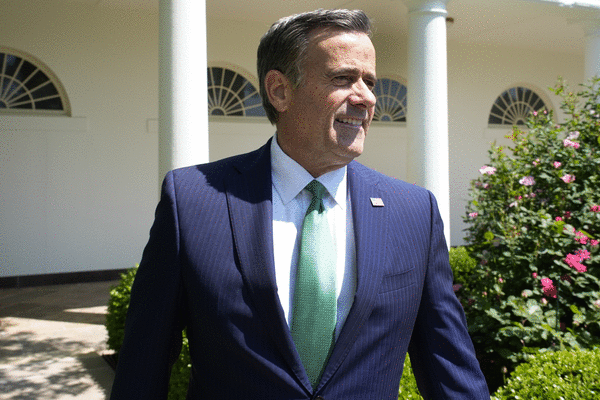
CIA Director John Ratcliffe traveled to Havana on Thursday and met with Raúl Castro’s grandson to deliver a message: The United States’ offer to help Cuba economically is genuine, but it has an expiration date.
Ratcliffe visited Havana to discuss the essential steps the Cuban regime must do to build a productive relationship with the United States, a CIA official told The Miami Herald. The high-level dialogue presents Cuba with a rare chance to stabilize its economy, but the window of opportunity will not stay open indefinitely, the official added.
Ratcliffe met with Raúl Castro grandson Raúl Guillermo Rodriguez Castro, Interior Minister Lazaro Alvarez Casas and the head of Cuba’s intelligence services “to personally deliver President Trump’s message that the United States is prepared to seriously engage on economic and security issues, but only if Cuba makes fundamental changes,” the CIA official said.
According to the official, during the meeting Ratcliffe urged the Cuban officials to seize this opportunity for genuine collaboration. With Venezuela as a backdrop, Ratcliffe emphasized that President Donald Trump would prefer to strike a deal but warned Cuban officials to take the president seriously and that they should be under no illusions that Trump will not take action to enforce red lines, the official added.
During the meeting, Ratcliffe and Cuban officials discussed intelligence cooperation, economic stability and security issues, “all against the backdrop that Cuba can no longer be a safe haven for adversaries in the Western Hemisphere.”
The surprising trip to Cuba of the CIA director takes place amid tension between the two countries, at a moment diplomatic talks appear at a standstill.
In a statement, the Cuban government provided a very different account of the meeting, which it said had been requested by the U.S. government.
The Cuban government said the meeting served to “categorically demonstrate that Cuba poses no threat to U.S. national security, nor are there legitimate grounds to include it on the list of countries that allegedly sponsor terrorism.”
The country’s leader, Miguel Díaz-Canel, had forcefully reacted to U.S. accusations, most recently by Secretary of Defense Pete Hegseth during a recent congressional hearing, that Cuba is a threat to U.S. national security.
Havana insisted that the meeting served to demonstrate that Cuba “does not harbor, support, finance, or permit terrorist or extremist organizations; furthermore, no foreign military or intelligence bases exist on its territory, and it has never supported any hostile activity against the United States, nor will it allow actions to be carried out against any other nation from within Cuba.”
Cuba’s statement did not identify the Cuban officials who met with the CIA director.
According to the Cuban government statement, both delegations expressed interest in developing the cooperation between law enforcement agencies to enhance “the security of both nations, as well as regional and international security.”
Shortly after Cuba published its statement, the State Department announced that Cuban political prisoner Sisi Abascal, a member of the Ladies in White Movement, had been released by Cuban authorities and granted a humanitarian visa to come to the United States with her family.
Earlier in the day, Díaz-Canel announced that Cuba would accept a $100 million humanitarian aid offer from the United States after initially rejecting it.
Ratcliffe’s visit, although unusual, is not unprecented: In 2015, the director of the CIA at the time, John Brennan, secretly traveled to Cuba and met with Col. Alejandro Castro Espín, the son of Raúl Castro.
The CIA station in Havana was reportedly forced to close after agency officials became the target of mysterious health incidents in late 2016 that later became known as Havana Syndrome. Marc Polymeropoulos, a former high-ranking CIA official who suffered one of these incidents – widely suspected to have been attacks with an energy weapon by Russian intelligence officers – said he hoped Ratcliffe raised the issue with the Cuban officials
“I hope CIA Director Ratcliffe is raising Havana Syndrome and the critical injuries CIA officers reported suffering in 2016, as part of any engagement he has with the Cuban regime,” he wrote on X. “Failure to raise this would be a betrayal of the CIA workforce.”
The CIA official said Ratcliffe told the Cuban officials the island can no longer serve as a platform for adversaries to advance hostile agendas in the Western Hemisphere.
©2026 Miami Herald. Visit miamiherald.com. Distributed by Tribune Content Agency, LLC.


Comments