Jared Kushner disappoints Mideast clients who spent millions seeking sway
Published in News & Features
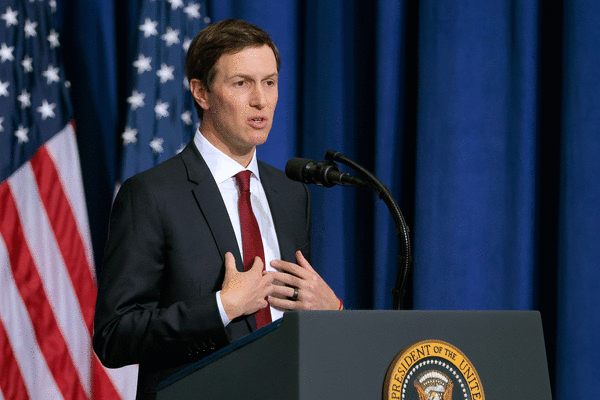
The WhatsApp messages go out, often several times a week, to royals across the Persian Gulf.
The sender: Jared Kushner, envoy for President Donald Trump — and a private investor handling billions of dollars for those same princes and emirs.
Since his father-in-law took the U.S. to war with Iran, he’s engaged in a campaign of official peacemaking and private moneymaking like none in modern American history.
Between attempts to broker peace, Kushner has participated in investment meetings at his private equity firm, Affinity Partners, which manages billions for Qatar, Saudi Arabia and the United Arab Emirates, according to a person familiar with the matter.
Those three energy-rich Gulf states aren’t just longtime allies of Washington but also key Affinity clients: They’ve agreed to pay Kushner’s firm tens of millions of dollars in fees annually in hopes of gaining influence at the White House as well as returns for their portfolios, according to people familiar with the matter. Trump’s decision to move forward with an Iran war that all three opposed shows the constraints of that approach.
According to interviews with more than a dozen people familiar with Kushner’s work and financial relationships in the Gulf, some government officials and wealth fund professionals — especially in Riyadh and Doha — have been disappointed with him given their large investments in Affinity.
Kushner has remained close to the $6 billion Affinity, even though he’s temporarily handed off day-to-day management, people familiar with the business say. During his negotiations with Tehran, the Miami-based firm has slowed but not stopped its hunt for profitable investments. Its goal is the same as ever: to find lucrative opportunities in technology and finance, particularly in the U.S. and Israel, with money mostly from the Gulf. Last year its assets jumped almost 30%, reflecting gains on investments.
“My volunteer work for the President has focused on delivering for America, irrespective of any business or personal relationship, and my commitment to that duty is unwavering,” Kushner said in an emailed statement.
Publicly and privately, Kushner has made clear he has no intention of disclosing more about his finances. He has said that he doesn’t have to, because he’s a volunteer with no formal administration role. White House Counsel Dave Warrington said, “Jared is acting in his capacity as a private citizen, therefore, he is not subject to disclosure requirements.”
That’s an argument his critics say flouts the spirit, if not the letter, of conflict-of-interest laws.
The war, now in its third month, has ground down to a stalemate and the vital Strait of Hormuz remains effectively blocked to shipping. Trump has declared the ceasefire with Iran is on “massive life support” and threatened to resume strikes unless Tehran drops its objections to his peace terms. That leaves Kushner and Steve Witkoff — Trump’s business-minded negotiators on Gaza, Ukraine and now Iran — with much diplomatic work to do.
How the Trump administration has prosecuted the war and Kushner’s direct role in trying to end it have become a point of growing consternation, particularly for officials in Riyadh and Doha, some of the people said. These officials believed that investing in Affinity might give them a greater say in Washington’s affairs in the Middle East. Their expectations haven’t been met, causing them to reassess alliances that go back decades.
The discontent stops short of a full rupture, particularly with the conflict still unresolved. But government officials and wealth fund executives say that the Iran war has exposed the limits of a business partnership that Gulf royals have spent billions to nurture, according to people familiar with the matter.
For now, Kushner remains in close contact with those royals, providing diplomatic and business updates in calls and frequent WhatsApp and Signal messages. His financial interests, today and in the future, now hang over his diplomatic work, his critics say. This has created a fraught backdrop as Trump tries to put an end to the biggest foreign-policy crisis of his presidency.
In Affinity some experts see the starkest example yet of how Trump’s circle has blurred lines between public policy and private profit — and how that can complicate affairs of state.
“The investments in Jared’s firm were meant to anchor ties with the Trump family,” said Sanam Vakil, director of the Middle East and North Africa program at Chatham House, the British think tank that regularly hosts senior regional officials in London. “The Gulf states likely felt very angered, if not let down, that the U.S. didn’t fully consider their security needs.”
White House spokeswoman Anna Kelly said, “Jared Kushner’s volunteer diplomacy efforts are conducted with the highest level of integrity and have nothing to do with his private businesses.” Spokespeople for the governments of Qatar, Saudi Arabia and the UAE didn’t respond to requests for comment.
Kushner has told associates that he can compartmentalize his roles, a person familiar with his thinking said. He has also pointed to the friction with his Gulf backers as evidence that he isn’t just doing their bidding, this person said.
Privately, he has projected a sense of assurance, even vindication, about his ability to manage conflicts without fully disclosing his various interests.
Friends and associates characterize his relatively limited investment experience — before Trump won the 2016 election, Kushner worked for his family’s real-estate company — as an unconventional advantage that gives him a different perspective.
But John Dinkelman, president of the American Foreign Service Association, said the State Department typically polices perceived conflicts even among junior staffers. Kushner’s twin roles place him in a league of his own.
“There would be a question whether we would assign someone to a country where they own an asset, much less deal with decision-making regarding a much larger investment,” says Dinkelman, whose century-old organization represents nearly 17,000 members, including active-duty and retired U.S. Foreign Service officers.
Founded in 2021, Affinity has pulled in most of its assets from Gulf wealth funds and investment firms. Based on standard industry practices, that sum could generate about $60 million in management fees annually. Affinity has invested about 80% of the money it has raised, according to a person familiar with the matter. In March, weeks into the war, it invested in a $575 million fundraising round for Whoop Inc., the wearable health-device maker.
That month, Kushner stepped onto a stage in Miami at a conference funded by Saudi Arabia’s wealth fund, which has now begun to pull back on some high-profile investments, including LIV Golf, a venture praised by Trump, who also spoke at the event. The golf retrenchment is a major shift that reflects the economic strains of the Iran war.
“Peace is not that different from business,” Kushner told the audience. “Both things are puzzles.”
For Kushner and Affinity, those puzzles have gotten trickier. When Trump tapped him last year to help with Ukraine and Gaza, Kushner handed off management at Affinity to two deputies: Luis Videgaray, an ex-finance minister of Mexico, and Asad Naqvi, a former banker at Lazard, according to a person familiar with the matter; Lauren Key, Affinity’s chief financial officer, provides additional support. That team meets with companies and holds quarterly meetings with investors.
Kushner, meantime, is navigating the demands of U.S. allies turned Affinity clients. He has been leaning into personal relationships that he cultivated during the first Trump administration with the ruling Al Saud family of Saudi Arabia, Al Nahyan family of Abu Dhabi and Al Thani family of Qatar, people familiar with the matter said. Affinity was in talks to raise more money from Saudi Arabia’s Public Investment Fund but reversed course as Kushner stayed on as envoy.
The Qataris, in particular, had lobbied the Trump administration to avoid an all-out war with Iran. But Kushner and other Trump advisers eventually sided with one of Affinity's preferred investment destinations: Israel, whose Prime Minister, Benjamin Netanyahu, successfully pressured Trump into a joint campaign against Iran.
Still, rulers in the Gulf see him as a power broker who might help to end a war that they didn’t want, says Ebtesam Al-Ketbi, president of the Abu Dhabi-based Emirates Policy Center, which closely reflects the government’s thinking. Kushner, she adds, is seen as something else, too: “a figure whose business interests now travel with him into every political conversation.”
In private discussions, Kushner has downplayed the tensions. His Gulf clients have left the door open to more business with Affinity, provided the war ends in a peace deal they find acceptable, according to several people familiar with the deliberations. (Officials in the region say there is no real distinction between the region’s royal families and their giant state wealth funds.)
For the Gulf, the conflict is existential. They’ve borne the brunt of Iran’s retaliatory attacks on energy infrastructure — the foundation of their economies — while also facing credible threats to desalination plants that supply most of their drinking water. Experts have warned that sustained strikes on those facilities could trigger shortages, potentially rendering parts of the region temporarily uninhabitable.
Kushner has indicated that his return to Affinity full-time could be delayed if his diplomatic duties expand.
Democrats on Capitol Hill have demanded that he turn over communications with Saudi, Emirati, Qatari and Israeli officials, among other records. Kushner didn’t meet an April 30 deadline to comply, according to a person familiar with the matter, but he could request an extension. Kelly, the White House spokeswoman, dismissed the Democrats’ efforts as “toothless.”
Kushner has taken a defiant stance, arguing that he has complied with Securities and Exchange Commission requirements and has no intention of going beyond them, according to a person familiar with his thinking.
More than a year into the second Trump administration, allies and clients in the Middle East are coming to new understanding about their point person in the U.S.
“The Gulf states are grappling with the fact that their investments didn’t get them influence on something that’s really existential for them,” says Cinzia Bianco, a visiting fellow at the European Council on Foreign Relations. “This will result in them rethinking their investments and pledges going forward.”
--------
—With assistance from Kate Sullivan.
©2026 Bloomberg L.P. Visit bloomberg.com. Distributed by Tribune Content Agency, LLC.




Comments