Cuba's new migration law changes little for Cuban Americans. Here is why
Published in News & Features
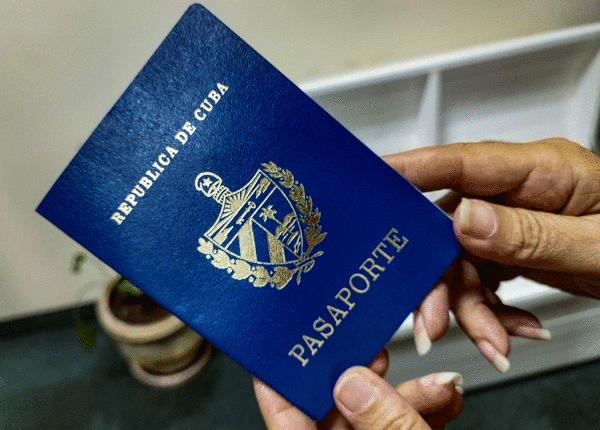
Cuba’s new migration and citizenship laws maintain several restrictions affecting Cuban Americans, including a requirement that Cubans with dual citizenship travel to the country with a Cuban passport and maintaining the government’s broad authority to deny entry to government critics.
The National Assembly passed the laws in July 2024, but the final approved wording was not published in the country’s official gazette until last week, at which time the law became effective. The reasons for the almost-two-year delay are unclear, but the new legislation comes at a time when Cuban authorities have said they welcome Cubans abroad as potential investors and private business owners.
Still, while the new laws include some revisions, they left the controversial passport provision intact, despite long-standing advocacy from many Cuban Americans who had urged the island's authorities to remove it.
In practice, that means that U.S. citizens who were born in Cuba will continue to be regarded as Cuban citizens while they are on the island, which is the current policy — and they can be denied consular services from the U.S. Embassy in Havana if they get in trouble, as the U.S. State Department warns in its travel advice. Such requirements have stopped many Cuban Americans from returning to the island.
The law is clear and leaves nothing to interpretation.
“Cuban citizens, while in the national territory, are governed by that status under the terms established in this Law and cannot make use of a foreign citizenship,” the citizenship law says. “Cuban citizens are obligated to identify themselves as such upon entry into, during their stay within, and upon exit from the national territory, as well as in legal acts carried out within the national territory or before Cuban diplomatic and consular missions abroad.”
The law also warns that people born in Cuba who hold other citizenships “do not enjoy, within the national territory, prerogatives, benefits, or protections related to such citizenships; nor does this constitute an impediment to the exercise of the rights and the fulfillment of the duties provided for in the Constitution of the Republic of Cuba and the laws.”
According to Cuba law, with the exception of children of foreign government officials or international organization employees, people who were born in Cuba are automatically presumed to be Cuban citizens, regardless of whether they have become citizens of other nations. Cuban Americans born on the island can only enter the country only with their American passports if they have gone through the legal process of renouncing their Cuban citizenship.
Earlier this year, Cuba’s minister for foreign investment, Óscar Pérez-Oliva Fraga, announced that Cubans living abroad would be able to own private businesses and make investments in the island. But as a requirement, he said, they needed to acquire the “business or investor” migration status created in the new migration law that had not been published at the time.
The published legislation now shows that acquiring such status will require approval by the Interior Ministry’s migration agency.
The migration law also gives ample leeway to immigration authorities to deny anyone, Cubans and foreigners alike, entry or exit from the country, citing national security or public interest, codifying a practice that has been regularly used by Cuban authorities to ban activists and government critics from leaving or entering the country.
The law made official the loosening of certain restrictions that had already been on hold since the COVID-19 pandemic, including ending a requirement that Cubans could only stay abroad for 24 months if they wanted to keep their residence on the island. But Cuban authorities still make legal distinctions between Cubans who have permanent residence on the island and those who don’t.
The new law is silent about the political rights of Cubans living abroad — who, for example, cannot vote —but an earlier version was amended to clarify that they would be able to enjoy property rights on the island.
©2026 Miami Herald. Visit at miamiherald.com. Distributed by Tribune Content Agency, LLC.






Comments