US sanctions new head of Cuban military firm; Canada's Sherritt mining company suspends Cuba operations
Published in News & Features
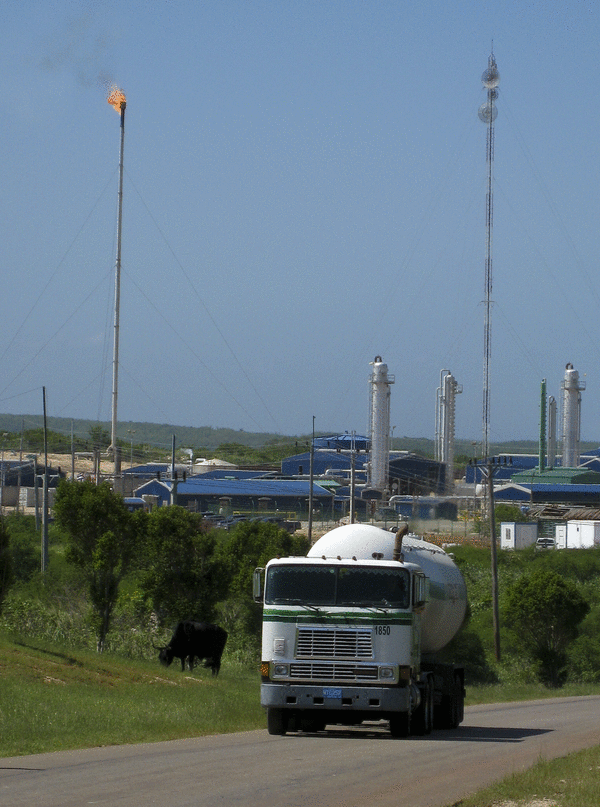
The U.S. State Department imposed sanctions Thursday on the top general who runs Cuba’s largest military conglomerate and a Cuban company involved in a joint venture with Canada’s mining giant Sherritt International, in the first round of sanctions deriving from an executive order signed by President Donald Trump last week.
Earlier in the day, Sherritt announced it was suspending operations in Cuba, where it mines nickel and cobalt, due to the executive order, which threatens sanctions on Cuban and foreign companies doing business in key sectors of the island’s economy, including mining.
The designations, along with Sherritt’s likely exit from Cuba, are ramping up pressure on the Cuban government to strike a deal with the Trump administration, which has been urging Cuban leaders to make economic and political reforms.
Rubio targets GAESA
Secretary of State Marco Rubio said in a statement that he had added the GAESA — short for Grupo de Administración Empresarial S.A — and its president, Gen. Ania Guillermina Lastres Morera, to the Treasury’s blacklist of “Specially Designated Nationals and Blocked Persons.” GAESA and its subsidiaries run a large chunk of Cuba’s economy, including the tourism industry.
“GAESA, a Cuban military-controlled umbrella enterprise, is the heart of Cuba’s kleptocratic communist system,” he said in the statement. “While the Cuban people suffer from hunger, disease and chronic under-investment in critical infrastructure such as its power grid, much of the proceeds of GAESA’s activities are funneled away to hidden overseas bank accounts.”
“According to recent public estimates, GAESA’s revenues are likely more than three times the state’s budget, and GAESA likely controls up to $20 billion in illicit assets,” he said, in reference to a Miami Herald investigation that revealed that the conglomerate had $18 billion in current assets in March 2024.
Lastres, he added,” is responsible for the management of GAESA’s illicit assets held internationally.”
Rubio also added Moa Nickel S.A., a joint venture between Sherritt International Corp. and the Cuban state-owned Compañía General de Níquel, which he said “profits from assets that were originally expropriated by the Cuban regime from U.S. persons and corporations.”
The sanctions mean that U.S. individuals cannot carry out any transactions with the designated entities and that their assets in the U.S. — or assets controlled by a U.S. company or individual — are blocked. The statement also warns that foreign financial institutions dealing with entities or people sanctioned under the executive order’s authority to proceed with “caution.”
“Actions to return assets to a sanctioned party or transfer them to another jurisdiction for potential use by the target could expose non-U.S. persons to significant sanctions risk,” the statement says.
The statement also notes that “the ultimate goal of sanctions is not to punish, but to bring about a positive change in behavior. ”
Sherritt leaving Cuba
Reaction to Trump’s executive order has been immediate.
Before the State Department’s sanctions announcement, Sherritt said in a statement that it had suspended its direct participation in joint venture activities in Cuba, dealing another blow to Cuba’s economy. The company said it was pulling all its foreign employees out of the country and asked its Cuban employees to leave Canada.
The company said Sherritt has not been formally designated under Friday’s executive order but that such a designation “could occur at any time."
“In any event, the mere issuance of the Executive Order itself creates conditions that materially alter the Corporation’s ability to operate in the ordinary course, including activities related to Sherritt’s Cuban joint venture operations,” the company said.
The decision by Sherritt is significant because it shows that the mere threats contained in Trump’s executive order were enough “to prompt proactive disengagement from its operations in Cuba,” said John Kavulich, the president of the U.S.-Trade and Economic Council. Few companies would be likely to fill in the void because of the executive order, he added.
“There will now be additional reasons for companies to avoid Cuba and for those engaging with Cuba to disengage,” he said. “A result will be further pressure for Cuba to make commercial, economic, and financial changes to satisfy President Trump. So, thus far, President Trump 3 and President Miguel Díaz-Canel 0.”
The Canadian company had been doing business with Cuba since 1991 in Moa, in Holguin province, in facilities expropriated by the Cuban government from a U.S. firm, the Freeport Sulphur Company, shortly after Fidel Castro took power in 1959. The U.S. Foreign Claims Settlement Commission certified a property claim related to the Moa site, valued at $88.3 million. In the 1990s, Sherritt executives had their U.S. visas revoked because of the company’s use of the confiscated facilities.
In February, Sherritt said it was reducing its operations in Cuba due to fuel shortages on the island.
Sherritt also has interests in Energas, a Cuban joint venture.
“These sanctions are part of the Trump administration’s comprehensive campaign to address the pressing national security threats posed by Cuba’s communist regime and hold accountable the regime and those who provide it material or financial support,” Rubio said. “Just 90 miles from the American homeland, the Cuban regime has brought the island to ruin and auctioned off the island as a platform for foreign intelligence, military and terror operations. Additional designations can be expected in the following days and weeks.”
_____
©2026 Miami Herald. Visit miamiherald.com. Distributed by Tribune Content Agency, LLC.




Comments