US and Iran trade fire in Gulf, jolting 4-week-old ceasefire
Published in News & Features
WASHINGTON — The U.S. and Iran exchanged fire in the Persian Gulf in a flareup of violence on Monday that also drew in the United Arab Emirates, prompting calls for renewed strikes on Iranian targets and casting doubt on the fate of a four-week ceasefire.
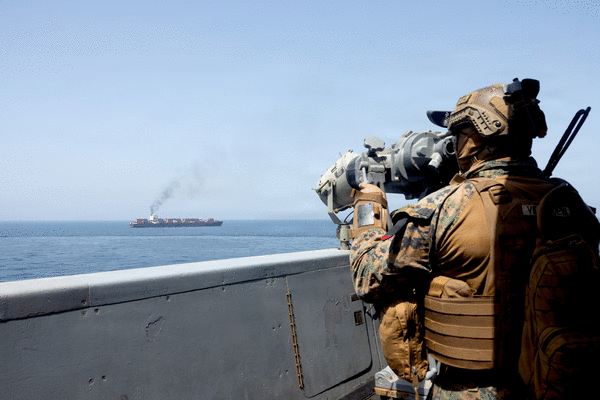
The American military fought off attacks from Iranian drones, missiles and armed small boats as it facilitated the passage of two U.S.-flagged vessels through the Strait of Hormuz, U.S. Central Command chief Admiral Brad Cooper told reporters in a briefing on Monday.
“We’ve shot down seven small Boats or, as they like to call them, ‘fast’ Boats,” President Donald Trump said in a Truth Social post, adding that Defense Secretary Pete Hegseth would hold a press conference on Tuesday. Hegseth will brief reporters at the Pentagon along with General Dan Caine, the chairman of the Joint Chiefs of Staff.
Adding to the tension, the UAE said it intercepted Iranian cruise missiles and blamed an Iranian drone strike for a large fire at its Fujairah port that hospitalized three people. The Gulf state issued several missile alerts to its residents for the first time since the ceasefire between Washington and Tehran began nearly a month ago.
The alerts came after an oil tanker owned by the UAE’s state oil company Abu Dhabi National Oil Co. was struck by Iranian drones in a separate episodes outside the Strait of Hormuz.
Oil prices surged on news that Iran had attacked Fujairah and tankers were under renewed threat in the strait, through which about a fifth of the world’s oil and liquefied natural gas transited before the war began in late February.
International benchmark Brent jumped about 6% to end the session above $114 a barrel, while U.S. crude futures rose more than 4% to settle near $106 a barrel.
The violence shook a ceasefire that has largely held since going into effect on April 8.
It’s also prompted calls for the U.S. and ally Israel to renew attacks on Iran after a campaign that had previously struck thousands of targets, killed Iran’s supreme leader and other top officials, and led to the closing of the vital Strait of Hormuz — causing global energy prices to soar.
On Monday, Senator Lindsey Graham, a South Carolina Republican, said on X that Iran’s choice to attack the UAE and cargo ships “more than justifies a big, strong and short response to inflict further damage on Iran’s war machine.”
In a social media post, former Israeli Prime Minister Naftali Bennett said Iran’s UAE strike amounted to “a declaration of the renewal of Iran’s war against the allies of the United States and Israel across the region.”
Centcom’s Cooper repeatedly declined to address questions about whether the ceasefire had been broken. In a separate briefing on Monday, U.S. ambassador to the United Nations Mike Waltz said he would “defer to to the White House on declaring violations” of the ceasefire.
“It’s a fluid situation,” he added.
In Iran, Foreign Minister Abbas Araghchi said on X Monday night that talks with the Americans were “making progress” but that the U.S. and the UAE “should be wary of being dragged back into quagmire by ill-wishers.”
‘Project Freedom’
When announcing the plans to guide stranded ships out of the Persian Gulf — dubbed Project Freedom — Trump said several countries asked the U.S. for help freeing up their ships.
On Monday afternoon, Trump said commercial ships from around the world had been “kidnapped by a pretty evil place, but we’re taking care of it,” and reiterated the U.S. wouldn’t permit Iran to have a nuclear weapon.
The violence on Monday cast fresh focus on the failure of the U.S. and Iran to come to an agreement on a longer-term deal.
“All of this underscores that the U.S.-Iran ceasefire is fragile,” Bloomberg Economics defense lead Becca Wasser wrote in a research note on Monday. “Our view remains that the most likely outcome is a protracted conflict with ongoing tensions and sporadic fighting keeping oil prices elevated.”
At the center of the dispute is Hormuz, where Iran has blocked almost all shipping traffic. Tehran said it would only reopen the strait after the U.S. lifts a naval blockade on Iranian ports.
Asked about Iranian sea mines in Hormuz, Centcom’s Cooper said “it’s not so extensive” that the U.S. couldn’t use its “exquisite technology to clear a pathway.” He added that the U.S. had used “low-observable capability” to do so, implying the use of underwater drones.
The war, which began on Feb. 28 when the U.S. and Israel started bombing the Islamic Republic, has left more than 5,500 people dead, most of them in Iran and Lebanon.
Here’s more on the war:
— Trump said he’s looking forward to meeting his Chinese counterpart Xi Jinping in mid-May, after the Iran war delayed a previous meeting.
— There were more reports of attacks on ships. A tanker reported being hit by projectiles north of the UAE port Fujairah, according to the UK Maritime Trade Operations. South Korea confirmed an explosion and subsequent fire were reported by a vessel in the Strait of Hormuz, Yonhap reported citing the foreign ministry.
— China has ordered its companies to ignore U.S. sanctions on private refiners linked to the Iranian oil trade, an unprecedented act of defiance that threatens to trap a vast banking sector in the crossfire as tension rises between the world’s largest economies.
_____
(With assistance from Courtney Subramanian, Magdalena Del Valle, Veena Ali-Khan, Omar Tamo, Arsalan Shahla, Devika Krishna Kumar, Carla Canivete and John Harney.)
____
©2026 Bloomberg L.P. Visit bloomberg.com. Distributed by Tribune Content Agency, LLC.






Comments