DeSantis signs law placing new restrictions on teacher unions
Published in News & Features
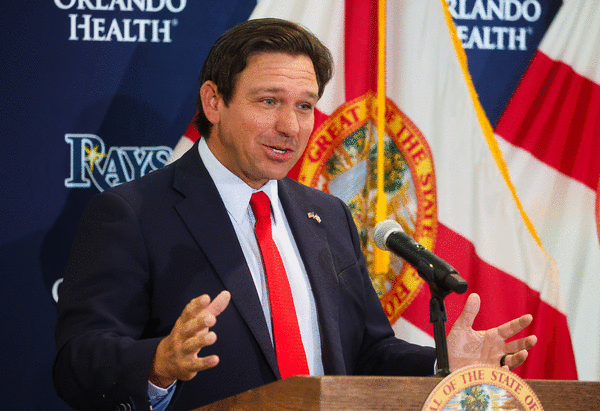
Standing behind a placard declaring Florida “the education state,” Gov. Ron DeSantis on Friday signed into law two measures that make it harder for teachers to collectively bargain pay and working conditions.
The first item (SB 1296) changes the rules for how unions can win and retain their certification, mandating that at least half of all eligible members must vote in elections establishing their existence. That way, DeSantis said, the unions that remain will have demonstrated they represent a majority. The second (HB 1279) removes unions from the discussion as school districts establish pay incentives to bring highly evaluated teachers to low-performing schools.
DeSantis said the effort to bring unions to heel has long been a conservative goal. He called the organizations partisan and argued the unions don’t have the best interests of their members — not to mention schools and students — at heart.
“They’re adopting all these positions as far left as you can. That’s what they see their role as,” DeSantis said during a press conference and signing ceremony at Fort Myers High School. “It leads to a lot of really, really bad things.”
As one example, he pointed to a situation in Lee County, which led its local lawmakers to advance the legislation. Lee district officials sought to provide added pay to teachers who would take jobs at struggling schools, but the teachers union fought the effort, saying it was not allowed without bargaining.
As another, he spoke about his administration’s efforts to place more money from the state budget directly into teacher pay, only to see the funds sit unallocated by districts as they negotiate contracts. A handful remain at impasse now, with the end of the school year approaching.
The unions were “using that money to leverage other things,” DeSantis said. “When I saw that, I was like, we’ve got to do something about it.”
Union leaders deplored the action.
“It’s sad how much they are against the working class in this state. Organized labor is not the enemy,” said Lee Bryant, president of the Pinellas Classroom Teachers Association.
Pinellas has not faced the problems outlined by the bill supporters. It negotiated its teacher pay raises early, and leaders agreed to allow the district to provide incentives for teachers in struggling schools.
The teachers union recertified last year and is in the process of collecting signatures to do so again this year. But participation in the vote hasn’t reached half of eligible voters, raising concerns for future elections.
“It’s not going to have a great turnout unless we are seriously able to spark the interest in unions,” Bryant said, noting that without a union, employees would have their working conditions set unilaterally by the school board.
“I hope it’s a wakeup call,” he said. “I think it will be.”
Andrew Spar, president of the Florida Education Association, an umbrella organization for the local unions, quickly criticized the bill as a betrayal of working-class Floridians. The initiatives have been promoted by the Freedom Foundation, an anti-union national think tank.
Hundreds of workers, including several who identified themselves as loyal Republicans, spoke against the proposal during the legislative session.
“It’s no surprise that the governor has signed this bill right before Teacher Appreciation Week, given how his policies have negatively impacted educators across the state,” Spar said in a statement emailed shortly after the bill signing. “For the past decade, Florida students have suffered under lawmakers who have placed political agendas ahead of students and their families.”
The measure does not impact only teacher unions. During floor debate, lawmakers noted that it also affected a wide range of other public sector workers, such as pipefitters and physicians, while not being imposed on law enforcement and first responders.
That led to a complaint that it creates two tiers of employees with differing rights, which they suggested would be a basis for a court challenge.
_____
©2026 Tampa Bay Times. Visit tampabay.com. Distributed by Tribune Content Agency, LLC.





Comments