Message carved into Colo. high school shooter's shoe invoked 'incel' ideology, experts say
Published in News & Features
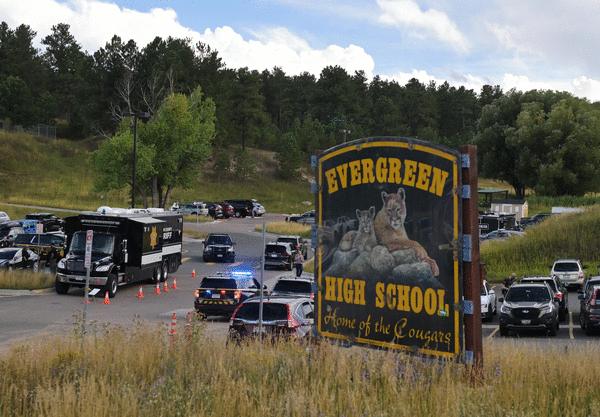
DENVER — A message carved into the shoe of the boy who shot two students and then himself at Evergreen High School last year makes clear the teenager was deeply entrenched in online extremist networks and that his radicalization was central to his attack, experts said.
The 16-year-old attacker had the phrase “ER SENDS HIS REGARDS” carved into the sole of his shoe, according to a report released by the Jefferson County Sheriff’s Office last week in a cache of 664 pages of witness accounts and deputies’ reports about the Sept. 10 shooting that seriously injured two students and left the attacker dead.
That carved message likely refers to Elliot Rodger, a 22-year-old man who killed six people in Isla Vista, California, in 2014 and has become a prominent figure for the “involuntary celibate” or “incel” movement. The largely online group consists primarily of men who blame women and society for their lack of sexual or romantic attention.
Rodger was the first in the modern incel movement to shift from online talk to real-world violence, and has since become an icon in the misogynistic ideology, to the point that extremists use the phrase “Go ER” to refer to committing a mass shooting, experts said.
The message, along with other details released in the reports, confirm that the 16-year-old school shooter was part of a new wave of online extremism known as nihilistic violent extremist networks — groups that focus on using violence to destroy society — and that the radicalization was a core reason he carried out the shooting, said Matt Kriner, executive director of the nonprofit Institute for Countering Digital Extremism.
“This paints a more clear picture of him being embedded in the space as a motivating factor, rather than it being a corresponding factor,” Kriner said. “It goes from a sidecar element, this association, to this is the motorcycle he is driving. This is an essential part of who he is. He is clearly an accelerationist, clearly involved in inceldom and clearly in the nihilistic extremist network.”
The shooter also used a photo of Rodger as the profile picture on at least one of his social media accounts, where he espoused white supremacist and antisemitic views and showed a deep interest in violence and mass shootings.
He showed some “fringe fluidity” by picking and choosing from a variety of extremist ideologies, said Meredith Pruden, an assistant professor at Kennesaw State University who studies the incel movement. White supremacy and male supremacy ideologies are closely connected but distinct, she noted.
“Whether he put that on his shoe right before going to school that day or whether it had been on his shoe for some amount of time, he definitely had, at the very least, admiration for misogynist incel killers, which is important,” she said. “And we need to think about how male supremacism and violent misogyny are dangerous ideologies in their own right.”
The shooter, Desmond Holly, also carved the words “BYE!” and “SMILE” into the soles of his shoes, according to the Jeffco sheriff’s reports. The latter phrase could be related to a white supremacist slogan, “Never lose your smile,” which is usually accompanied by a half-skull image, according to the Anti-Defamation League.
The newly released investigative reports offer some indication that the shooter’s radicalized views seeped into his offline life before the attack.
A friend told investigators that Desmond kept videos on his phone of school shootings set to music, that he made “dark” jokes and discussed neo-Nazis. The friend described the teenager as “pretty racist,” and that he’d paid a “creepy” amount of attention to one fellow student at the school, once secretly taking a photo of the student.
His sister also told investigators that Desmond used the term “femoid,” a derogatory slang term for women that is used within the incel community, and that he’d at one point dated a boy, but seemed to still be figuring out his sexuality. On the day of the attack, Desmond had cut marks up and down the insides of his arms that were in various stages of healing, the reports revealed.
The new reports make clear there were enough warning signs before the attack that adults should have been able to intervene, Kriner said. The FBI was alerted to the attacker’s online extremism two months before the attack, yet was unable to identify the teenager before he acted.
“In retrospect, this is a failure,” Kriner said. “The system failed to prevent an act of violence that could have otherwise been prevented. There was enough there to figure something out and divert this person from what they clearly identified to the world what they were intending to do.”
New details of attack
On the day of the attack, Desmond rode the bus to school and attended his morning classes without incident, the reports show.
The typically quiet, withdrawn student seemed more engaged in his first-period class than usual, English teacher Sarah Murer told investigators. He was talkative and high-energy. In third period, he was similarly engaged. He gave no indication of his plan, teacher Chad Mott said.
Desmond attended lunch, which typically starts around 12:10 p.m. A student who sat at the same table told investigators Desmond appeared “happy,” and held a conversation with another student instead of focusing on his phone. Desmond was at lunch for only a few minutes before he walked away, the student said.
He then apparently made his way to a boy’s bathroom in a hallway in the school known as G-Hall, carrying a backpack that contained an empty 50-round box of .38-caliber ammunition, a butterfly knife and a black T-shirt with the word “Wrath” written in red. He’d posted a photo on social media wearing a shirt with that design a few days before the attack; it is similar to what one of the killers wore in the 1999 massacre at Columbine High School. Desmond wore a large knife on his belt and carried a black fanny pack filled with ammunition.
Evidence suggests Desmond fired a shot from a Smith and Wesson .38 Special revolver into the bathroom ceiling before making his way farther into the school, according to the reports. The revolver — an heirloom that had been kept in a safe in his family’s home — was the only gun Desmond used during the attack, which began around 12:24 p.m. and lasted about nine minutes.
Witnesses saw Desmond emerge from the area near the bathroom and start shooting, according to the reports. He shot a 14-year-old boy on a stairway between the school’s floors. The boy, who has not been publicly identified, was shot twice and fled up the stairs, into and out of the school’s library, and eventually ran out of the school to the Wulf Recreation Center. Teachers and center staff there put the boy on a conference room table and applied pressure to his wounds.
Seventy-three students took shelter in the recreation center, mathematics teacher Alison Meyers told investigators. Other students hid in locked classrooms, ran outside or holed up in homes in the neighborhoods that bordered the school.
The Jefferson County Sheriff’s Office redacted the shooter’s precise movements through the school from a report that detailed his path and has consistently declined to make public the chronology of the attack, so Desmond’s exact route during the shooting remains unclear.
Witnesses, however, described several key moments.
Soon after the lockdown alarm blared through the school, a group of teachers in a teacher’s lounge peered out into the hallway and spotted a student near the library. They urged the boy to take cover in a classroom, and he jogged toward them with his hand in either his pocket or a fanny pack. One of the teachers asked the student what was in his hand, and the student — Desmond — pulled out a gun and shot at them, three witnesses told investigators. The teachers retreated, some taking cover in the room. At least one ran through the school warning of a shooter.
The teenager also at one point approached the room where the Gay-Straight Alliance club met — also in G-Hall — shouted a homophobic slur at the students there and fired at them, two witnesses told investigators.
Desmond eventually exited the school and was locked out. He approached the exterior door for the school’s band room — Door #26 — and peered through the door’s window. Witnesses in the band room said he smiled and waved and greeted one student by name before he fired through the door’s window, then hit the glass with the gun, thrusting the weapon through the broken pane.
Investigators later found five spent casings near the door, and a trail of blood outside the school building that began at the band room’s door, trailed around the north side of the school’s auditorium, went up stairs to the double doors of the auditorium then back down, then around and up stairs to another exterior door labeled #16, and back down, the reports showed.
A few minutes after the attack began, a witness saw Desmond walking down stairs from the outdoor track to the soccer field. He sat on the stairs for a moment before getting up and walking “casually” across the soccer field, Betty Grosbach, who lives nearby, told investigators. She saw the teenager was carrying a handgun and fled as he walked toward South Olive Road.
There, Desmond encountered Matthew Silverstone, an 18-year-old student who ran from the school’s main hallway, where he’d been eating lunch, with a large group of students when the shots began. Silverstone ran to the intersection of South Olive and Buffalo Park roads, then stopped and waited.
Desmond shot Silverstone twice at that intersection as deputies closed in. A deputy and security guard held Desmond at gunpoint and ordered him to drop his weapon. The teenager said that he would, then lifted the gun and shot himself in the head, according to the reports.
Silverstone’s mother, Paige Silverstone, received a phone call from her son’s phone, but he didn’t speak. She stayed on the line for nearly an hour as she heard other people say phrases like “You’re OK,” “Breathe” and “He’s actually got two.” She heard what sounded like an ambulance, but she wasn’t sure whether it was her son who was injured or someone else. She rushed to the reunification center and learned there that her son was in critical condition.
Silverstone and the 14-year-old boy both survived the attack. Desmond died from his self-inflicted injury.
Transparency and prevention
The 664 pages of reports released by the sheriff’s department largely include first-person accounts of the shooting. Officials have chosen not to release particulars of the shooter’s movement through the school, surveillance video of the attack, records made by the shooter, some crime scene photos and records from juvenile victims’ phones, the agency wrote in a February letter.
The sheriff’s office opted to withhold details of the shooter’s path — including both surveillance video and a written description of his movements — out of concern that the details might inspire other school shooters or allow the event to be re-enacted, spokeswoman Jacki Kelley said in an email.
She noted that the sheriff’s office learned lessons in the wake of the shooting at Columbine, which continues to inspire violence nearly three decades later.
“Our hard-won understanding of the importance in being deliberate about the information we release has included expert lessons that certain details can unintentionally memorialize a shooter,” Kelley said in an email.
The decision highlights the near-complete discretion law enforcement agencies have to withhold records from the public in criminal matters.
The process, governed by the Colorado Criminal Justice Records Act, requires law enforcement officials to balance various interests when deciding whether to release a record — including public interest, privacy concerns and investigative value, among other factors.
As long as officials explain their reasoning, they have broad discretion to act as they see fit, and their decisions are very difficult to challenge, said Jeff Roberts, executive director of the Colorado Freedom of Information Coalition.
“Essentially, it is not reviewable,” he said, noting that the process for criminal records is different than records kept by other public entities, which are governed by the Colorado Open Records Act. That law mandates records be released unless particular exemptions apply.
There’s a real danger that details of an attack could feed online radicalized communities, Kriner said.
“That does come up quite a bit, the hyper-detail-oriented review of attackers’ physical movement, the way they did things, it absolutely feeds into a radicalization structure in those communities,” he said. “It can also help them to consider how to do their own target.”
But understanding the details of an attack can also be critical to preventing future attacks, he said, and it is difficult for communities to challenge law enforcement or school officials’ actions and hold them accountable when investigators withhold information. One of the Jefferson County sheriff’s deputies showed up to the attack while drunk, and that information did not become public for months.
The sheriff’s office also characterized the shooter’s parents as uncooperative during the probe, but the released records show the couple answered investigators’ questions about Desmond.
“I’m pleased to see that the sheriff’s office is finally being transparent, and that transparency is illustrating that we were transparent all along,” the family’s attorney, Doug Richards, said Thursday. He declined further comment.
Local law enforcement might also fail to recognize the importance of particular details that, if released, would shift researchers’ understanding of the attack and improve broader prevention efforts, Kriner said.
“There is danger on both sides of this,” he said. “Having the detailed movements like that does provide a kind of blueprint for others to follow or fixate on, but it also means people might not be able to integrate the understanding — like, yeah, maybe there is something about bathrooms that opens up a risk space we should evaluate, or something about how he is moving around the school ahead of time that should have been considered. Like, can you walk us through how an individual was able to carry around a firearm until lunch and then decide to use it? What does that accountability space look like, if (communities) don’t have that information?”
He noted that the response to the Evergreen attack has been “muted” in online extremist forums, and he hasn’t seen the same kind of positive reaction to the Evergreen shooting as other mass-violence attacks.
____
Denver Post staff writer Katie Langford contributed to this report.
____
©2026 MediaNews Group, Inc. Visit at denverpost.com. Distributed by Tribune Content Agency, LLC.




Comments