Virginia Supreme Court considers legality of redistricting election
Published in News & Features
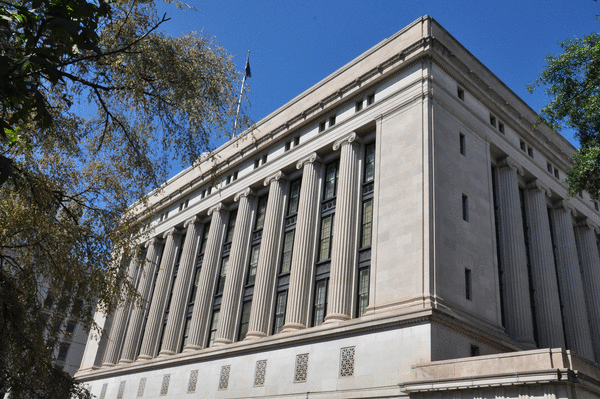
RICHMOND, Va. — The Supreme Court of Virginia heard arguments Monday in a case that challenges the legality of the process used for the April 21 redistricting referendum, with key arguments centered on the timing of the election and the scope of legislative authority used to get the measure on the ballot.
Republicans filed the lawsuit challenging the process used by Virginia Democrats to get the redistricting constitutional amendment on the ballot. It’s one of several Republican-backed legal challenges playing out in court after Virginia voters narrowly approved a Democrat-backed redistricting plan last week that could net four additional Democratic U.S. House seats in the midterm elections.
At the heart of Monday’s hearing was whether Virginia Democrats improperly used a special session on budget-related issues to advance the amendment, and whether the November election counts as a proper intervening election as required in Virginia’s constitution.
In Virginia, amending the constitution requires the General Assembly to pass the measure twice with a House of Delegates election in between. Virginia Democrats maintain they’ve followed the law by first approving the measure in October, followed by a House election in November, and a second vote to approve the amendment in January.
The case pits House Speaker Don Scott against Republican Senate Minority Leader Ryan McDougle. Justices asked attorneys representing both sides whether the November election counts as the intervening election.
Virginia Democrats’ first vote on the amendment took place in October, just days before the Nov. 5 election. Republicans argue Democrats didn’t follow the state constitution as early voting was underway when they passed the amendment for the first time.
Justice Wesley Russell posed a question to Virginia Solicitor General Tillman Breckinridge, who represented Scott, on the timing.
“(Regarding) a constitutional amendment that is adopted at 6 p.m. on Election Day with an hour left, is that still the next general election?” Russell said. “Because, hey, you could have waited until 6:59 to go to the polls to vote. Therefore that’s the next general election, because there’s still 60 minutes left.”
Breckenridge disagreed.
“(The) Commonwealth’s position is to base the decision in the text of the Constitution, which establishes that Election Day is the election, so anything that gets passed must be passed before Election Day.”
Democratic lawyers argue the 45-day early voting period doesn’t violate the intervening election requirement since all votes are counted on Election Day.
“The case that we have here is the General Assembly passed the proposed amendment before the election, where the term ‘election’ is defined in the constitution by five separate provisions, as a single day that takes place in November,” said attorney Matthew Seligman, representing Scott.
Justices also had questions about the duration of the special session, when he General Assembly first voted on the constitutional amendment. In 2024, former Gov. Glenn Youngkin called for a special session to pass a biennium budget, but the scope of the October special session was changed to include the redistricting referendum.
“If you’ve been in special session and we get around to another general session … why doesn’t the general end the special?” Russell asked.
Seligman argued a special session is defined as “something that happens outside of the general session.”
The Virginia constitution allows for a special legislative session either at the governor’s request or a two-thirds majority in both chambers. Thomas McCarthy, representing McDougle, argued that only the governor, not Scott, may convene or expand the scope of a special session.
Seligman, however, said only the legislature can hold itself accountable for its own set of rules.
“This court does not have the power to enforce alleged violations of legislative rules. That principle has been established by the United States Supreme Court and has been established by this court and state courts around the country,” Seligman said.
Another argument from Republicans touched on the requirement that court clerks post notices of the constitutional amendment 90 days before the intervening election, which didn’t happen. But the judges seemed less interested in sorting that one, pointing out whether — hypothetically — one rogue clerk who decides not to post prevents all of Virginia from amending the constitution.
It’s unclear when the justices will rule on the case. The Virginia Board of Elections is slated to certify the election Friday. However, certification of the election was blocked last week in a court order issued on a separate but similar case challenging the election. That case also made its way to the state Supreme Court, but a hearing has not been scheduled.
A separate Republican-led attempt challenging the referendum was thwarted this week in Richmond City Circuit Court. On April 20, the Republican National Committee argued in favor of blocking the General Assembly from repealing the 2021 congressional maps, arguing the new maps aren’t “compact” as required by the state constitution. A court ruling issued Sunday denied that attempt.
_____
©2026 The Virginian-Pilot. Visit at pilotonline.com. Distributed by Tribune Content Agency, LLC.






Comments