Miami Catholics wrestle with faith, politics amid pope-Trump feud
Published in News & Features
MIAMI — Weeks before the clash between Pope Leo XIV and President Donald Trump began, the pope called on all Catholics and people of good will to contact their political leaders to demand an end to the war in Iran. The plea came days after Trump threatened to destroy the entire Iranian civilization — an attack the pope described as “truly unacceptable.”
Ellie Hidalgo, a devout Catholic living in Miami, said that she was one of many people at her parish who heeded the pope’s call. She contacted local elected officials and the White House, asking them to “do everything in their power to bring this war to an end and to negotiate a cease fire,” Hidalgo said.
“I told them that, as a Catholic, my values are to prioritize negotiating peace and ending this war,” she said. “I asked them to do this for our children and grandchildren ... we want peace to protect their futures.”
The compounding offenses from Trump in recent weeks — from calling for the elimination of an entire civilization, to publicly criticizing the pope and posting an image depicting himself as a Christ-like figure — have revealed underlying tension among Catholics, including those who have been the president’s most vocal supporters.
“For Many Christian believers, Catholics and Christian believers, this is a violation in their minds of the first and the second commandments,” which instruct believers to not worship false idols, said Quardricos Bernard Driskell, an ordained minister and professor of religion and politics at The George Washington University Graduate School of Political Management.
The tension between the nation’s two most prominent leaders reveals “just how deeply religion has been politicized in the American political context,” said Driskell. “How much will [Trump’s] religious supporters stick with him to the very end, given all of these varying dynamics?”
The United States Conference of Catholic Bishops rallied behind the pope, saying in a statement that a just war is “defense against another who actively wages war” and that the pope is “preaching the Gospel and exercising his ministry as the Vicar of Christ.”
Miami’s own Archbishop Thomas Wenski reminded the faithful last week that while this isn’t the first time the church has clashed with political leaders, “the pope doesn’t have to please anybody except the Lord.” South Florida is home to over one million Catholics, according to the Archdiocese of Miami or 30% of adults, according to Pew Research Center.
Meanwhile, some Christians in Miami, a place known for its cultural, religious and political diversity, are grappling with something of an identity crisis as the dispute puts their religious and political beliefs at odds.
That’s especially true for Catholics, who have also been reeling from the Trump administration’s decision to defund a refuge run by the Catholic Church for unaccompanied migrant children. The move to defund the program, which benefitted many Cuban children fleeing communism, has sparked outcry from South Florida political and religious leaders — including members of the president’s own party.
“It’s calling into question all of one’s identities at this intersection of politics and culture,” Driskell said.
Humanity over politics
A few days after the pope urged people to call their representatives to oppose ongoing war, Catholics around the world came together for a Saturday prayer vigil to “pray for peace,” which coincided with the pope’s own at St. Peter’s Basilica where tens of thousands gathered.
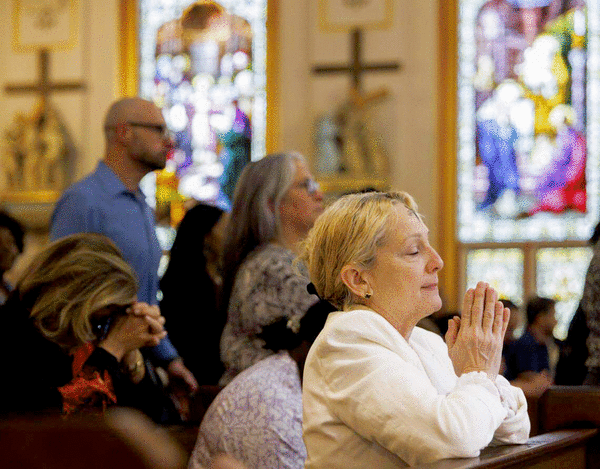
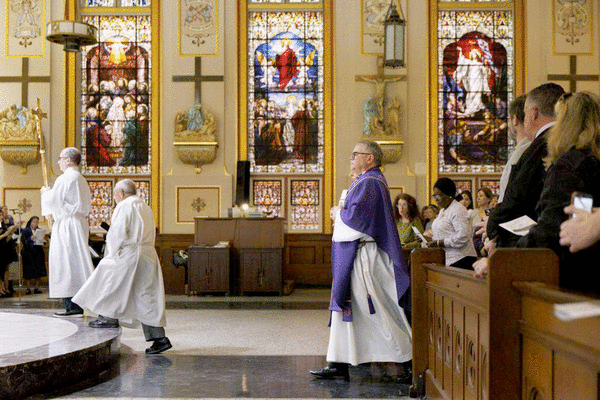
At Hidalgo’s parish, Our Lady of Divine Providence Church, over 100 people showed up to the 8:30am Saturday mass. During the prayer vigil, which was broadcast live by Vatican News and other media outlets, Pope Leo continued his urgent call for ending the war. Speaking about the world’s leaders, he said, “To them we cry out, Stop! It is time for peace! Sit at the table of dialogue and mediation, not at the table where rearmament is planned and deadly actions are decided!”
The uniqueness of the situation, a pope from the United States using the teachings of the Catholic Church to promote civic action, struck Hidalgo as inspiring.
“He’s asking us to fervently pray for peace and for an end to this war, but then also to call our elected representatives and let them know that we want them to work for peace,” Hidalgo said. “For Catholics, it’s such a core part of our Gospel value — ‘Blessed are the peacemakers.’”
Brittany Quintana Marti, a lifelong Miami Catholic and attorney, said she doesn’t see the pope’s calls for a ceasefire as overtly political. For her, the pope’s stance “feels like a very spiritual position,” she said.
“That is the function of religion which is to have people rely on faith and to teach people the golden rule, which is to love your neighbor as yourself. To me, it’s not political. It’s a human dignity type situation,” said Marti, an alum of Our Lady of Lourdes Academy, an all-girls Catholic school in Miami. Marti now regularly attends St. Thomas the Apostle Church with her family.
Marti, who is Cuban American, said she is openly against Trump and expresses opinions that are often in the minority among the parents at her children’s school, who she said lean conservative. Many of Marti’s friends or acquaintances within the Catholic community vote Republican, she said, but that identity is tied to their Hispanic roots, as many have relatives who have fled communist countries.
Their political identity is almost a form of protest, she said: “I am not communist, and therefore I’m Republican. So I am Republican, therefore I am loyal.”
But, the current feud between the pope and the president is perhaps raising questions from friends and family who identify as conservative but are finding it more difficult to support the president, she said.
Marti said this is evident in the private texts she receives from friends or family expressing outrage over the AI-generated photo of Trump looking like a religious figure. She compares these private messages to “a bat signal,” she said. “They feel like they want to almost purge their opinions off their chest.”
“A lot of moms are second guessing, really down to a core level, like, is this the Catholic sort-of teaching that I want to teach my children?” she said. “To behave like these adults?”
Family members disagree over Trump
Raul Rios, 78, a conservative Catholic in Miami, said his support for Trump has not wavered following the disagreements between the two leaders. Rios said he understands the church’s pleas for peace, but in his eyes, the war is a necessary evil.
“President Trump’s philosophy is to beat through strength,” he said, adding that the president had no choice but to “take action,” against the Iranian regime, which has been oppressive towards the people of Iran for decades. “If you do not stop abuse, that’s a sin. It’s the 11th sin, which is omission.”
Rios said he views the pope’s most recent statements about not wanting to “debate” Trump as an apology to the president.
Speaking to reporters over the weekend, the pope said he was not interested in engaging in a debate with the president and said that his trip to Africa is focused instead on peace-building rather than any personal clash.
“The church has its place in the world, but the President of the United States has a very, very big responsibility, because he’s not just a president, he’s the leader of the biggest, most powerful nation,” Rios said.
Rios’ sister-in-law, Mari Tere Brolley — also a devout Catholic and of Cuban descent — has the opposite feelings about the president’s leadership. Brolley described herself as a “card-carrying Republican” for most of her life, but now identifies as an Independent.
“I can’t reconcile being Catholic and being pro Trump,” she said, adding that her own Cuban American friends and family who support Trump “should know better.”
Brolley, a regular parishioner of Saint Francis de Sales Catholic Church in Miami Beach, said she completely supports Leo’s comments about the war and wants to see an even stronger stance from Catholic Church leadership on other issues.
“I think Pope Leo has finally done what the Catholic Church needed to do,” Brolley said.
“[The Catholic Church] should have been preaching Jesus’ teachings as it related to the daily events going on from the very beginning of Trump’s second term. Now they are, but it’s too little too late,” she said.
Christ-like photo sparks backlash
One thing all the Catholics who spoke to the Herald shared was a mutual disgust at the now-deleted AI-generated image Trump posted to his social media depicting him as a Christ-like figure.
But Driskell, the professor, said that the image seemed to offend even many in far-right Christian nationalist groups Trump has always counted on.
Even evangelical faith leaders who’ve been very vocal supporters of President Trump say that “the AI-generated image was blasphemous and a bridge too far,” said Driskell. It might cost him that support, he said.
“This kind of presidential blasphemy, I think is a warning for many of his religious supporters about potential conclusions to the story,” said Driskell.
Trump later deleted the image, saying he had thought it depicted him as a doctor. But by then, religious and political leaders from around the world condemned the image, some calling it a sacrilege.
Even for Rios, who voiced support for Trump’s war efforts against Iran, the AI-photo was not something he can get behind.
“I think that’s totally sacrilegious,” said Rios. “Whoever is using and abusing AI, whether it’s for Trump, for the Pope or my grandmother, I think that is sacrilegious.”
©2026 Miami Herald. Visit at miamiherald.com. Distributed by Tribune Content Agency, LLC.






Comments