California adds 3 new state parks, expands others
Published in News & Features
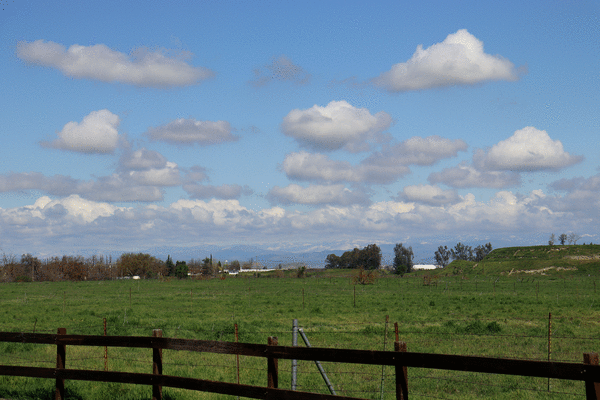
Three new properties, including two located along major rivers in the Central Valley and a former migrant farmworker camp near Bakersfield that was the inspiration for John Steinbeck’s classic novel “The Grapes of Wrath” will become new California state parks, Gov. Gavin Newsom announced Wednesday.
In addition, California also will add roughly 30,000 acres — an area the size of San Francisco — to existing state parks by 2030 under a new law aimed at streamlining parks expansions, he said.
Newsom, working to boost his conservation legacy as the final year of his second term winds down and a widely expected run for president looms, called the news a historic upgrade that will boost California’s state park system, a network of landscapes that includes towering redwood forests, sandy beaches, Lake Tahoe shoreline and Big Sur oceanfront, from 280 to 283 parks.
“As Trump sells out America’s national parks, California is doubling down on protecting the Golden State’s natural beauties,” Newsom said, referring to staffing cuts and budget reductions at national parks during the past two years of President Donald Trump’s administration.
Newsom unveiled the three additions at an Earth Day event in Fresno. They are Feather River Park, a roughly 1,600-acre site south of Marysville in Yuba County on the Feather River that includes a beach and boat launch; the San Joaquin River Parkway, 874 waterfront acres on Fresno’s northern edges along the San Joaquin River; and the Sunset Migratory Labor Camp, a 2-acre property south of Bakersfield that was built in 1937 by the administration of President Franklin Roosevelt to provide housing to hardscrabble farm families who fled the Dust Bowl in Oklahoma and other states seeking a better life in California.
The labor camp, already on the National Register of Historic Places, was run by Tom Collins, to whom Steinbeck dedicated his 1939 Pulitzer Prize-winning book "The Grapes of Wrath."
The three parks mark a rare shift.
Since 2010, under Newsom and former Gov. Jerry Brown, only one new state park has been added anywhere in California, Dos Rios State Park near Modesto in 2024, the longest such stretch of inactivity since 1927 when the state parks department was first established. The state also added one off-highway park for motorcycles during that time, Eastern Kern County Onyx Ranch State Vehicular Recreation Area on the edge of the Mojave Desert in 2014.
For years, both governors have been reluctant to expand the state park system because it involves committing funding to hire new rangers and maintenance workers. Environmental groups and parks advocates, however, have said the lack of new facilities has made it more difficult for working families to book campsites and to enjoy the outdoors as the state population has grown.
The new parks are in the Central Valley, a place that has among the fewest state parks of any part of California.
“We’re bringing more parks to more places,” said Wade Crowfoot, Newsom’s secretary of natural resources, “particularly in the Central Valley, a beautiful region that has too often been overlooked for new parks.”
The parks announced Wednesday are not entirely new, however. All three are already owned by the state or local governments and two already are open to the public.
“It’s great news,” said Bob Doyle, former general manager of the East Bay Regional Park District. “But most of these things are not new acquisition investments. They are transfers that have been in the works for a long time.”
The Feather River Park is land preserved as part of a flood control project in 2009 by the Three Rivers Levee Improvement Authority of Yuba County. Two years ago, Yuba County supervisors banned camping and off-road vehicles there after repeated problems with trash dumping, illegal encampments and trespassing on adjacent private farmlands.
The San Joaquin River Parkway is a collection of several pieces of public land currently owned by the San Joaquin River Conservancy, a state agency. Much of the area is open to boating, hiking and fishing.
The Sunset Migratory Camp, where 300 people derided as “Okies” lived during the late 1930s in one-room tin cabins, is owned by the Housing Authority of Kern County.
The Newsom administration did not say Wednesday when the new properties would officially transfer into state parks ownership. Public meetings will be held this summer with a report required from state parks officials to the governor by the fall with more details.
The announcement did not feature any commitments of new funding for rangers or maintenance workers at the three new parks. Dos Rios State Park, a 2,100-acre property at the confluence of the Tuolumne and and San Joaquin Rivers which the Newsom administration opened in 2024, is only open on Fridays, Saturdays, and Sundays now, although last year new trails were built, and swimming, boating and hiking is allowed.
Highlighting how far the state has fallen short of its goals, in 2009, the state parks department published a report recommending that 11 new state parks be created in the Central Valley by 2030, totaling 22,485 acres of new land with 1,856 new campsites, 1,048 picnic sites and 10 visitors centers.
“Major trends — including significant population growth, shifting ethnic composition and increasingly sedentary lifestyles — all drive the need for more parks,” the report noted. Yet almost none of the goals have been met.
Doyle said that for years, state lawmakers and Newsom have been willing to provide money to nonprofit groups to purchase lands, particularly with bond funds, but have been slow to repair aging facilities at existing state parks or invest in opening new ones.
“What families want is a place to go camping with their kids” he said. “They want the bathrooms not to be broken. They want trails to be maintained.”
On Wednesday Newsom also highlighted a new policy in which state parks will begin purchasing or accepting donations of land adjacent to existing parks under a law, SB 630, that he signed last year to cut red tape. The law speeds a notoriously slow process and allows state parks officials to more easily buy lands for less than $1 million or take free donations from environmental groups if the properties abut existing state parks and won’t require hiring new rangers or other staff.
Under that law, last month state parks officials announced plans to add one mile of oceanfront in San Mateo County to Pigeon Point Lighthouse State Historic Park, expand Mount Diablo State Park near Walnut Creek by 101 acres, and add 453 acres to Montgomery Woods State Reserve in Mendocino County, 218 Acres to South Yuba River State Park in Yuba County, and 31 acres to Big Basin Redwoods State Park in the Santa Cruz Mountains to replace ranger housing lost in the 2020 CZU Lightning Complex Fire.
“Californians need a state park system that can grow and evolve. It’s been static for a while” said Sara Barth, executive director of the Sempervirens Fund, a Los Altos-based group that preserves redwood forests. “These new parks are a symbol of a new era. It’s exciting to see a state parks system that is once again receptive to expansion. But for this to all be manifest there will need to be financial support to care for the land and to make it accessible to the public.”
_____
©2026 MediaNews Group, Inc. Visit at mercurynews.com. Distributed by Tribune Content Agency, LLC.






Comments