Gunman at Mexico's Teotihuacán pyramid was obsessed with Columbine massacre
Published in News & Features
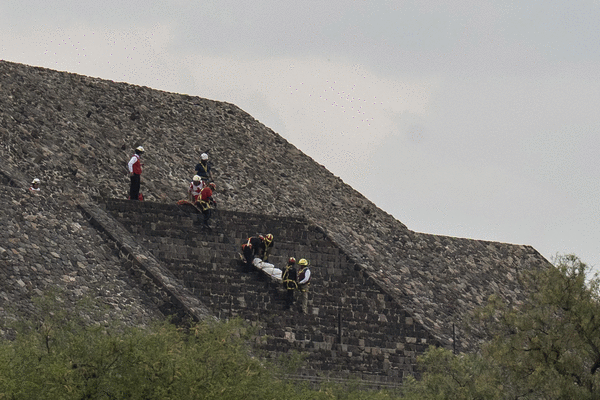
MEXICO CITY — The assailant who opened fire on tourists at one of Mexico's signature archaeological sites — leaving a Canadian woman dead and 13 other foreign visitors injured, including six U.S. citizens — was a copycat who admired mass shooters and meticulously planned the attack, Mexican authorities said Tuesday.
The shooting Monday triggered new fears about Mexico's vital tourist industry at a pivotal moment: The country is gearing up to host matches in June and July during the World Cup, perhaps the globe's premier sporting event.
Authorities have insisted that police have implemented an extensive World Cup security regimen to protect both soccer venues and people. On Monday, officials described the gunfire at the archaeological site of Teotihuacán as the work of a single disturbed man who was obsessed with the Columbine High School massacre in Colorado.
"Everything indicates that this person had traits of psychological problems, and was influenced by episodes that have occurred" outside Mexico, said President Claudia Sheinbaum at her morning news conference.
The official comments came as survivors, including a young couple from Chicago, described frantic efforts to escape the gunman from the 140-foot-tall pyramid.
The assailant, identified as Julio César Jasso Ramírez, 27, shot himself dead as police and troops approached him near the top of the pyramid, authorities said.
After Monday's attack, Mexican officials were quick to repeat assurances of safety for the World Cup and tourism in general.
World Cup matches will be held in three major cities, and hundreds of thousands of soccer fans are expected to descend on Mexico.
"We are convinced that the security of the World Cup is guaranteed," Mexico's federal security chief, Omar García Harfuch, told reporters.
Whether that message allays doubts among soccer aficionados planning to venture here for the games is a major question. Recent headlines and social media posts have contributed to Mexico's image — however overstated — as a place of intractable violence.
The fact that the vast majority of victims of crime in the country are Mexican citizens — and attacks on tourists are relatively rare — may be cold comfort for some.
Monday's bloody incident comes less than two months after rampaging cartel gunmen — enraged about a raid that killed their legendary boss — wreaked havoc across much of the country, effectively paralyzing popular tourist destinations, including the coastal resort of Puerto Vallarta and the city of Guadalajara.
Before the gunman killed himself, scores of panicked tourists clambered down stone stairs and leaped from walls on the famed Pyramid of the Moon in desperate bids to save their lives. Many were injured.
Jalen Aybar and his girlfriend, Jaslim Landaverde, had just smiled for pictures atop the pyramid when they heard the crackle of gunfire.
A woman lay sprawled on the ground nearby. A man wearing a black mask was approaching, holding a raised handgun.
Aybar, a 26-year-old marketing manager, and Landaverde, a 25-year-old store owner, had come to Mexico to attend a concert near the pyramid. Early Monday morning, the couple from Chicago had taken a hot air balloon ride above Teotihuacán, taking in a dramatic sunrise.
Now they found themselves stranded with hundreds of other tourists at the mercy of a gunman whose backpack, authorities said later, contained literature about other mass shootings, including the 1999 Columbine massacre.
Huddled on a stone ledge as the masked gunman took shots at people around them, Aybar whispered in his girlfriend's ear: "We have to jump. We can't just lay here."
It was about a 15-foot drop to the platform below. Without speaking, they leaped.
Landaverde remembers thinking: "If you stand up, you're going to stand out."
She and Aybar completed their first drop safely. But the second time they leaped to a lower platform — Landaverde felt a terrible crunch. She had a broken a foot.
High on adrenaline and fear, she jumped twice more before finally reaching the ground, where a friend that the couple was traveling with hoisted her on his back. They sought shelter at a nearby restaurant.
The shooter had the profile of a "psychopath" and "copycat" who sought to mimic the homicidal actions of mass shooters, said José Luis Cervantes, district attorney for the State of Mexico, where the archaeological zone is situated. Jasso acted alone and there is no indication of "external" or "outside" participation, the prosecutor said.
Media reports indicated that the killer was a far-right fanatic and admirer of Hitler. The attack occurred on April 20, which is both Hitler's birthday and the anniversary of the Columbine school shooting.
The gunman employed a single revolver — a .38 Special Smith & Wesson, dating from 1968, authorities said. He also carried a knife in his backpack. He took an Uber to the murder site and stayed in a nearby hotel, authorities said, and he had scouted the area and planned the attack for days.
All of those injured were foreigners, authorities said. It was unclear whether the shooter targeted foreign visitors deliberately.
The sprawling Teotihuacán complex was closed Tuesday but set to reopen Wednesday with enhanced security, officials said. Apart from being a major tourist draw, the site is an economic linchpin for thousands of workers, vendors and other businesses dependent on the visitor trade.
The 2,000-year-old complex, once home to one of the ancient world's largest urban centers, was abandoned centuries before the rise of the Aztec empire. Archaeologists still debate the reason for its abandonment, a fact that adds to its timeless allure.
Mexico has a much higher homicide rate than the United States and frequently experiences mass violence, often in the context of organized crime.
But Mexico has not traditionally been the site of what experts define as "public mass killings," like what occurred at Columbine, where shooters fired at random in an effort to gain notoriety.
Experts in violence say the largest percentage of such shootings globally occur inside the U.S. but are on the rise in other developed countries, including a recent spate of school shootings in Western Europe.
Adam Lankford, a criminologist at the University of Alabama who has studied the global proliferation of mass shootings, said the internet gives broad access to online communities where mass shooters are idolized.
Lankford's data show a rise in mass shootings globally, with many shootings influenced by killings in the U.S.
"Sometimes the United States has a product, like blue jeans, or McDonald's, that becomes globalized and fashionable everywhere. It's kind of a horrific idea but the same thing can happen with bad behaviors, and that's what the data we collected has shown," Lankford said.
He added that "attacking a national landmark fits the idea of a fame-seeking attack. Picking a symbolic target is a way to almost guarantee yourself more attention."
_____
(Times staffer Cary Schneider and special correspondent Liliana Nieto del Río contributed.)
_____
©2026 Los Angeles Times. Visit latimes.com. Distributed by Tribune Content Agency, LLC.




Comments