US-Iran talks in limbo as clock ticks toward end of truce
Published in News & Features
The U.S. is still in the dark on whether Iran will take part in fresh talks to end the war before a ceasefire expires on Wednesday, with the sides deadlocked on issues including access to the Strait of Hormuz.
U.S. President Donald Trump said Tehran had “no choice” but to send a delegation to negotiations in Pakistan, with his vice president, JD Vance, primed to fly to Islamabad on Tuesday. The U.S. is in a strong negotiating position, he told CNBC, and is “ready to go” with a resumption of bombing if a breakthrough isn’t reached.
Iran has yet to confirm its attendance in Pakistan with Trump’s ceasefire deadline fast approaching, raising the risk of a resumption of fighting in a seven-week war that’s killed thousands of people and triggered a growing energy supply crisis.
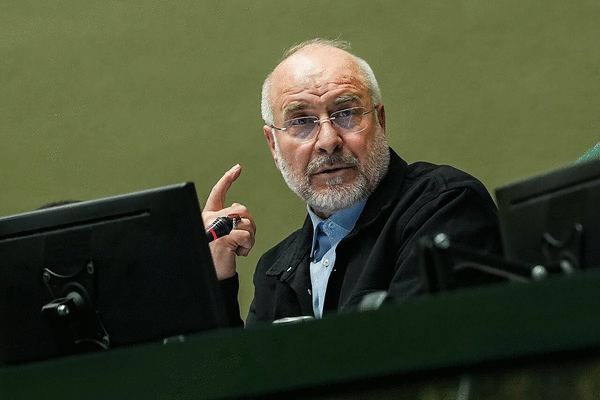
Parliament Speaker Mohammad Bagher Ghalibaf, who led Iran’s delegation during the first round of talks earlier this month, said his country would not “accept negotiations under the shadow of threats.”
Trump said he’s “going to end up with a great deal” and that a U.S. naval blockade on Iranian ports would stay in place until an agreement. He doesn’t want to extend the ceasefire with Iran, which is due to expire late Wednesday U.S. time, he told CNBC.
Referring to the U.S. capture of an unspecified ship on Monday, Trump said it “had some things on it, which wasn’t very nice, a gift from China, perhaps.” He added that this had come as a surprise due to what he called an “understanding” with President Xi Jinping. Trump didn’t provide further details on the incident.
Trump said earlier this month that Xi told him Beijing isn’t providing weapons to Iran. He’s threatened 50% tariffs on goods from countries who do, which could upend the U.S.-China trade relationship if he follows through.
Ghalibaf has said the Strait of Hormuz — through which about a fifth of the world’s oil and liquefied natural gas exports flowed before the war — will remain closed to most commercial traffic for now, as it has since just after the start of the war on Feb. 28.
The standoff underscores the uncertainty surrounding fresh talks, even after Trump previously said negotiations could begin as early as Tuesday. The U.S. president has threatened strikes on Iran’s power infrastructure if diplomacy fails.
A pause in hostilities has mostly held for two weeks after a month of fighting, during which the U.S. and Israel bombed Iran while the Islamic Republic fired missiles and drones across the Persian Gulf, hitting key energy infrastructure. Israel has also largely paused attacks on the Iran-backed Hezbollah group in Lebanon since a truce was agreed last week.
The conflict has hurt Trump politically and lead to fears of an inflation crisis and slower economic growth across the world.
Iranian officials have stopped short of ruling out participation in the talks in Pakistan. It’s possible the sides reach a preliminary agreement to reopen Hormuz and end the U.S. blockade, while leaving longer-term issues related to Iran’s nuclear and missile program to be resolved in later talks.
Oil held steady on Tuesday at just over $95 a barrel and is about a third more costly than before the war began. Prices don’t yet reflect the scale of the supply disruption caused by the Hormuz closure, analysts said, a situation that will only worsen the longer a deal remains elusive.
“The scale seems to be something where the market can’t actually get its head around it,” Trafigura Group’s Chief Economist Saad Rahim said at the FT Commodities Global Summit in Lausanne.
Frederic Lasserre, head of analysis at trader Gunvor Group, said if the war persists for another month, oil markets will hit tank bottoms — a phrase that means markets run out of stockpiles.
Trump’s push for talks contrasts with the tone of Iranian officials, a difference that became more pronounced after the U.S. intercepted and seized an Iranian-flagged cargo vessel on Sunday. Iran said last week it would reopen the Strait of Hormuz, only to reverse the decision hours later as the blockade on its own ships persisted.
Beyond Hormuz, another fraught issue is Iran’s nuclear program. Trump has demanded that Iran forswear any ambitions for a nuclear weapon and hand over stockpiles of enriched uranium. Tehran has balked at giving up its uranium and has said its nuclear program is for peaceful purposes.
Trump and advisers see his varying comments about what might happen if the ceasefire deadline lapses as creating strategic ambiguity that the U.S. could exploit in talks, said a White House official, who requested anonymity to describe internal thinking.
Yet that uncertainty could create misunderstandings with Iranian negotiators, who are also grappling with internal divisions among the country’s leaders.
Conservative elements within the Iranian government and military leadership, including those at the top of the Islamic Revolutionary Guard Corps, have taken the continuation of the U.S. blockade as a further signal that Trump can’t be trusted, according to U.S. and Iranian officials.
The IRGC’s leader, Ahmad Vahidi, is pushing for a tough negotiating stance, people familiar with the dynamics said.
There is a divide between the likes of Vahidi and less ideological figures, such as President Masoud Pezeshkian and Foreign Minister Abbas Araghchi, who are more inclined to reach an accord with Washington, said the U.S. and Iranian officials, asking not to be named because of the sensitivity of the matter.
Trump is also facing pressure at home to end the war, with polls showing most Americans disapprove of the conflict. The president campaigned on keeping the U.S. out of foreign entanglements and lowering consumer prices, two pledges strained by his decision to start the war.
He has sought to assuage those worries, insisting that fuel prices will fall quickly once the war ends and that the U.S. is not embroiled in a years-long conflict. U.S. gasoline pump prices have risen above $4 a gallon on average, the highest level in almost four years.
----------
—With assistance from Elaine To, Thomas Hall, Jon Herskovitz, Arsalan Shahla and Michelle Jamrisko.
©2026 Bloomberg L.P. Visit bloomberg.com. Distributed by Tribune Content Agency, LLC.




Comments