With planned GPS launch, Space Force turns again to SpaceX amid ULA Vulcan issues
Published in News & Features
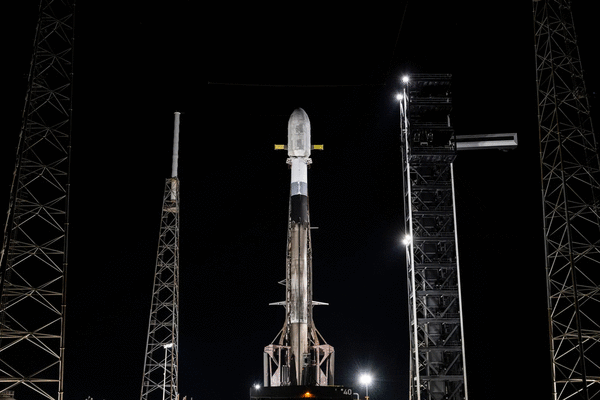
Once again, the Space Force is turning to SpaceX to get its national security hardware into space with a GPS satellite launch planned in the overnight hours early Tuesday.
A SpaceX Falcon 9 is aiming to lift off from Cape Canaveral Space Force Station’s Space Launch Complex 40 during a 15-minute window that opens at 2:53 a.m. Eastern time on the GPS III-8 mission, headed to medium-Earth orbit.
The launch comes after a one-day delay because of severe weather Monday morning. Space Launch Delta 45’s weather squadron forecasts a 90% chance for good conditions Tuesday, but those chances drop slightly to 85% if delayed to Wednesday morning.
The first-stage booster for the flight is making its seventh trip to space and will aim for a recovery landing downrange on the droneship Just Read the Instructions stationed in the Atlantic.
This is the last of the GPS III series built by Lockheed Martin. It’s heading up to become part of 32 active satellites in orbit at about 11,000 miles altitude, with the most recent having about 15-year lifespan, according to Space Force Col. Stephen Hobbs, commander of Mission Delta 31, who heads up the GPS satellite program.
“Closing out the GPS III block is not the end of the story, but rather it’s a foundation for what comes next,” he said. “We’re excited to turn the page and continue advancing our mission with the GPS 3F generation, bringing even greater capability to the joint force and to the global users who rely on this system every single day.”
The first of the new GPS IIIF satellites is expected to launch in 2027. For now, it’s assigned to launch on a ULA Vulcan, but it’s possible the Space Force may need to switch it to SpaceX.
That’s been the move the Space Force has done for this GPS mission as well as three previous, starting with the Rapid Response Trailblazer launch in December 2024 and followed by the GPS III-8 mission in May 2025 and GPS III-9 mission this past January.
One benefit of the switch has been testing out how quickly Lockheed Martin and SpaceX can get a satellite ready and into space.
It’s been only three months since the last SpaceX launch of a GPS satellite, said Anne Mason, SpaceX’s director of its National Security Space Launch program.
The company has launched nine of the 10 satellites in this GPS III constellation, including four in the last 16 months, “all on accelerated timelines for the Space Force, each time decreasing our rapid response while it’s still ensuring safe delivery to orbit.”
She credited SpaceX’s fleet of flight-ready Falcon 9 rockets.
“It’s important to emphasize that our launch cadence and reliability is only made possible with our laser focus on safety for every national security mission,” she said.
The satellite, which is the 10th of the GPS III series, has been nicknamed “Hedy Lamarr” by the Space Force, in honor of the Hollywood actress and Florida resident who was also the inventor alongside composer George Antheil of a patented frequency-hopping technology in 1941 that laid the foundation for modern wireless communication.
Fang Qian, Lockheed Martin’s vice president of its GPS program, said this satellite will feature anti-jam capability that’s eight times stronger and three times more accurate than the legacy spacecraft on orbit today.
It will also be the first GPS satellite equipped with optical cross-link technology, which for now will be tested with ground stations, but in the future would allow for satellites in the constellation to communicate with one another, a safeguard against interruptions in communication from Earth. It also has a more robust atomic clock that allows for more precision timekeeping.
“These payloads go beyond incremental gains and are aimed at establishing a foundation for the next generation IIIF satellites,” she said.
Lockheed Martin is contracted for the first 22 of up to another 32 satellites in the GPS IIIF series.
USSF Col. Ryan Hiserote, the National Security Space Launch program manager and commander of Space Systems Command’s System Delta 80, said the GPS constellation serves the military, but is one of the most beneficial to the civilian population.
“This system is the gold standard for global navigation, and this launch ensures its continued service for billions of users and guarantees a tactical edge for our war fighters around the world,” he said.
SpaceX has been the Space Force’s go-to launch provider of late, as United Launch Alliance’s Vulcan rocket suffered an issue with its boosters on its only flight this year, the USSF-87 mission in February.
That mission as well as Tuesday’s GPS launch are among those awarded under the NSSL Phase 2 contract, which handed out 48 task orders between fiscal years 2020-2024. All of those missions were targeting launches between 2022-26, but so far only 14 have flown so far.
SpaceX, which only received 22 of the 48 contracts, has managed 11 of those with Tuesday’s GPS launch marking its 12th.
ULA, though, was delayed because of development issues with its Vulcan rocket, a replacement for its Atlas V and Delta IV class of rockets.
Vulcan only made its debut in 2024 and didn’t receive certification until spring 2025, so its first national security mission came three years late.
ULA has since only managed two Vulcan national security launches. The last one, though, saw the nozzle on one of its solid rocket boosters burn through on liftoff, and despite the rocket getting its Space Force payload to orbit, officials said they would halt Vulcan launches until ULA figured out its booster problem.
Vulcan’s issues are putting a damper on Space Force’s needs, said Hiserote.
“The Vulcan Anomaly certainly throw a wrench into our plan manifest,” he said. “We’re continuing to evaluate that. You know, how many we get to this year? I couldn’t tell you at this time, so we’ll keep everyone apprised of status as much as we can. But you know, we’re kind of still investigating that.”
With Vulcan still tasked with 23 of those Phase 2 launches (one mission — a nuclear propulsion spacecraft test flight — has since been canceled), the Space Force has also been handing to SpaceX the lion’s share of task orders for the new five-year round of contracts — Phase 3 — that began to be awarded in fiscal year 2025.
Two years into that contract, SpaceX has been given 12 of 16 task orders total with ULA getting the other four. Blue Origin’s New Glenn is technically open for the lucrative orders as well, but its heavy-lift rocket is taking a long track to certification opting for a four-launch approach as opposed to the normal two launches required by the Space Force.
But even that path for Blue Origin has hit a bump in the road after this past Sunday’s NG-3 mission saw a failure in its upper stage that left its payload in too low of an orbit. The Federal Aviation Administration has since grounded New Glenn after classifying the mission as a “mishap” that requires an investigation.
It just adds to the Space Force’s potential headaches down the line as it tries to knock out its long list of missions, but with only one active launch provider available at the moment.
After Tuesday’s launch, the Space Force already has 55 missions among all providers on order through 2029, with at least another 50 missions to be assigned in the next three years.
All three of SpaceX, ULA and Blue Origin are expected to eventually cash in on the fully promised amount that tops $13.7 billion under Phase 3’s “Lane 2” missions, a more demanding slate of flights for which only SpaceX’s Falcon 9, Falcon Heavy, ULA’s Vulcan and Blue Origin’s New Glenn are eligible.
When announced, the Space Force said from that total, it would dole out to SpaceX more than $5.9 billion, ULA more than $5.3 billion and Blue Origin nearly $2.4 billion among more than 54 expected “Lane 2” missions to be awarded through fiscal year 2029. This is on top of a less demanding side set of missions called “Lane 1” worth another $5.6 billion across 30 orders that conceivably opens the door for less proven providers, like Rocket Lab and Firefly Aerospace, on top of the traditional providers. Thus far, though, the Space Force has still awarded all of those missions to SpaceX.
The general timeline has been for missions to be flown two to three years after they are awarded.
“As the Vulcan anomaly investigation is going on, we are continuing to look at the manifest writ large,” Hiserote said. “But as far as predicting out launch dates and things like that for next year and beyond, we’re not ready to talk about about that.”
_____
©2026 Orlando Sentinel. Visit orlandosentinel.com. Distributed by Tribune Content Agency, LLC.






Comments