New NYPD committee to study racial disparities in street stops
Published in News & Features
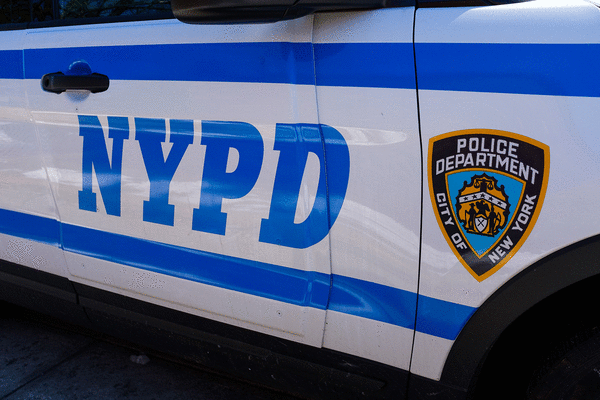
Two academics have been tapped to analyze disparities in police street stops, the latest attempt to make sure officers don’t engage in racial profiling, according to the NYPD’s federal monitor.
The recently formed Racial Disparities Review Committee comes nearly 13 years after a federal judge ruled that the stop-and-frisk tactics of the nation’s largest police force violated the constitutional rights of minorities.
The NYPD since then has adapted numerous court-ordered reforms. But the federal monitor in place since that ruling has repeatedly said that even when officers conduct a legally justified stop, the subsequent frisk or more invasive search is too often not justified.
Enter Prof. Sharad Goel of the Harvard Kennedy School and Associate Prof. Alex Cholas-Wood of New York University.
Goel, who teaches public policy, will serve as an adviser to the committee while Cholas-Wood, who specializes in computational science, will support implementation of the Fourteenth Amendment compliance plan.
Goel did not respond to requests for comment and Cholas-Wood noted that he started working for the committee March 19 and referred questions to the NYPD. The department also did not respond to requests for comment but has routinely said it does not engage in racial profiling.
The monitor has repeatedly found that officers in specialized units, tasked largely with getting guns off the street, have a higher rate of unconstitutional stops than those of patrol cops, who conduct stops in response to a specific suspect description.
The monitor has noted, most recently in a February report, that while official internal reviews conducted by the NYPD’s Quality Assurance Division generally align with the monitor’s findings, the front-line supervisors who first assess street stops approve “nearly all stops, frisks, and searches, including unlawful ones, suggesting continued inadequate supervision at the command level.”
Jonathan Moore, a lawyer in the class action suit that lead to the federal ruling, said he has little hope the committee will make a difference.
“The mandate is still to go out and be aggressive on the street,” Moore said. “And the supervisors are not doing their job when there are bad stops. So if you’re an officer making these kinds of stops and you’re not going to be disciplined, then why would you worry?”
“It’s too early to tell what the committee will do but I would be surprised if something meaningful comes out of it,” he added.
The number of stops peaked in 2011, when nearly 686,000 stops were recorded, then declined more than 90% before increasing again during the Adams’ administration, with 26,400 stops last year.
Molly Biklen, legal director for the New York Civil Liberties Union, said that even though street stops are not nearly as pervasive as they once were, the demographics are still much the same — up to 90% of those stopped are Black or Hispanic, with arrests made or summonses issued only in a small percentage of instances.
“It is time for the Racial Disparities Review Committee not just to study them,” Biklen said, “but to take immediate and concrete actions to end the NYPD’s disproportionate and racialized policing.”
©2026 New York Daily News. Visit at nydailynews.com. Distributed by Tribune Content Agency, LLC.





Comments