Blue Origin aims to join SpaceX with milestone New Glenn launch early Sunday
Published in News & Features
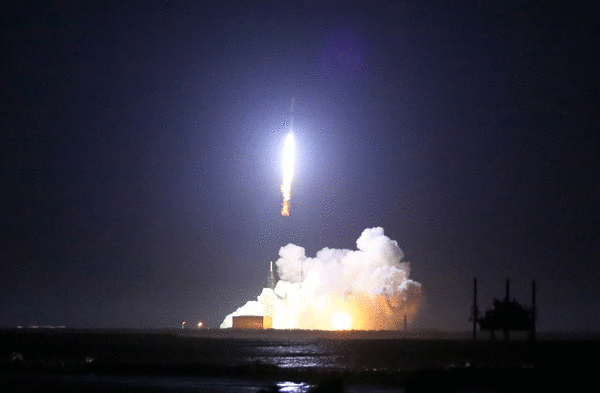
ORLANDO, Fla. — Jeff Bezos’ Blue Origin is set to join Elon Musk’s SpaceX in the club of commercial companies to ever launch, land and re-fly a rocket booster during a mission aiming for liftoff early Sunday.
It’s a club SpaceX has been the lone member of for more than nine years.
But only on its third flight ever, a New Glenn rocket using the same booster flown on its second mission is aiming for liftoff from Cape Canaveral Space Force Station’s Launch Complex 36 during a window that runs from 6:45-8:45 a.m.
Space Launch Delta 45’s weather squadron forecasts a 90% chance for good conditions, which drops to 50% in the event of a 24-hour delay.
The launch is using a booster named “Never Tell Me the Odds,” in reference to Han Solo’s retort to C-3PO telling him the chances of successfully navigating an asteroid field was approximately 3,720-1 in the 1980 film “The Empire Strikes Back.”
While the booster fuselage is the same, the seven BE-4 powering the heavy-lift rocket are new. Combined they provide 3.85 million pounds of thrust on liftoff, compared to the 1.7 million pounds of thrust on a Falcon 9.
“With our first refurbished booster we elected to replace all seven engines and test out a few upgrades including a thermal protection system on one of the engine nozzles,” said Blue Origin CEO Dave Limp on a post on X. “We plan to use the engines we flew for NG-2 on future flights.”
Along for the ride is a payload from Midland, Texas-based AST SpaceMobile. Its BlueBird 7 satellite is headed for low-Earth orbit, the second in the next-generation satellites for the company.
The first was launched from India in late 2025. The satellites, which have 2,400 square feet of arrays, aim to deliver high-speed cellular broadband direct to smartphones. The company’s previous BlueBird satellites had only 693 square feet, so the new versions are touted by the company as the “largest commercial phased arrays ever deployed in low Earth orbit.”
After separation, the booster will once again aim for a successful landing downrange in the Atlantic on the recovery vessel Jacklyn, named after Bezos’ mother. It nailed the company’s first landing during a launch in November 2025. The first launch of New Glenn in January 2025 using a booster named “So You’re Telling Me There’s a Chance,” a reference to a line in the 1994 film “Dumb and Dumber,” was not able to stick the landing.
SpaceX paved the way for rocket reusability with its Falcon 9 rocket making the first successful recovery in 2015 on the rocket’s 20th launch attempt. Another SpaceX recovered booster launched in 2016 became the first to be reused for the first time on its second launch attempt in 2017. The company has several boosters in its Falcon 9 arsenal that have made more than 30 flights each with the current fleet-leader having successfully flown 34 times, the most recent just last month. SpaceX has increased its reflight target over the years, now aiming for a limit of 40 launches.
New Glenn’s boosters are designed to support 25 flights and return on Jacklyn to be offloaded at Port Canaveral.
A third New Glenn first-stage booster was revealed earlier this month to be used on a future flight. It was named, “No, It’s Necessary,” a reference to the 2014 film “Interstellar.”
All New Glenn rocket stages are manufactured at Blue Origin’s campus in Exploration Park in Merritt Island adjacent to the Kennedy Space Center Visitor Complex. The company also uses the site and another in Cape Canaveral to build its Blue Moon landers, one of which may be the next launch in store for the company.
The uncrewed lunar lander called the MK1 Blue Moon, named Endurance, returned to Florida this week after a successful set of tests in Houston ahead of the company’s plans to launch to the moon later this year.
“Up next: testing MK1’s launch vehicle separation system and communications system, and performing a wet dress rehearsal of the lander, where we fully fuel with cryogenic propellants,” the company posted on X. “Once complete, we will encapsulate it in New Glenn’s fairing and prepare for launch.”
A crewed version of Blue Moon is slated to support NASA’s Artemis program and is in competition with SpaceX’s Starship to be the chosen lander for Artemis IV, the mission that aims to return humans to the lunar surface for the first time since Apollo 17 in 1972.
SpaceX and Blue Origin are pushing forward to have a working version of their lander ready for a prelanding mission, Artemis III, that will test out docking with the Orion spacecraft, but closer to Earth. Orion just completed its first crewed flight, Artemis II, which splashed down on April 10 in the Pacific completing a 10-day lunar flyby.
Bezos has invested more than $3 billion in manufacturing and launch facilities on the Space Coast including $1 billion at LC-36.
It’s one of the closest launch pads available for public viewing located only 5 miles north of the inlet in Cape Canaveral.
Previous launches have brought out thousands to the beaches south of Jetty Park at Port Canaveral, which offer a great view of launch.
The booster won’t land near the Florida coast, though, with the previous recoveries taking place 375 miles out in the Atlantic.
©2026 Orlando Sentinel. Visit orlandosentinel.com. Distributed by Tribune Content Agency, LLC.






Comments