Connecticut Senate Democrats pass tighter restrictions on ICE agents, right to sue agents
Published in News & Features
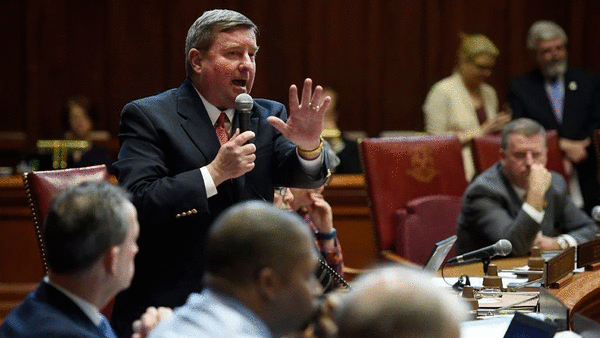
HARTFORD, Conn. — Prompted by shootings and heavy-handed tactics, the state Senate voted on party lines Tuesday night for a new state civil rights law that would allow Connecticut citizens to sue federal immigration agents.
The controversial measure would permit civil lawsuits against federal officials if citizens believed that their civil rights had been violated.
After more than four hours of debate, the Senate voted 24-10 on strict party lines with Democrats in favor and Republicans against. Two senators were absent from the final vote at about 7:30 p.m.
Senate Democrats who wrote the bill have blasted the Immigration and Customs Enforcement agency, known as ICE, and President Donald Trump’s administration as citizens have been detained in Connecticut and across the nation.
Senate President Pro Tempore Martin Looney, a liberal Democrat from New Haven, said that Connecticut residents have been “appalled” by the “abuses committed by ICE.” As a result, the caucus crafted the 40-page Senate Bill 397 with the assistance of Gov. Ned Lamont and state Attorney General William Tong.
“This is our response,” Looney declared Tuesday. “ICE agents have been operating like vigilantes in Connecticut and elsewhere. … We believe ICE agents are not well-trained.”
Looney describes the legislation as “the most consequential bill” of the 2026 legislative session so far.
California, Maine, Massachusetts, New Jersey and Illinois have all passed similar measures, and legislation is also pending in other states. While the issue is relatively new in some states, the senators noted that California’s law is more than 30 years old.
Known as Converse 1983 claims, the law at the state level would allow citizens to file lawsuits related to federal Section 1983. In California, the Bane Act allows lawsuits against those who use threats, coercion or intimidation to violate a person’s constitutional rights.
Looney and other senators said they fully expect the federal government to challenge Connecticut’s bill under the Supremacy Clause, which states that laws of the federal government supersede laws passed by the states. Looney and others predicted that Connecticut will be on solid legal ground, but Republicans said that they believe that the bill, if signed into law, will be overturned in the future in the courts.
But Senate Republican leader Stephen Harding of Brookfield said that there are “barrels of case law” in favor of overturning the legislation. After the smoke clears and the debate ends, Harding said, “All we’re left with is another anti-cop bill from Hartford.”
Sen. Rob Sampson, one of the legislature’s most conservative members, blasted the bill as “extremely offensive” in its treatment of law enforcement.
“I would call it a Trojan horse, anti-police bill,” Sampson said on the Senate floor. “It cannot be overstated just how important they are to maintaining law and order. … Most of this bill is patently unconstitutional. … Immigration policy falls under the federal government. It’s the United States, not the state of Connecticut, that makes immigration policy.”
He questioned the title of the bill, “An Act Concerning Democracy and Government Accountability,” that he said was improperly named.
“I’m the government accountability guy,” Sampson said. “I came here to hold this place accountable. … This is not about accountability.”
Rejecting the notion that ICE agents are “tremendous villains,” Sampson said, “Most of them are doing a very good job.”
Multifaceted bill
Among other things, the bill creates a new, private right of action that would allow citizens to file civil lawsuits against ICE agents in court.
“We want to make sure it doesn’t happen here,” said Sen. Gary Winfield, a New Haven Democrat who co-chairs the legislature’s judiciary committee. “When they have violated someone’s rights, that’s not part of their job. … I say, when that happens, there should be a way to deal with that. … It is not their job to violate the rights of anyone. … The point of this is to protect people. It’s not a violation of the Supremacy Clause for a number of reasons. The supreme law of this land is the Constitution of the United States.”
After Sampson spoke on the Senate floor for more than 75 minutes, Winfield said that 14% of the people that ICE dealt with were criminals despite Trump officials making it seem like they were dealing with criminals 100% of the time.
“I don’t care about Donald Trump. In a couple of years, he will be gone,” Winfield said. “What are we trying to protect here, I think it should be the citizens of the state of Connecticut.”
Sen. John Kissel of Enfield, who serves as the ranking Senate Republican on the legislature’s judiciary committee, opposed the bill for multiple reasons.
“It impedes the ability of the federal government to perform its functions,” Kissel said, naming the FBI, Drug Enforcement Administration, ATF, Department of Justice, and the Secret Service. “Those are the preeminent law enforcement agencies that the federal government has. … This bill is drafted in a way that is extremely broad. … When it comes to federal agencies, it’s outside our wheelhouse. … As soon as it’s challenged in the courts, it will be struck down.”
The bill blocks all law enforcement officers — at the local, state and federal levels — from wearing masks. The measure has some exceptions, such as undercover operations, SCUBA teams, bomb squads, and SWAT teams, but broadly bans masks. The officers also must wear a visible name tag or a badge as some citizens have complained that they have had trouble identifying ICE agents.
Winfield said that ICE agents should not be allowed to cover up their name tags.
“We don’t have secret police in the United States of America,” Winfield said.
Sen. Herron Gaston, a Bridgeport Democrat, said that ICE has been operating under “an unhinged, rogue federal administration.”
Sen. Ryan Fazio, a Greenwich Republican who is running for governor, said the bill was pushing “an ideological, anti-public safety immigrant enforcement system” that will undermine public safety.
The bill also mentions “protected areas,” which limits locations where people can be arrested by ICE agents. That includes schools, churches, synagogues, mosques, crisis centers, shelters, food banks, and day care centers, among others.
The bill also states that automated license plate reader systems should not be abused. Data obtained from the license plates cannot be held for more than 21 days unless there is an active criminal investigation, officials said.
“License plate data cannot be used to determine race/ethnicity; any activity protected under the First Amendment; suspected immigration status; and reproductive health care or gender affirming care,” Democrats said.
The measure also states that a license plate reader cannot be placed near abortion clinics so that patients cannot be followed in those areas.
A summary by the legislature’s nonpartisan research office says that federal law enforcement agencies will be liable “when their officers interfere with someone taking a photo, digital still, or video of them or another officer performing their duties; makes an immunity defense unavailable in a civil liability action for an intentional tort committed while interfering with the taking of the photo, digital still, or video.”
Duff said that Republicans should have supported the bill to show their independence from Trump.
“Now, it’s gut-check time for the Senate Republican MAGA caucus,” Duff said. “Where do they stand? With Donald Trump and his modern-day brownshirts? Or with the people of Connecticut?”
But Sampson said that the bill, written by Democrats, was highly political.
“It is a distraction nonetheless,” Sampson said. “I don’t need a lecture from the majority about civil rights. … I believe very strongly in civil liberties, the rule of law, due process. … We do not have any convictions (in Minneapolis). … I don’t want to bring politics into this room. … I do not believe in weaponizing civil rights law, like this bill does.”
Sampson added, “It’s not a legitimate policy statement. It’s a political statement. … People that are committing wrongdoing … should be held accountable. Period. End of story. Nobody wants a king.”
He added, “You cannot rewrite federal law. I’m sorry you didn’t like the last federal election. … This is a political attempt to undermine policy.”
Public Citizen, an advocacy group founded by Connecticut native Ralph Nader, has sharply criticized the federal agents.
“The lawless, ragtag goon squads of DHS, ICE, and the like are not making America safer,” the group said. “And they are not performing anything approaching a legitimate law enforcement purpose.”
The group added, “ICE is now the largest and most expensive law enforcement agency in America, with a budget greater than that of every other federal law enforcement agency, including the FBI, combined. In fact, the U.S. is now spending more on ICE than all but a handful of other nations spend on their entire military.”
The vote follows the announcement Monday of a federal lawsuit brought by the Trump administration against Gov. Ned Lamont, the state of Connecticut, the city of New Haven and its Mayor Justin Elicker over “sanctuary” policies and the state’s Trust Act, which limits police cooperation with ICE agents.
_____
©2026 Hartford Courant. Visit courant.com. Distributed by Tribune Content Agency, LLC.






Comments