Minneapolis city leaders to consider bathhouses that allow sexual activity
Published in News & Features
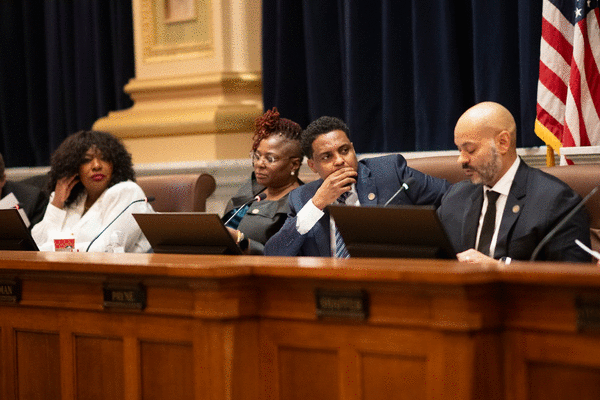
MINNEAPOLIS — Minneapolis city leaders are considering legalizing adult bathhouses and sex venues where “sexual activity between consenting adults” would be allowed.
The City Council will decide Tuesday whether to have city staff research several ordinances that would allow adult bathhouses and sex venues to operate again after a 38-year ban.
The ordinances would remove “stigmatizing language” and add “new definitions to be inclusive of establishments where sexual activity between consenting adults may be facilitated.”
Adult bathhouses were popular among some men in the U.S. until public pressure and laws led to their closures in the 1980s during the AIDS crisis.
In Minneapolis, bathhouses and sex clubs operated until a 1988 ordinance banned businesses that facilitate “high-risk sexual conduct” — which it defined as fellatio, anal intercourse and vaginal intercourse for pay.
The Safer Sex Spaces Coalition — made up of the Aliveness Project, OutFront MN, and community stakeholders — formed three years ago to lobby the City Council to remove language in the 1988 ordinance that targeted same-sex partnerships and people with HIV and AIDS. The ordinance was updated to remove the language in 2023.
More recently, the Safer Sex Spaces Coalition reached out to Minneapolis City Council President Elliott Payne and others about creating a business license for adult sex venues. The coalition argues that the ban discourages outreach to communities and has driven sex-related gatherings underground, often to “unsafe and inaccessible spaces.”
Payne said such businesses are “historically LGBTQ+ gathering spaces and one of people’s main points of access to safer sex supplies and STI/HIV testing.”
Along with Payne, council members Jason Chavez and Soren Stevenson are authors of the proposed ordinance changes. In a statement Monday, Chavez said, “LGBTQIA+ gathering spaces, including bathhouses, have long been targeted by criminalization and policing, and our communities have paid a devastating price for that. That’s why we’re referring this to staff to begin building policy alongside community members and stakeholders.”
Payne said the plan to regulate bathhouses would model San Francisco, which has extensive regulations focused on safety and public health, with requirements for condoms, monitoring, staff training, lighting and wash-up and waste disposal facilities.
“Parties and events that operate as adult sex venues already happen in the shadows, and we are trying to ensure that they are safe for patrons, especially when LGBTQ+ individuals are under attack by the federal government,” Payne said.
A 2024 city auditor’s report on “sexual encounter establishments, swingers’ clubs, and sex clubs” found six U.S. cities — including Duluth, Chicago, Seattle and Miami — allow bathhouses without a special permit or regulation beyond general business requirements related to amenities like food, pools and alcohol. None of the cities reported issues with the businesses.
Four cities license and regulate the businesses, including St. Paul, which licenses bathhouses as long as “no unlawful acts” are allowed. St. Paul doesn’t appear to have bathhouses where sexual activity is allowed, but Duluth does have one such sauna with a regular business permit, according to Duluth Public Information Officer Kelli Latuska.
In the 1980s — the last time adult bathhouses were in Minneapolis — the issue divided the gay community, Star Tribune archives show.
The first out gay member of the Minneapolis City Council, Brian Coyle, helped to pass the ban, saying high-risk sex went on in the bathhouses, although education materials were also distributed in them. At the time, he said many LGBTQ people supported the ban.
Coyle was diagnosed with HIV in 1986 but didn’t go public about it until 1991, the same year he died from AIDS-related complications at age 47. A Minneapolis community center is named after him.
The city’s last adult bathhouse, the 315 Health Club, closed in 1988 before the ban was passed and after being picketed by people carrying signs that said, “AIDS Kills/ Avoid Gay Bath Houses.” The protest was led by a LGBTQ man and former customer of the club who blamed anonymous sex at bathhouses for causing HIV to spread.
Two years before its closure, the 315 Club shut down so-called “orgy rooms” and began distributing free condoms and information about AIDS prevention.
At the time, a vice police officer said he arrested hundreds of people in bookstores and saunas for indecent conduct, sodomy and prostitution. The ordinance sought to limit anonymous sex by not allowing holes in the building partitions to facilitate sexual activity.
Opponents said the ordinance was “anti-gay” and a way to shutter adult bathhouses and bookstores.
A spokesperson for Mayor Jacob Frey said he’s supportive of city staff continuing to look into the proposal.
Council Member Michael Rainville’s aunt, Alice Rainville, served as president of the City Council when it banned bathhouses. Michael Rainville expects the proposal to reverse that action to be controversial again.
“I want to learn more. It’s very vague language,” he said. “I look forward to the conversation and debate. It’s hard to tell what the intent is, other than allowing people to have sex in commercial buildings.”
©2026 The Minnesota Star Tribune. Visit at startribune.com. Distributed by Tribune Content Agency, LLC.






Comments