WA federal courts flooded with immigration cases
Published in News & Features
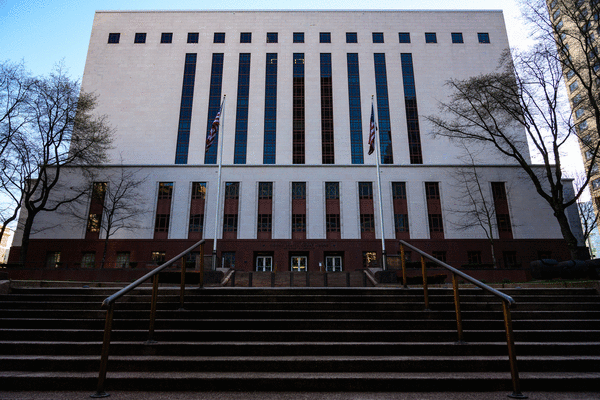
Since Donald Trump took office for the second time and began an aggressive effort to deport immigrants, federal courts in Western Washington have seen a massive surge in the number of people objecting to their detainment, according to a review of filings by The Seattle Times.
In Washington and across the country, the number of detention appeals under the fundamental legal principle known as habeas corpus has far outpaced previous presidential administrations, including Trump's first term. The influx has clogged courts, tied up judges and delayed other cases in the system.
In 2025, the U.S. District Court in Western Washington saw more than six times as many habeas appeals related to immigration detainments than in Joe Biden's last year in office, according to data pulled from the federal public access to court electronic records system, known as PACER.
That pace has continued mostly unabated this year, with more than 400 cases filed by immigrants so far.
In a similar review of case filings, the nonprofit news site ProPublica noted that Washington ranks 14th nationally in the number of immigration-related habeas cases filed since January 2025. Texas and California topped the list, with thousands of cases filed in both states.
Matt Adams, the legal director of the Northwest Immigrant Rights Project, said at least a portion of the rise has been due to the federal government detaining immigrants who have followed the rules, in some cases for years. He said they will show up for a routine hearing or check-in and suddenly find themselves behind bars.
Instead of focusing on people who are a flight risk or who pose a danger to the community, the attitude has been 'Let's just lock everybody up,'" Adams said.
Habeas corpus — a Latin term meaning "you shall have the body" — is a legal principle dealing with detention and personal freedom. It requires the government to justify to a judge why someone is being detained. In the past, it was most often used by people in prison challenging their convictions.
However, the Trump administration's emphasis on immigration enforcement has flipped that traditional dynamic, leading to a "rash of new claims we haven't dealt with before in the past 20 years," Adams said.
Charles Neil Floyd, the first assistant U.S. attorney for Western Washington, defended the Trump administration's focus on detaining and deporting immigrants.
"What we don't want to have happen is that these petitions get used as a sword or an avenue of relief for respondents in immigration relief," he said. "This has been the law of the land for 20 years. The difference is that we are enforcing it."
Bottleneck
The flood of immigration cases has caused a bottleneck in the court system, according to attorneys and judges who participated in a continuing legal education panel on the topic this year. In many instances, attorneys are seeking emergency restraining orders aimed at stopping their clients from being detained for long periods without due process — or even shipped out of the country without the benefit of appearing before a judge to argue whether their expulsion was justified or legal.
In the past, immigration appeals — a few dozen a year — would meander through the system.
The first to hear a petition would be a magistrate judge — a statutorily empowered judicial officer whose job is to help district court judges handle their caseloads — who would then write a report and recommendations. A district court judge would then review the magistrate's report and approve, modify or reject the petition altogether. The cases would sometimes bounce between the magistrate judge and the district judge several times before final disposition, a process that could take weeks or even months.
Judges have been working after hours and on weekends attempting to address the deluge of petitions for temporary restraining orders, which they must prioritize, congesting justice in cases across the federal legal spectrum, U.S. District Judge Tiffany Cartright said at the legal education panel.
"The reality we are facing is that we have many cases on each our dockets that present that scenario," said Cartwright, a Tacoma judge who made a landmark decision striking down a restrictive Trump administration bond practice for immigrant detainees.
The district judges, working with the various litigants, including the U.S. attorney's office and the Northwest Immigrant Rights Project, arrived at a partial solution in recent months that includes strict deadlines for pleadings and the dissolution of the old "report and recommendation" back-and-forth between the magistrate and district judges. With consent, habeas cases can now be heard in total by one or the other.
The influx of cases, Cartwright said, has resulted in "several cases for each judge each week," overwhelming them under the report and recommendation system. The new order has expedited filings and provided a template for how the habeas petitions would be litigated.
U.S. attorney responds
What has been particularly noteworthy is the cooperation of the U.S. attorney's office in Seattle, the local extension of an administration that has played the hard line with immigration cases to the point that some immigration judges have refused to abide by district court orders, including here in Washington.
Floyd, himself a former immigration judge, was praised for participating in formulating the new rule expediting habeas cases, which can result in the release of detained immigrants.
"I am a little worried now that everybody at the table have said I made it easier to file habeas petitions," he joked at the continuing legal education panel. "Hopefully that doesn't come back to bite me."
He said the amount of work required by his office to respond to petitions under the old report and recommendation system was "untenable" and a "heavy lift."
But the cooperation pretty much ends there. Adams, the legal director at the Northwest Immigration Rights Project, says the only reason there's a backlog at all is that immigration officials "are arresting everyone they see."
Cartwright, the judge, said there remained some "preadjudicated cases where an agency continued to defy court orders," that remain a drag on the new system. There also were instances where the Department of Homeland Security, which oversees federal immigration agents, defied the court's jurisdiction.
Floyd acknowledged to litigants that, "Sometimes, like you, we have client control issues."
"Sometimes (Homeland Security) listens to me," he said, "sometimes they don't."
Floyd, in response to questions by attorneys attending the legal education panel, defended Trump administration actions and said fear within the community about how the agency conducts itself is unjustified.
"I understand people out there are afraid," he told the audience of lawyers. "The comments I hear are that people are afraid of ICE and a lot of that is attributed to people casting them as some sort of demon or, you know, evil, or portraying ICE as doing a job with improper motives."
While he acknowledged "that there is a tremendous amount of request" for him to have compassion for those being detained, he said he also has to help protect federal law enforcement, who "are under attack as well."
"My job is to try to keep it safe for everyone, Floyd said.
©2026 The Seattle Times. Visit seattletimes.com. Distributed by Tribune Content Agency, LLC.





Comments