Federal judge blocks termination of parole for migrants who entered US with an app
Published in News & Features
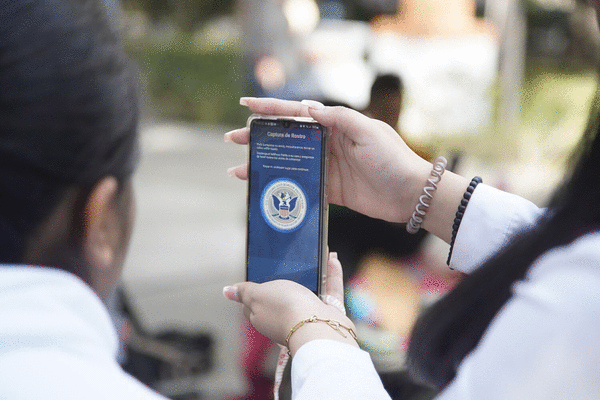
A federal judge has temporarily blocked the U.S. government from ending parole and work authorization for hundreds of thousands of migrants who entered the country using the CBP One app.
District Judge Allison D. Burroughs in Massachusetts ruled that the Department of Homeland Security acted unlawfully by terminating parole en masse without reviewing individual cases, which she said is a violation of the Administrative Procedure Act, which governs how federal agencies propose, adopt and enforce regulations.
“The parole terminations exceeded the agency’s statutory authority and contradicted the procedures set forth in its own regulations,” the judge wrote in the ruling on March 31.
The migrants affected by the ruling entered the United States through CBP One, a mobile application launched in 2023 under the Biden administration that allowed individuals to request parole, schedule inspections, and coordinate legal entry with U.S. Customs and Border Protection. The program was designed to manage border crossings more effectively and provide a legal pathway for migrants to enter the country. DHS’s early mass termination of the program affected more than 900,000 people nationwide who had entered the U.S. using the app.
The 25-page ruling vacates the April 2025 terminations, restoring the legal status and work authorization of migrants affected by mass notices from the administration. It also allows a class-action lawsuit to proceed, though the court narrowed the scope to migrants directly impacted by the blanket terminations.
In a written statement, DHS said it disagrees with the judge’s ruling, calling it “blatant judicial activism undermining the President’s authority to determine who remains in this country.” The department added: “The Biden Administration abused the parole authority under the disastrous CBP One program to allow millions of illegal aliens into the U.S., which further fueled the worst border crisis in U.S. history. Under federal law, DHS had full authority to revoke parole. Canceling these paroles is a promise kept to the American people to secure our borders and protect our national security.”
DHS also encouraged migrants to take control of their departure using the CBP Home app, noting that the United States is offering $2,600 and a free flight to self-deport.
The case was filed in August as a potential class action by three women from Haiti, Cuba and Venezuela along with the Venezuelan Association of Massachusetts, an advocacy organization representing immigrant communities. The immigrants and the organization are being represented by the legal advocacy organizations Democracy Forward and the Massachusetts Law Reform Institute, which argued that DHS violated the federal act by abruptly revoking paroles and work authorizations en masse without individual reviews.
The plaintiffs argued that the Trump administration’s abrupt email telling hundreds of thousands of people that “it is time for you to leave the United States” violated federal law because DHS failed to conduct the required case‑by‑case determinations before ending parole — a process that protects migrants’ legal presence and work authorization.
For migrants, the ruling could provide immediate relief. Many had relied on parole and work authorization to support their families and navigate life in the United States. Advocates had warned that the sudden terminations left thousands in legal limbo, at risk of deportation, and without the ability to work.
“Summary judgment is hereby entered for Plaintiffs on their first through third claims,” the judge wrote, referring to the core claims that DHS violated administrative law by failing to follow required procedures.
However, the ruling was not a complete win for plaintiffs. The judge rejected broader claims that went beyond administrative procedures violations, declined to review certain discretionary immigration decisions, and limited the class definition, narrowing the number of migrants who could benefit from the case.
Legal experts said the decision underscores that while DHS retains authority to terminate parole, it cannot do so in blanket fashion and must document the reasons for each decision.
“For many Venezuelan families, this decision brings long‑awaited relief after months of fear and uncertainty,” said Carlina Velásquez, president of the nonprofit Venezuelan Association of Massachusetts. “These are individuals who followed every step required, trusted the system, and built their lives here—only to be told they had to leave everything behind. This ruling restores their stability, dignity and hope.”
Skye Perryman, president and CEO of Democracy Forward, called the ruling a clear rejection of an administration that attempted to erase lawful status for hundreds of thousands of people with the click of a button.
“Our clients followed the law: they waited, registered, were inspected, and were granted parole under the law,” Perryman said. “The Trump‑Vance administration’s effort to tear that status away overnight was unlawful and cruel — and the court rejected that harmful and destabilizing policy.”
For migrants in South Florida, and the thousands across the country who relied on CBP One to enter the United States, the ruling provides a crucial reprieve and a chance to maintain stability while the case moves forward.
_____
©2026 Miami Herald. Visit miamiherald.com. Distributed by Tribune Content Agency, LLC.






Comments