New law in Washington state limits when school staff can restrain or isolate students
Published in News & Features
SEATTLE — School district employees can’t use pepper spray, mace or sedatives to restrain students, under a new law Gov. Bob Ferguson signed last week. They can’t restrict students’ movements with handcuffs, zip-ties or belts.
They’re also barred from pinning down students or putting them up against a wall in a way that restricts their breathing or blood flow.
The law, passed after three previous attempts to get a version through the state Legislature, aims to curb restraint and isolation in schools and other agencies that serve public school students, except in cases where there’s imminent likelihood the student or others would be seriously harmed.
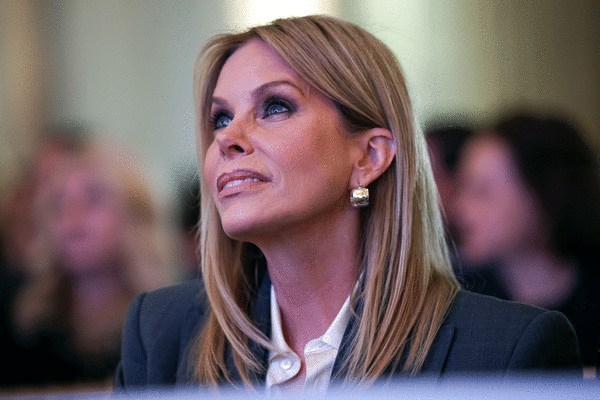
“It’s definitely great to get something across the line,” said state Rep. Lisa Callan, an Issaquah Democrat and the legislation’s prime sponsor. The bill passed largely along party lines.
“It’s a good, solid start,” she added. “When we don’t have a lot of money to put toward professional development and other ways to really help our school districts out, getting clear definitions, and then making sure we are not perpetuating the problem is a good step forward.”
Ferguson said at Tuesday’s signing the changes “ensure we are promoting safe and healthy school environments for students and staff.”
Some disability and education advocates have been trying for years to ban isolation — when students are confined alone to a room they can’t leave — and reduce the instances when educators can restrain or restrict a student’s movement.
While the new law does not ban isolation, it prohibits districts, schools and agencies that serve public school students from building and remodeling rooms for that purpose. The language also signals the Legislature’s intent to end isolation in pre-K-12 schools by 2031 and offer alternatives and professional development for teachers.
Several districts already ban isolation. Seattle Public Schools’ policy prohibits it in all cases and allows restraint “as a last resort” when there’s “imminent likelihood of serious bodily harm” to someone.
Spokane did away with isolation after the U.S. Department of Justice found in 2023 that its practices violated state and federal laws.
Disability rights advocates said the new law is a step in the right direction.
Advocates argue that even when used sparingly, the practices are harmful and traumatic for students and educators. They affect students’ attendance and trust in educators and the school system and contribute to dropouts, said Andrea Kadlec, an attorney with Disability Rights Washington, a nonprofit advocacy group for people with disabilities.
Repeatedly locking students into what she described as “closet-size rooms” can have long-lasting effects, including post-traumatic stress disorder that continues into adulthood.
“Isolation is profoundly harmful, psychologically, in the same way that solitary confinement is,” Kadlec said.
“We want to make sure that educators have the support they need in real time in the classroom,” she added. “And that’s what this policy has always been about.”
A joint 2023 report by the group and the American Civil Liberties Union of Washington found that students with disabilities and those who are Black, multiracial, homeless or lived in foster care were disproportionately impacted by these practices. Their use was most common in schools serving elementary-aged students, according to the report.
While students with disabilities comprised about 15% of the state’s public school students in 2020-21, they made up 92.5% of the students who had been restrained and 96% of those who had been isolated, the report found.
But some educators and others who work in schools worried the law would remove one of the last tools to protect them and students when a student’s behavior threatens other children and staff.
They also argued the Legislature should fund professional development and training and address the shortage of staff who work with students with acute behavioral needs, including paraprofessionals.
Some lawmakers were also concerned the bill would prohibit districts from building calming and sensory rooms for students or restrict in-school suspensions.
The law, as passed, does not do so. It also does not bar employees from touching or holding a student’s hand or wrist to escort them or guide them in their school work.
Larry Delaney, president of the Washington Education Association, said the union’s advocacy focused on ensuring there was money to train staff on any new regulations and guidelines.
“With this pared-down bill, the (professional development) needs are not as great as the original version or the years’ past,” he said. The union supported the version that passed.
The legislation was whittled down to only include changes that didn’t require additional state funding, Callan said.
Callan agreed teachers, paraprofessionals and other school staff needed professional development and training on prevention techniques to work with students with complex behavioral needs. That will reduce reliance on restraining and isolating students and, in turn, help with staff retention, she said.
Under the law, restraint or isolation are only allowed when they’re “reasonably necessary to control spontaneous behavior that poses an imminent likelihood of serious harm” to the student, their peers or staff. That makes it clear, Callan said, that those practices should not be used as disciplinary tools.
The law now explicitly states that schools and other places that serve public school students can’t use mechanical, chemical or physical restraint on students. Mechanical restraints include tools like handcuffs. Chemical restraints can refer to medicine or drugs used to immobilize a student.
The law allows restraint as planned intervention if it’s part of a student’s Individualized Education Program, but only if a student needs more advanced support and a parent requests and consents voluntarily in writing. In those cases, a licensed health care worker must also confirm that it’s medically necessary.
If a student is restrained or put in an isolation room, the district must review the incident with the child’s parent or guardian and the staff member. The principal should notify parents verbally within 24 hours and in writing within five business days of the incident.
The staff member also has to inform the building administrator as soon as possible and file a report, including any injuries and a description of the incident that triggered the restraint or room confinement, to the superintendent or appropriate administrator within two business days.
Districts and others that provide public education services also have to provide annual case summaries to the state Office of Superintendent of Public Instruction by January 1. The agency then must publish the reports within 90 days in a format that allows users to analyze the data.
Janis White, the former president of the Seattle Special Education PTSA, also saw the law as a positive movement.
Her son, now a 21-year-old college junior, is autistic and was repeatedly restrained and put in isolation in elementary school for behaviors she said were “not appropriate.”
White thinks isolation should be banned, but there are instances when educators need to restrain students. Prevention is also crucial, she said.
“We need to really focus on working to change the way we think about student behavior and how best to address concerning behavior when it happens,” she said.
©2026 The Seattle Times. Visit seattletimes.com. Distributed by Tribune Content Agency, LLC.






Comments