Mandatory life sentences for second-degree murder are unconstitutional, Pa. Supreme Court rules
Published in News & Features
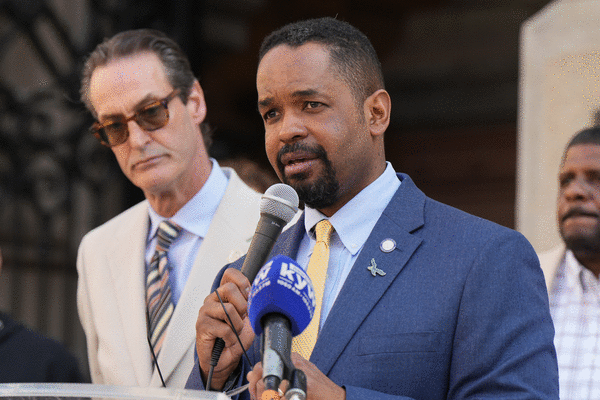
The Pennsylvania Supreme Court on Thursday ruled that mandatory life sentences for second-degree murder are unconstitutional — a significant decision that is likely to reshape a portion of state law that many criminal justice advocates and some public officials have long targeted for reform.
In an opinion released Thursday morning, Chief Justice Debra Todd said the law mandating a life sentence for anyone convicted of so-called felony murder violated the Pennsylvania Constitution’s protections against cruel punishments.
Under the law, anyone convicted of participating in a felony that results in death — such as a robbery — receives an automatic life sentence, even if the person didn’t commit the killing or intend for anyone to die. More than 1,100 people are serving that penalty in Pennsylvania, which is one of only two states in the nation to mandate incarceration for life for such a crime.
Todd, writing for the majority, said the law “fails to assess individual culpability regarding the intent to kill, and mandates the same punishment regardless of that culpability.”
And although the justices said life sentences may be appropriate in some felony murder cases, it was unlawful to mandate the penalty in every one.
“Ultimately, we find that the mandatory sentencing scheme for second-degree murder poses too great a risk of disproportionate punishment, and, thus, find it to be cruel,” Todd wrote.
The impact of the decision — and how it might affect the sentences of people already behind bars — may remain unclear for some time. The justices paused their ruling for 120 days to allow the state legislature time to address the issue and revise the state’s laws.
How lawmakers approach that process — and what remedies they might settle on — could be the subject of intense debate. Options could include seeking resentencing hearings for every person already convicted under the law, to more narrow approaches that might invite additional questions — and litigation — about how to apply the new finding to cases that were decided decades ago.
Any legislative change will require agreement from the Democratic-controlled House and the GOP-controlled Senate. It’s unclear when lawmakers might decide the issue — or if they will hit the court’s 120-day deadline.
Gov. Josh Shapiro, a Democrat and the state’s former attorney general, praised the court’s decision, saying in a statement he has “long believed this law is unjust and wrong.”
“Common sense and true justice dictate that we need different penalties for different conduct,” Shapiro said. “For example, the getaway driver shouldn’t get the same sentence as the person who pulls the trigger.”
One of the lead lawyers in the case, Bret Grote of the Abolitionist Law Center, said the decision “will have profound ramifications” for the state’s criminal justice system, and that it “represents the culmination of decades of movement-building by incarcerated people and their families and communities.”
And Marsha Levick, Phyllis Beck chair at Temple’s Beasley School of Law and former chief legal officer of the Philadelphia-based Juvenile Law Center, described the ruling as “groundbreaking” because the court found that Pennsylvania’s constitutional protections against cruel punishment were actually stronger than those articulated in the U.S. Constitution, and thus required that the law be struck down.
“That is a really big deal,” she said.
Disproportionate impact
Grote filed the appeal in the case on behalf of Derek Lee, who took part in a fatal robbery in Pittsburgh in 2014 but whose coconspirator committed the killing in the basement while Lee was upstairs.
In Lee’s appeal, Grote argued that a mandatory life sentence was unusually cruel, and therefore in violation of Lee’s constitutional protections.
Advocates and some legislators have debated that issue for years. In addition to calling it cruel, advocates often said those imprisoned for the crime in Pennsylvania are disproportionately Black, and that about half are from Philadelphia. Many had also spent decades behind bars, advocates said, and aged beyond the point they’d be likely to commit another crime.
In some cases, defendants said they were simply lookouts or otherwise minor participants in crimes that unexpectedly turned deadly. And in certain instances, primary offenders received lighter sentences than their accomplices.
The high court heard argument in Lee’s case in late 2024, but gave no indication how it might rule.
The justices on Thursday released five opinions, four of which concurred with the majority’s 72-page ruling. One justice, P. Kevin Brobson, wrote an opinion that offered both support and dissent for different aspects of his colleagues’ findings.
In the majority opinion, Todd, the chief justice, wrote that “a mandatory sentence of life without parole for all individuals convicted of second degree murder cannot be reasonably justified by any of the traditional theories for punishment.”
Automatic life imprisonment, Todd later added, “prevents the sentencer from considering whether this harshest of sentences proportionately punishes the offender.”
Uncertain impact
While the justices were clear about their views on the mandatory sentence, they deferred to legislators to decide what the remedy should be, and whether or how it should apply to people already imprisoned for felony murder.
Celeste Trusty, state legislative director for Families Against Mandatory Minimums, an advocacy group, said bills to address the issue have circulated in Harrisburg for years but have repeatedly stalled in the legislature.
One of those bills was co-sponsored by State Sen. Sharif Street, a Philadelphia Democrat. Street’s bill would set a mandatory 25-year minimum sentence for second-degree murder convictions, but allow for parole after that time.
That legislation, if approved by the General Assembly and signed by the governor, would also apply retroactively, meaning anyone serving a life sentence for second-degree murder would be eligible for parole after 25 years. Enacting that legislation would likely lead to a wave of new parole hearings for people who have already spent decades behind bars.
Street said in an interview that he has heard privately over the years from Republican lawmakers who’ve expressed support for ending Pennsylvania’s felony murder provisions, but have been hesitant to say so publicly.
Thursday’s ruling “makes it a lot easier” for any tough-on-crime Republicans to back new approaches, Street said.
Rep. Tim Briggs, D-Montgomery, who chairs the House Judiciary committee and authored a separate bill that would allow people sentenced for felony murder to be eligible for parole, said in a statement Thursday his committee would “move legislation as quickly as possible to stop these constitutional violations.”
Waiting for action
Philadelphia District Attorney Larry Krasner, who supported the notion of striking down felony murder’s mandatory life sentence, said at a news conference Thursday that the ruling was “the beginning” of what could be a far-reaching legal process.
If the decision is applied retroactively, he said, prosecutors could face the prospect of revisiting hundreds of cases — a process that could take years to complete.
What new sentences might look like also remained an open question. Peter Andrews, who supervises the federal litigation unit in the district attorney’s office, said he expects judges would have greater discretion to set minimum terms.
Krasner said the ruling would also raise immediate and difficult questions for victims’ families. He said his office would begin reaching out to those families now, even as key details are still unsettled.
“It’s always a difficult and sensitive situation” when cases are reopened or sentences are challenged, he said.
Levick, the Temple professor, coauthored briefs in a series of cases that struck down life sentences for juvenile offenders, and said Pennsylvania’s high court in this case appeared to be positioning its ruling for retroactive application — even if it stopped short of saying so.
The opinion, she said, echoes the reasoning the U.S. Supreme Court used to make similar decisions retroactive in juvenile cases, though she cautioned that “we’re going to have to wait for action.”
The legislature will ultimately have to decide that question, among others.
Grote, the lawyer who filed the appeal, said lawmakers should seek to address the issue in a comprehensive manner.
“It would be shortsighted and cruel for them to omit the retroactivity question,” he said.
_____
©2026 The Philadelphia Inquirer. Visit inquirer.com. Distributed by Tribune Content Agency, LLC.






Comments